
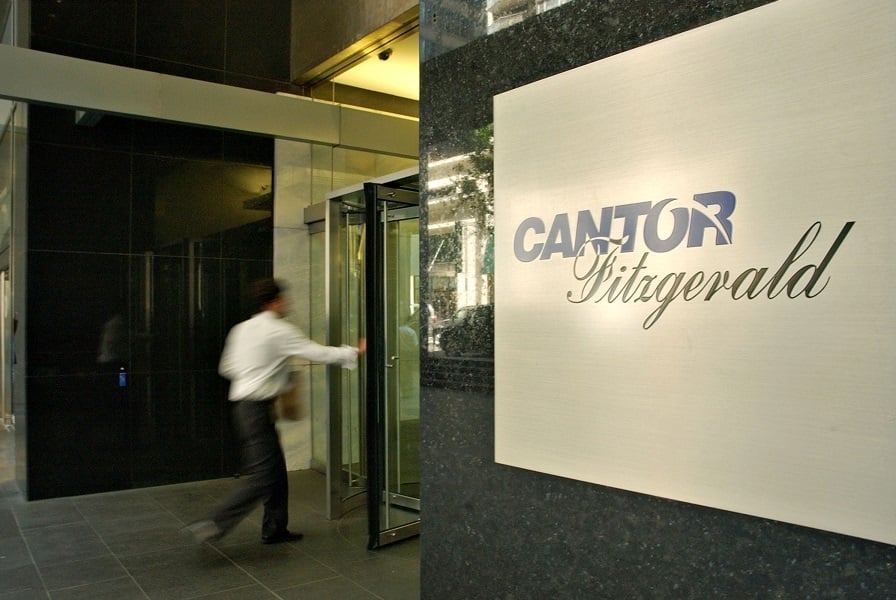
Cantor Fitzgerald is shrinking its workforce, breaking with firms across Wall Street that have vowed not to lay off employees during a pandemic that’s unleashed the worst unemployment crisis in decades.
The private financial services firm run by Howard Lutnick plans to cut hundreds of jobs across divisions as he seeks to shore up his empire, according to people with knowledge of the matter. That would make the reductions the deepest to emerge among Wall Street’s major firms since the coronavirus outbreak in the U.S.
“We have made prudent head count and cost reductions to position the firm for the uncertain macroeconomic conditions expected for the remainder of the year,” the company said in an emailed statement.
Investment banks such as Morgan Stanley, Citigroup Inc. and HSBC Holdings have pledged to hold off on such dismissals during the pandemic this year, reassuring employees about their income and health insurance as the economy reels from the spread of the deadly virus. Lutnick is worried about the hit from an extended economic downturn, the people said.
It marks a tempering of ambitions for the 58-year-old, who paired up with former Deutsche Bank boss Anshu Jain to compete with the biggest players on Wall Street. It’s part of a broader retrenchment by Lutnick, the sharp-elbowed magnate who set out to rebuild the firm into what he called the industry’s “biggest little guy.”
Shares of affiliate firm BGC Partners plummeted after it slashed its dividend last month and announced it had drawn down $230 million from a revolving credit facility since the end of the year. And senior leaders at affiliate Newmark Knight Frank, a commercial real estate firm, have been asked to take pay cuts and eliminate positions, the people said, asking not to be identified because the deliberations are private.
More expected
Some of the cuts across Cantor’s capital markets and commercial real estate units have already happened, while others are expected over the coming weeks.
The timing of Cantor’s layoffs makes them different from the usual ebb and flow on Wall Street, where firms tend to cut employees earlier in the year. Most of the workers Cantor is letting go had already gotten their bonus checks, the people said.
At various divisions, senior managers were told to identify employees to lay off first, and in some cases they were later ordered to expand those lists, the people said. While the cuts will amount to less than 5% of the company’s workforce, reductions in some units will be significantly higher than the firm-wide average. Cantor employs about 12,000 people around the world, according to its website.
The 75-year-old company has withstood challenges before. Cantor Fitzgerald was almost destroyed when airliners struck the World Trade Center on Sept. 11, 2001, killing 658 people who worked at the company. The brokerage was rebuilt, making it a Wall Street success story. In late 2016, Lutnick enlisted a new president, Jain, as the firm sought to expand in investment banking and prime brokerage.
Laying off his workers just as the U.S. erases a decade of job gains sets Lutnick apart from his peers, at least for now.
On Thursday, Morgan Stanley Chief Executive James Gorman said it was a “no-brainer” to decide against cutting jobs at his firm while a crisis rages. “Psychologically I think it would be a disaster,” Gorman told analysts on a conference call. “The worst possible thing.”

Elsewhere, Wells Fargo Advisors adds a $400 million Morgan Stanley veteran in Naples as an ex-Cetera advisor goes independent with LPL

According to a federal charges Bradley Heppner, 60, received more than $150 million in payments through funneling money from GWG Holdings to a shell company.

A $1B fund allegedly skimmed 30% off the top, then swapped cash for locked-up stock.

Insiders allegedly rewrote projections three times in four days.

TCI Wealth Advisors also has also tapped JIFFYAI to unify onboarding and servicing, while TradePMR adds ICE market data to its Fusion advisor platform
Knighthead Life entered the market with a competitive MYGA. A strong launch earned advisor confidence and paved the way for FIAs.
As AI makes financial information more accessible than ever, Lana Hock explains why human judgment, trust, and empathy remain the qualities clients value most in a financial advisor

