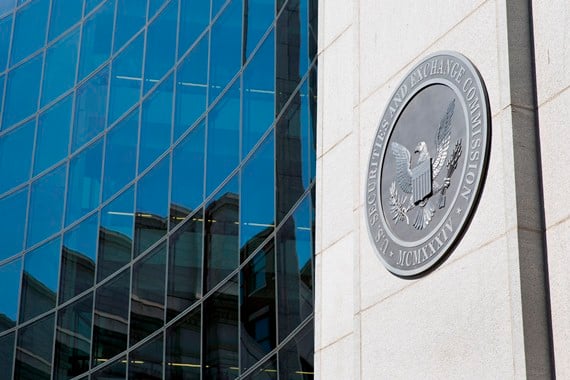
A major business organization called on the Securities and Exchange Commission to adopt formal policies for when and how it uses in-house judges to decide enforcement cases.
Reforming adjudication by administrative law judges was
one of 28 recommendations from the U.S. Chamber of Commerce in a report released Wednesday. It said doing so would “provide clarity” and “eliminate unnecessary ambiguity” in SEC enforcement.
The SEC's increasing use of its own judges has sparked controversy over the last several months. The agency released a statement in May outlining its rubric for taking cases to administrative proceedings.
The Chamber said defendants should have more flexibility in selecting venues and that rules for administrative proceedings should be revised.
“If you're going to have more use of ALJs in the future, everyone would benefit from more defined rules of process and discovery,” David Hirschmann, president and chief executive of the Chamber's Center for Capital Markets Competitiveness, said at an event Wednesday. “It is important that for more serious offenses that a case can be brought into the district court and the right to a jury trial be preserved.”
Other recommendations in the report ranged from requiring SEC investigators to provide more information about their evidence against targets before charges are filed, to streamlining the investigation process and allowing parties to review SEC press releases before settlements are announced.
The SEC said the Chamber's prescription would hinder its enforcement activities.
“The report contains recommendations that would significantly weaken the commission's ability to protect investors through strong and effective enforcement of the federal securities laws,” Andrew Ceresney, director of the SEC Division of Enforcement, said in a statement. “The Enforcement Division continues to aggressively hold wrongdoers accountable in impactful cases that span the securities industry, bringing record numbers of enforcement actions and monetary sanctions.”
In fiscal 2014, the agency brought 755 enforcement actions and obtained $4.1 billion in penalties and disgorgements.
The Chamber countered that its report was designed to make SEC enforcement more efficient and allow the agency to target its resources.
“We strongly believe that none of our recommendations will weaken enforcement or otherwise make it harder for the SEC to act swiftly and effectively to protect investors,” Mr. Hirschmann said. “Let's put aside the game of gotcha — us versus them — and recognize that we all sink or swim together.”
The popular metaphor that the SEC is the cop on the securities market beat overemphasizes enforcement, said Scott Kimpel, a partner at Hunton & Williams.
“It's a market regulator that has enforcement powers. That's the proper way to conceptualize it,” Mr. Kimpel, a former counsel to former SEC Commissioner Troy Paredes, said at the chamber event.
One area in need of reform is the so-called Wells process, the report said. In the procedure, an investigation target is given a Wells notice to indicate SEC staff is considering recommending enforcement to the commission. The target can submit a brief in response to the notice.
The Wells notice should provide more information about the SEC staff's theory of the case and its evidence, according to Eugene Goldman, a partner at McDermott Will & Emery.
“The more open the staff is, the more effective a Wells brief can be — and that will be helpful to the commission and our clients,” Mr. Goldman said in an interview on the sidelines of the chamber event.