
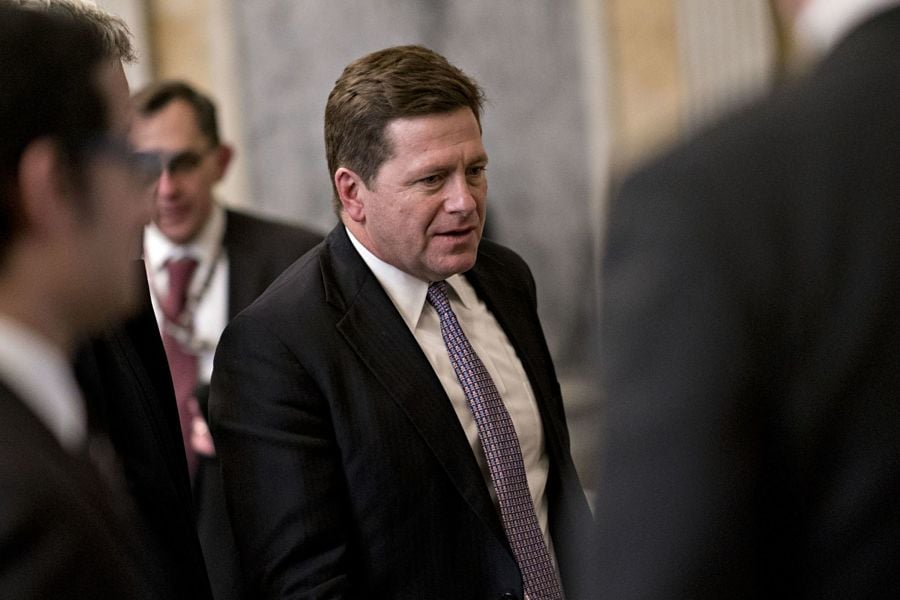
Even though staff members have had to work remotely since early March, the Securities and Exchange Commission imposed more financial sanctions in enforcement cases than in the year prior, Chairman Jay Clayton said Thursday.
Clayton said the agency conducted more than 700 enforcement actions over the last fiscal year, a significant number of which occurred after March 15. The agency obtained more than $4 billion in “financial remedies,” which exceeded last year’s total.
The SEC also examined 15% of the approximately 13,000 investment advisers registered with the agency.
The agency’s fiscal year runs from Oct.1 through Sept. 30. A little more than half of fiscal 2020 occurred during the coronavirus pandemic, which has forced the SEC to implement a mandatory telework policy for its approximately 4,500 staff members.
“I am pleased to report that while the pandemic significantly impacted how we do our work, it did not negatively impact the work itself,” Clayton said during the Practising Law Institute’s SEC Speaks virtual conference. “Our planned oversight, examination, rulemaking, and enforcement work continued with vigor, rigor and transparency.”
While Clayton touted the agency’s enforcement statistics, Republican SEC Commissioner Elad Roisman expressed skepticism about keeping score on disciplinary efforts.
“I do not equate high numbers with success,” Roisman said at the SEC Speaks event.
SEC enforcement actions must be approved by the five-member commission. Roisman said that his rubric for evaluating them centers on whether they advance the SEC’s mission. The pillars of that mission are protecting investors, maintain orderly markets and promoting capital formation.
He warned against discipline that hurts investors more than the firm being targeted. He also criticized so-called “regulation by enforcement,” a term critics use to describe a situation in which they say the SEC sets new regulatory standards through disciplinary actions rather than rulemaking.
Roisman cautioned that the SEC should not try to impose a “culture of compliance” on firms and instead should concentrate on particular rule violations.
In his remarks, however, Clayton praised the Office of Compliance Inspections and Examinations for publishing risk alerts and hosting education events that helped financial firms prevent compliance violations before they occur.
“There are no statistics for ‘problems prevented,’” Clayton said. “Yet, we all know the most effective regulatory environment is one that drives a culture of compliance. That is just what OCIE does.”
The SEC’s examination priorities for investment advisers for the next fiscal year include reviewing how they disclose conflicts of interest related to revenue sharing and fees related to the use of turnkey asset management platforms, as well as their disclosures surrounding environment, social and governance investing, said Kristin Snyder, co-deputy director of the SEC’s investment adviser and investment company examination program.
Another area of focus will be compliance with Form CRS, a disclosure document that was implemented last summer as part of the investment advice reform package centering on Regulation Best Interest, the new broker advice standard.
The SEC has launched the first phase of Reg BI exams, said John Polise, associate director of the SEC broker examination program. The agency will report on its initial observations about Reg BI compliance at an Oct. 26 forum.

Halbert Hargrove senior wealth advisor weighs in on the products' guaranteed income upside, the operational drag and his wish list for carriers.

With 8.6% of advisors set to switch firms in 2026, Cerulli says advisor recruitment hinges on technology, branding and HNW support.

“I’m seeing more disputes like this between advisors and other advisors at the same practice,” said one industry executive.

Longer retirements and steady inflation could drain retiree portfolios before heirs inherit, with 4% net returns running dry by year 34.

A single fintech partner triggered a $68.8M credit hit.
As AI makes financial information more accessible than ever, Lana Hock explains why human judgment, trust, and empathy remain the qualities clients value most in a financial advisor
Northern Trust’s Ken Lassner shows advisors how to convert volatility into after-tax portfolio gains

