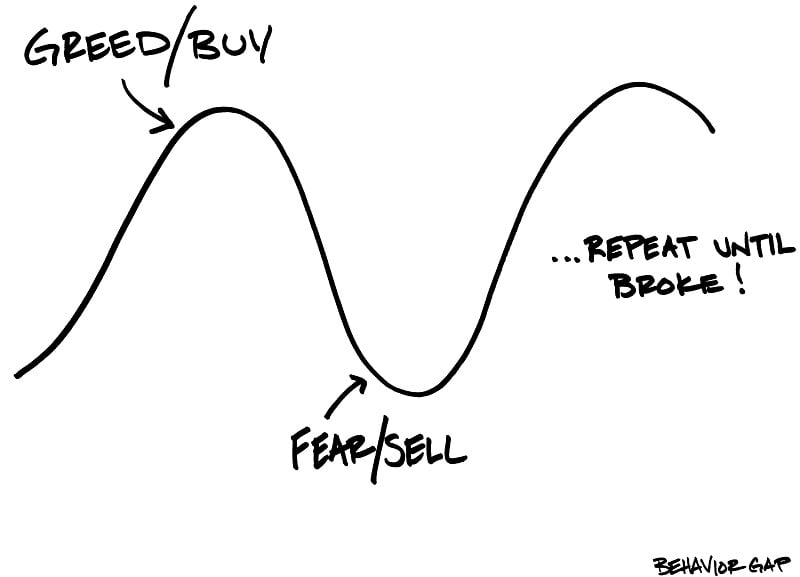
During the last few weeks, you've probably noticed an uptick in client calls and emails. When the markets start to feel "scary," people tend to react, even if they have a financial plan. So today, I want to share the story and sketch I use to help people better understand "scary" markets.
Now, I know I'm not the first person to draw a sketch like Fear & Greed. But time after time, it's been the perfect visual for helping people understand "scary" markets. I like to use the story of what happened in the late '90s with the technology bubble.
At the top of the market, it seemed like nothing could go wrong, and the money just kept going in to stock mutual funds. In fact, people were setting new records for how much they were investing. But within a matter of months, markets took a serious dip and investors set records for how fast they pulled money out of stock mutual funds. It made zero sense!
(More from Carl Richards: How to get clients comfortable discussing their money)
The problem with this cycle is that it runs counter just about every other buying decision we make. We'd never buy a shirt for full price then be O.K. returning it in exchange for the sale price. "Scary" markets convince people this unequal exchange makes sense.
This behavior also isn't limited to the U.S. Go anywhere in the world and you'll find a story about people jumping in at the peak of a market only to turn around and sell at a loss a short time later. Our reaction to "scary" markets is both predictable and manageable, but we have to start by recognizing why it's happening.
I encourage you to pick a story of your own that you think best captures this behavior. Maybe it's the real estate boom in 2007 or the tulip craze in the 1600s. Whatever the story, you'll help people better understand what NOT to do when markets get "scary."
Carl Richards is a certified financial planner and director of investor education for the BAM ALLIANCE. He's also the author of the weekly "Sketch Guy" column at the New York Times. In 2015, he published his second book, The One-Page Financial Plan: A Simple Way to Be Smart About Your Money (Portfolio, 2015).You can email Carl here, and learn more about him and his work at BehaviorGap.com.