
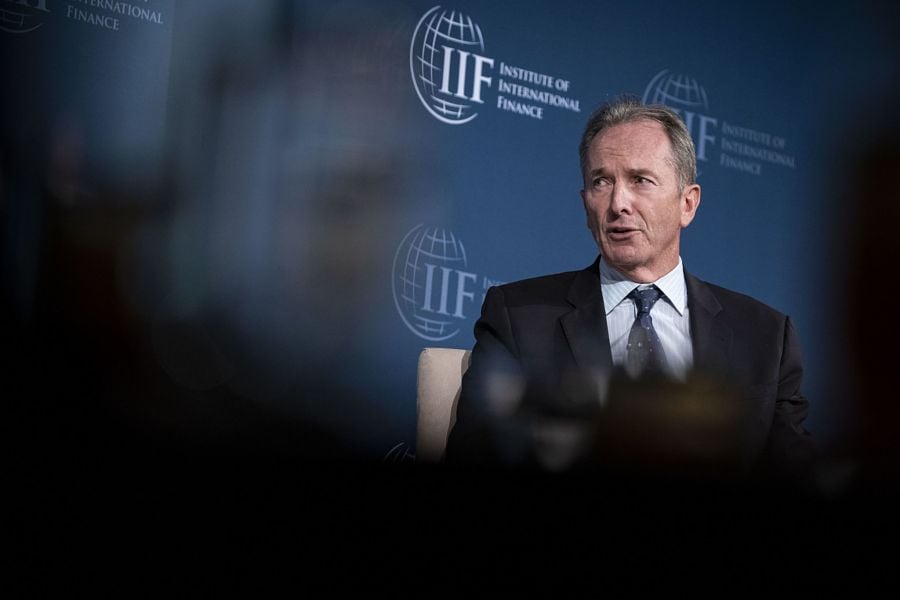
James Gorman, who transformed Morgan Stanley after it nearly collapsed during the global financial crisis, plans to step down as chief executive officer within the next year and assume the role of executive chairman.
“It is the board’s and my expectation that it will occur at some point in the next 12 months,” Gorman, 64, said Friday at the firm’s annual meeting. “That is the current expectation in the absence of a major change in the external environment.”
Gorman, who became CEO at the beginning of 2010, said in January that there are three finalists to take over as CEO when he leaves. Though he didn’t name his likely successors, Ted Pick and Andy Saperstein, the New York-based firm’s co-presidents, have been in the running alongside investment management chief Dan Simkowitz.
Gorman said Friday that he will serve as executive chairman “for a period of time” after leaving the CEO post.
“We believe this structure will ensure the continued stability of Morgan Stanley while at the same time positioning it for a decade of exciting growth under new leadership,” he said.
The Australian-born Gorman is now in his 14th year atop Morgan Stanley. His time as CEO has been marked by a major strategic overhaul of the firm that’s been accelerated by two of the largest deals struck by one of the big U.S. banks in the years after the 2008 financial crisis.
Those transactions — the acquisitions of ETrade Financial Corp. and Eaton Vance Corp. — and the bank’s growing reliance on a dual engine of the investment bank and its giant wealth management business delivering growth has made the company’s stock one of the best performers among peers in the past decade.
Morgan Stanley has more than tripled in value during Gorman’s tenure, as he built the firm into the world’s largest wealth manager starting with the purchase of Citigroup Inc.’s Smith Barney brokerage. Those moves came as new banking rules and a massive bull market made the steady business of advising rich clients far more attractive to shareholders. Morgan Stanley now trades at the biggest premium to its book value of any major US bank.
The first several years of Gorman’s tenure were spent resolving costly issues from the financial crisis, shrinking the fixed-income trading unit and winning back the trust of clients who were spooked by the firm’s near collapse in 2008. In recent years, the company played more offense.
Ever since the recovery from the 2008 meltdown, major banks have been looking for opportunities to expand. But the Melbourne-born Gorman was more willing than his peers to pounce on acquisitions. He said the deals “have accelerated the decade-long transformation of Morgan Stanley into a company with a sustainable business model.”
Morgan Stanley’s pivot away from the investment bank, which involves things like playing matchmaker for blue-chip corporations and helping hedge funds trade, is most visible in its recent results. The wealth management unit, which now oversees about $4.5 trillion, exceeded the revenue posted by the investment bank last year, and along with the asset management arm accounted for roughly 55% of firmwide revenue.
“I’ve seen a lot of environments — some challenging, some not, some crisis, some not, some ebullience — and the world will certainly get through this period,” he said. “I remain extraordinarily optimistic about the future of Morgan Stanley.”
Even since announcing a management shakeup in 2021, when Pick and Saperstein were elevated to co-presidents, Gorman has been preparing the groundwork to hand over the reins. In addressing the topic at the shareholder meeting, he prefaced the news with a more light-hearted quip about the TV show “Succession.”
“I’m not just talking about the TV series and I definitely have no plans to go out like Logan Roy,” Gorman said, referring to the protagonist of the HBO show who died while his family was feuding over his replacement.

Goldman Sachs retirement survey finds 83% want guaranteed income, while the annuities providing that income increasingly hold private credit.

The AI meeting assistant's Advisor Intelligence plugin turns client conversation data into annual reviews, tax scans and attrition alerts.

Chuck Roberts and Stifel have been facing scrutiny due to sales of structured products and structured notes.

Among other updates, the proposals would let advisors to regulated funds earn performance fees and allow interval funds to offer monthly repurchases.

What will financial advice look like 20 years from now? Evan Vladem explores how AI may transform wealth management while reinforcing the enduring value of human guidance, trust, and empathy.
As AI makes financial information more accessible than ever, Lana Hock explains why human judgment, trust, and empathy remain the qualities clients value most in a financial advisor
Northern Trust’s Ken Lassner shows advisors how to convert volatility into after-tax portfolio gains

