
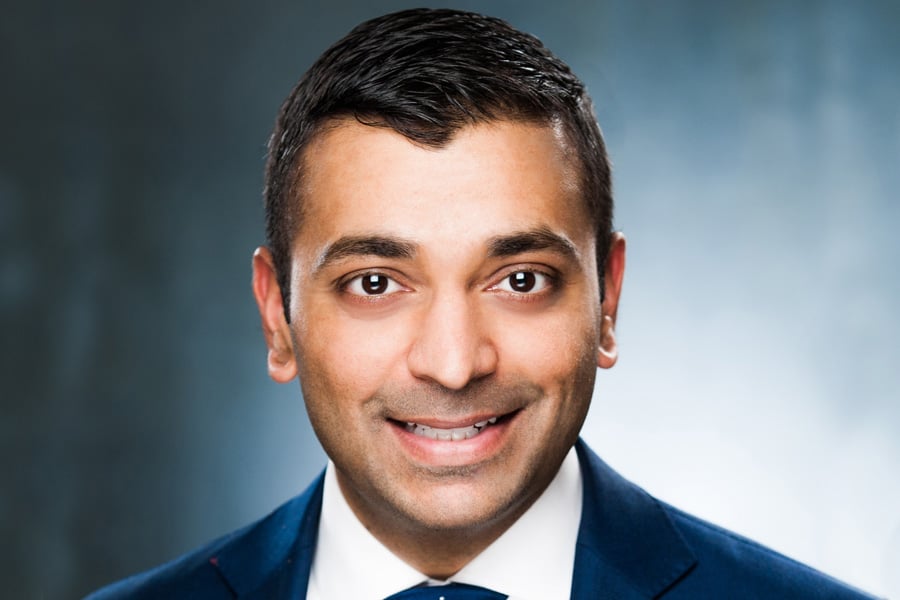
His parents, who emigrated to America from India, valued safety and security. It took years for Pratik Patel to reach beyond that code and put his ambition into gear.
“I was content for a long time making a paycheck and doing well enough,” said Patel, managing director with the BMO Family Office. “There’s a complacency in terms of risk-taking.” But colleagues and managers urged him, he recalled, to tap into his latent aspirations. “You can do more, you can do better, you can lead a group: It takes people saying, ‘You deserve more,’” he said.
Patel pushed himself to network, joining professional groups and taking on committee responsibilities. Now, he coaches Asian Americans a few career steps behind him to blend family perceptions with their own career goals, lest they find themselves inadvertently held back by widely held perceptions that pigeonhole Asians.
This month, the Association of Asian American Investment Managers released a report that shows that Asian Americans tend to plateau at midlevel at asset management firms. The industry loses half of its Asian American employees between entry and senior levels. Mutual funds have an especially weak track record, with about 20% of junior positions held by Asian Americans, shrinking to only about 8% at the senior level.
Asian Americans comprise about 7% of the American population and about 4.1% of certified financial planners, according to the Certified Financial Planner Board of Standards Inc.
The AAAIM study puts numbers to the daily experience of many Asian-Americans, said Jim Park, the group's CEO.
“Yes, we are well represented as analysts and associates, but once you hit the mid-career level, the opportunities seem to disappear,” Park said.
The perception that Asian Americans are good at back-office functions narrows their opportunities, he said, because it’s client-facing experience and capabilities that open doors to the top. “You don’t get to build out your full skill set as a leader,” he said.
Deliberately including midlevel Asian-Americans in leadership development and executive sponsorship programs will break the stalemate, he said.
“You need to give people a vision for the upward path. I’m encouraged that more companies want to do employee resource groups that are substantive and that build career paths,” said Park. “But it’s not happening enough. If this continues, it’s not good for companies.”
Family financial habits validate Asian Americans’ generally conservative approach. A new report from the Finra Investor Education Foundation found that Asian American families tend to be more financially resilient. Those from east Asia — China and Japan — are especially likely to have household emergency savings and avoid carrying credit card balances. Pacific Islanders’ financial habits more closely track with those of Americans overall, the report found.
Asian high-net-worth investors prioritize asset growth and building family wealth, according to fresh data from UBS; two-thirds of such investors that UBS surveyed were first- or second-generation immigrants whose families came to America specifically for career and educational prospects.
Asian family heritage sets a firm foundation for fiscal responsibility that rising advisors and asset managers can draw on as they muster determination to reach beyond, Patel pointed out.
“When you don’t come from wealth, but you’re in a role where sales is important, you don’t think you can cultivate [a network],” he said. “But you don’t have to be born into it. We can build it.”

LPL Financial and Raymond James also add independent advisors from Osaic and Edward Jones in Michigan and Arizona.

The SEC-registered RIA advises on more than $1 billion in client assets, with no advisory fee through 2027 and no human financial advisors.

95.8% of house trades were winners. For clients? The SEC says just 14.9%.

The complaint says Duolingo added friction on purpose, then lied about it.

The four wirehouse firms lost 1,449 experienced advisors and recruited 932 in the first six months of the year, according to Diamond Consultants.
Knighthead Life entered the market with a competitive MYGA. A strong launch earned advisor confidence and paved the way for FIAs.
As AI makes financial information more accessible than ever, Lana Hock explains why human judgment, trust, and empathy remain the qualities clients value most in a financial advisor

