
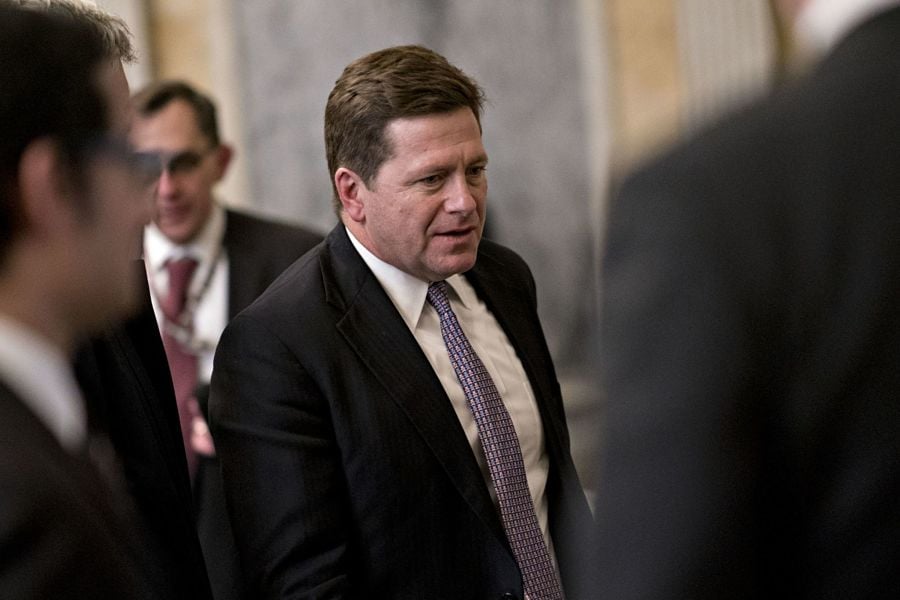
Securities and Exchange Commission Chairman Jay Clayton was surprised and dismayed by the political battle that erupted over his pending nomination to be the top federal prosecutor in New York, said people familiar with the matter.
Now, as it becomes clear that he may face insurmountable hurdles to winning Senate confirmation for the U.S. attorney post, some of Clayton’s close advisers are urging him to withdraw from consideration and announce that he’s staying at the helm of Wall Street’s regulator. Clayton hasn’t yet made a decision, the people said.
Clayton had been discussing the job with Attorney General William Barr and other Trump administration officials for several weeks or more, according to the people, who requested anonymity to discuss the matter. Though Clayton has golfed with Trump, including at the president’s Bedminster, N.J., club this month, the two aren’t known to be especially close.
The SEC chief is a political independent, and while he’s cultivated tight relationships at the White House, he’s mostly steered clear of partisanship and cast himself as a moderate financial regulator focused on protecting retail investors.
Before Trump appointed him to run the SEC, Clayton was a partner at Sullivan & Cromwell in New York, where he represented Goldman Sachs Group Inc. and other major banks. Many of his friends and colleagues assumed he would return to the law firm after his stint in government.
According to the people familiar with the nomination, Clayton thought his experience leading the SEC’s enforcement efforts would translate well to the U.S. attorney job, even though he doesn’t have the prosecutorial background often seen as requisite for the position. Another attraction was that the job would allow him to be in New York, where his family lives. He’s been commuting to Washington for work since taking the SEC job in 2017.
A spokeswoman for Clayton at the SEC declined to comment.
Clayton, 53, saw the Southern District of New York position as one more likely to be offered during a second Trump term, if the president is re-elected, the people added. Some of the advisers noted that the high-profile post has often provided an inside track to becoming U.S. attorney general, a job Clayton was eyeing down the road.
That plan started unraveling Friday night after Barr released a statement that announced the pending nomination of Clayton and the resignation of Geoffrey Berman, the sitting U.S. attorney. Berman quickly responded that he hadn’t actually quit and wasn’t planning to step down.
The remarkable dust-up between Barr and Berman, who garnered a reputation for protecting the Manhattan office’s independence, cast an immediate shadow over Clayton’s potential appointment. Many thought Clayton looked like a pawn in the larger dispute between Berman and the Trump administration.
The standoff ended on Saturday when Berman agreed to leave and his deputy was named as his acting successor. Still, the process was chaotic; Trump himself was forced to fire Berman, and Barr backed off a plan to put in a different official to run the office until Clayton was confirmed. And New York’s two U.S. senators, who by tradition are consulted on major nominations involving the state, expressed outrage over the machinations.
Senate Minority Leader Charles Schumer and Sen. Kirsten Gillibrand, both Democrats, criticized the decision to fire Berman and called for Clayton to pull out of contention for the job.
Schumer didn’t mince words, saying in a statement that the SEC chairman needed to “stand up to this corruption, withdraw his name from consideration, and save his own reputation from overnight ruin.”
Adding to Clayton’s troubles, Senate Judiciary Committee Chairman Lindsey Graham, a Republican and close Trump ally, indicated Saturday that he wouldn’t move ahead with the nomination unless Schumer and Gillibrand signed off on it, citing traditional committee procedure.
As the fast-moving events unfolded, Clayton was considering his options and consulting with close friends and advisers, the people said.
While he doesn’t blame anyone in the Trump administration, Clayton was uneasy about Friday’s rollout and wasn’t under the impression that Berman would fight the move, the people said. There’d been talk that Berman would be offered a job running the Justice Department’s civil division.
Shortly after midnight on Saturday morning, Clayton sent out a brief email to the SEC’s 4,000-plus employees, pledging that “pending confirmation, I will remain fully committed to the work of the commission.” Some at the agency said that the note, a copy of which was reviewed by Bloomberg News, was uncharacteristically short for Clayton, who’s known for sending lengthy messages to the staff.
On Sunday, Clayton sent another message to SEC employees, saying that family considerations and a desire to do more public service made him “grateful to be considered for the position by the attorney general and excited by the opportunity.” However, he added that “this is not a goodbye” and noted “we will be together for at least some meaningful period of time.”
As the weekend wore on, some of Clayton’s confidants saw little upside for him to stick with the nomination process, especially after it became clear that his chances to get Senate approval were dismal, the people said. One option being discussed would be for him to acknowledge that likelihood and announce that he plans to remain at the SEC for the remainder of Trump’s term.
Some people he consults with, however, are suggesting that Clayton sit tight for now and wait to see what happens, the people said. There could be less pressure now that Berman has stepped down, they said.

Halbert Hargrove senior wealth advisor weighs in on the products' guaranteed income upside, the operational drag and his wish list for carriers.

With 8.6% of advisors set to switch firms in 2026, Cerulli says advisor recruitment hinges on technology, branding and HNW support.

“I’m seeing more disputes like this between advisors and other advisors at the same practice,” said one industry executive.

Longer retirements and steady inflation could drain retiree portfolios before heirs inherit, with 4% net returns running dry by year 34.

A single fintech partner triggered a $68.8M credit hit.
As AI makes financial information more accessible than ever, Lana Hock explains why human judgment, trust, and empathy remain the qualities clients value most in a financial advisor
Northern Trust’s Ken Lassner shows advisors how to convert volatility into after-tax portfolio gains

