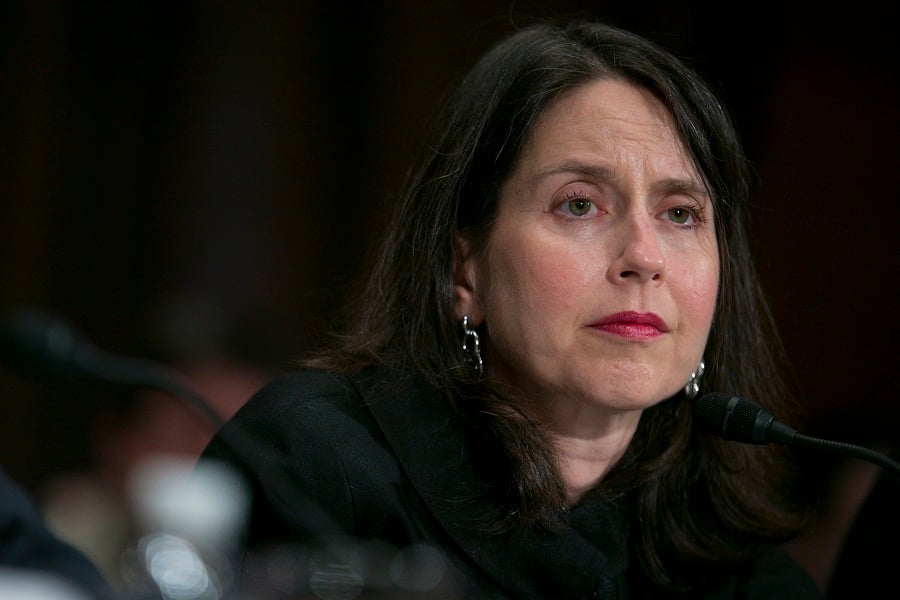
A Securities and Exchange Commission member said on Monday that the agency should scrutinize whether mutual funds that act like hedge funds are skirting rules for the
investment vehicles and endangering investors.
Mutual funds and exchange-traded funds that use complex, risky investment strategies or invest in illiquid assets “often operate in a gray area of mutual fund regulation,” said Kara Stein, an SEC commissioner, at a speech at the Brookings Institution in Washington.
Ms. Stein raised concerns that so-called alternative mutual funds appeal to investors as a way to outperform the market by mimicking hedge funds while not adhering to Investment Company Act of 1940 rules governing liquidity and leverage.
“Alternative mutual funds promising the upside of
hedge fund investments with the liquidity of traditional mutual funds are all the rage,” Ms. Stein said. “I think this trend should give everyone pause, and regulators and the public need to be asking questions about this development.”
The alternative fund market has soared from $46 billion in assets under management in 2008 to $311 billion at the end of 2014, according to Morningstar.
As retail investors increasingly demand alternative mutual funds, they think they're getting the protections of a traditional mutual fund, Ms. Stein said. They're commonly referred to as “liquid alts.”
“They may be less liquid, employ more leverage, and invest in exotic and complex instruments,” Ms. Stein said. “At a minimum, this raises the question of retail investor confusion.”
The SEC recently proposed new reporting rules for
separately managed accounts. Ms. Stein said the agency also could propose rules on liquidity and the use of derivatives in funds.
A focus on the safety of mutual funds and ETFs, whose combined assets under management totaled $18 trillion at the end of 2014, according to the Investment Company Institute, is critical at a time when most people are “living paycheck to paycheck” and are taking “more responsibility for saving for their retirement,” Ms. Stein said.
“Given this reality, regulators and the industry have a responsibility to make certain that the legal framework is stable and remains focused on protecting the retail investors,” she said.