
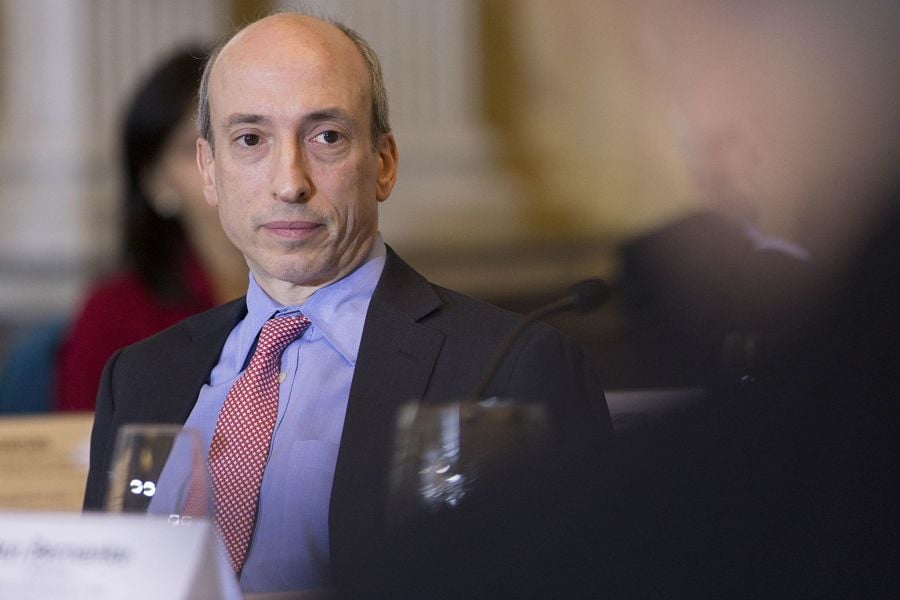
Most Republicans on the House Financial Services Committee haven't had warm, fuzzy feelings toward SEC Chair Gary Gensler, but the antipathy seems to be getting stronger.
Earlier this week, two GOP members of the panel, Reps. Warren Davidson of Ohio and Tom Emmer of Minnesota, introduced a bill that would restructure the Securities and Exchange Commission and remove Gensler from its helm.
The Republican-majority committee announced Thursday that two of its subcommittees would hold back-to-back hearings focused on the SEC next Thursday. One will feature officials from the SEC’s division of trading and markets, and the other is a hearing of the oversight subcommittee.
Gensler and other agency officials tend to get grilled at these Capitol Hill sessions by GOP members of the committee, who usually drill them on ESG, cryptocurrency and many other issues. Republicans and many financial industry trade groups criticize Gensler for being too aggressive in pursuing a regulatory agenda that’s too expansive.
Developments this week show that the tension between the House GOP and Gensler is escalating, said Michael Canning, principal at The LXR Group, a government relations consulting firm.
“Things have reached a boiling point,” Canning said.
The legislation to overhaul the SEC would fundamentally change how it operates.
Currently, the SEC consists of five members, with the majority representing the party that controls the White House. President Joe Biden nominated Gensler, who was confirmed by the Senate in April 2021.
Gensler and his fellow Democratic commissioners — Caroline Crenshaw and Jaime Lizarraga — have prevailed in many 3-2 votes to propose and finalize rules. The Republican commissioners are Hester Peirce and Mark Uyeda.
The Davidson-Emmer bill, the SEC Stabilization Act, would add a sixth commissioner to the SEC and create the position of executive director. One political party would never hold more than three seats at a time. Effectively, there would be no majority. That would force commissioners to come to “work together” to approve significant actions, according to the lawmakers.
“U.S. capital markets must be protected from a tyrannical chairman, including the current one,” Davidson said in a statement.
Emmer added in the statement: “American investors and industry deserve clear and consistent oversight, not political gamesmanship.”
An SEC spokesperson declined to comment.
Gensler has defended his approach, asserting that the SEC is trying to ensure financial markets are fair and efficient. He said he is trying to reduce the cost of financial intermediaries, an approach that can rile the industry.
Davidson and Emmer said they want the SEC to operate more like the Federal Election Commission. That agency, however, often deadlocks, 3-3, when it votes on election rules.
“That tells you everything you need to know,” Canning said. “The FEC is nonfunctional on major issues.”
The Davidson-Emmer bill likely can get through the committee because of the Republican majority on the panel. Emmer also is a member of House leadership, which could help it get to the House floor for a vote by the whole chamber. But the measure likely would halt in the Democratic-majority Senate.
Although its legislative prospects are limited, the measure could still damage Gensler.
“The bigger problem is the political toll all of this is taking on Gary Gensler,” Canning said.

Chicago-based Mesirow Fiduciary Solutions adds flexPATH's plan-level outsourced fiduciary book, boosting its retirement market reach to $164 billion.

Also, Raymond James's employee advisor channel adds breakaways from Wells Fargo and Stifel, while UBS welcomes an ex-Morgan Stanley duo in Indiana.

It promised guaranteed principal and 10% monthly returns. The SEC says it invested nothing.

Ten years after entering the fee-based annuity market, MassMutual Ascend says nearly half its lifetime sales came in the past two years alone – but barriers remain among fee-only advisors.

Amplify, WealthReach, Zeplyn and Zocks have unveiled partnerships aimed at automating portfolio management, content creation, account opening, and client communication.
Northern Trust’s Ken Lassner shows advisors how to convert volatility into after-tax portfolio gains
Dan Biagini of American Equity says the steady decline of pensions, longer lifespans and a reset in interest rates are rewriting how advisors build retirement income

