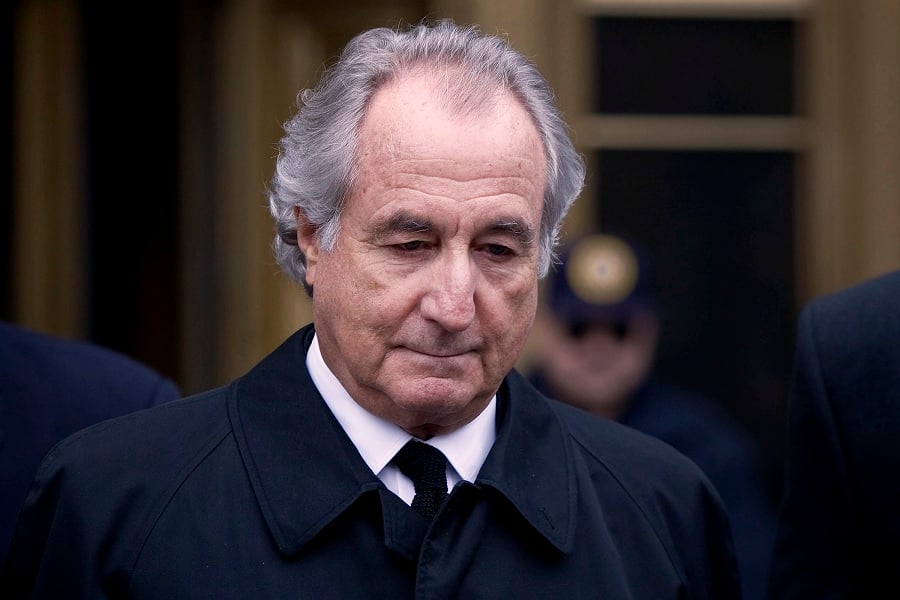
David Kugel, who helped create fake securities trades as part of the $17.5 billion Ponzi scheme, received a lighter sentence after helping the prosecution.
A former Bernard Madoff employee who helped create fake securities trades to trick customers for years avoided a prison sentence, the third ex-worker to do so after assisting in the prosecution of onetime colleagues.
David Kugel, a trader in the con man's legitimate brokerage operation for almost four decades, had faced as long as 85 years behind bars for his role in the $17.5 billion Ponzi scheme that collapsed on Dec. 11, 2008.
U.S. District Judge Laura Taylor Swain, who oversaw the only trial tied to the unprecedented fraud, sentenced Mr. Kugel Wednesday in Manhattan to two years of probation, including 10 months' home detention, and ordered him to perform 200 hours of community service.
Ms. Swain cited Mr. Kugel's early cooperation, which helped prosecutors understand how far back the fraud went and who the key players were. Mr. Kugel even directed attention to his own son, Craig, who worked for Mr. Madoff and also pleaded guilty, the judge said.
"The guilt, embarrassment and humiliation have become part of my DNA," Mr. Kugel, 69, said, reading from a prepared statement before the sentence was handed down. Watching his son get caught up in the crime "is punishment I cannot describe."
Craig Kugel, a former Madoff human resources employee who admitted to tax fraud, is scheduled to be sentenced Thursday in the same court.
FIVE CONVICTIONS
A jury last year convicted five of Mr. Madoff's former top aides after a trial that relied in part on testimony by the Kugels and other ex-employees who pleaded guilty.
David Kugel, hired in 1970, was the first witness to testify in the five-month trial to admit involvement in the creation of fake trading documents, though he said he wasn't aware customer money was being stolen.
"Mr. Kugel at no time had any idea there was a Ponzi scheme going on — that people were losing millions of dollars," his lawyer, Patrick Joyce, said in court Wednesday. "He was never part of the inner circle, the people who knew how bad the world was being treated."
Eric Lipkin, a former payroll clerk and longtime assistant to Mr. Madoff's late chief financial officer, Frank DiPascali, was sentenced last week to nine months of home detention, two years of probation and 200 hours of community service after cooperating in the trial. Former Madoff controller Enrica Cotellessa-Pitz, who also testified, got a similar sentence.
'ACTIVE' PLAYER
Randall Jackson, a prosecutor in the case, said Wednesday that while Mr. Kugel was an "active" participant in the fraud, his cooperation was pivotal. Mr. Kugel was also one of the few traders who made money for Mr. Madoff's firm in an otherwise money-losing brokerage, and did "legitimate" work every day, Mr. Jackson said.
"Mr. Kugel agreed to speak with the government almost immediately after Mr. Madoff's arrest," Mr. Jackson said.
Mr. Kugel, hired out of Pace University by Mr. Madoff, pleaded guilty to fraud in 2011. He testified that Mr. Madoff sometimes asked him for investment calculations during his first year on the job, and that he didn't know why.
When Mr. Kugel discovered the scheme — and his role in it — around 1977, he said, he continued helping to make sure the fake trades looked realistic.
ROLE ENDED
His client's role in the fraud was essentially over by the early 1990s, when fake trading data became easier to obtain by other means, Mr. Joyce said.
Mr. Kugel, who went on to become a supervisor in the market-making business, where real trading took place, gave particularly damaging testimony about Joann Crupi and Annette Bongiorno, who handled large accounts in Mr. Madoff's investment-advisory business at the center of the fraud.
He said he provided them with the real data they needed to make their fake trades appear realistic.
Ms. Bongiorno first approached him in the early 1970s for the documentation, and he obtained it from the Wall Street Journal and other sources to mimic actual trades. In the 1990s he supplied the same type of information to Ms. Crupi, he said.
Defense lawyers argued at trial that Mr. Kugel and other former Madoff employees who pleaded guilty were willing to lie and implicate their former colleagues to get less time behind bars when they're sentenced.
Ms. Bongiorno and Ms. Crupi were convicted alongside Daniel Bonventre, who oversaw the broker-dealer and proprietary trading operations where Mr. Kugel worked; and computer programmers George Perez and Jerome O'Hara, who allegedly automated the creation of millions of fake documents.
The five defendants were sentenced to terms ranging from 2 1/2 years to 10 years in prison.
Mr. Madoff, who pleaded guilty in 2009 and refused to help prosecutors, was sentenced to 150 years in prison.