
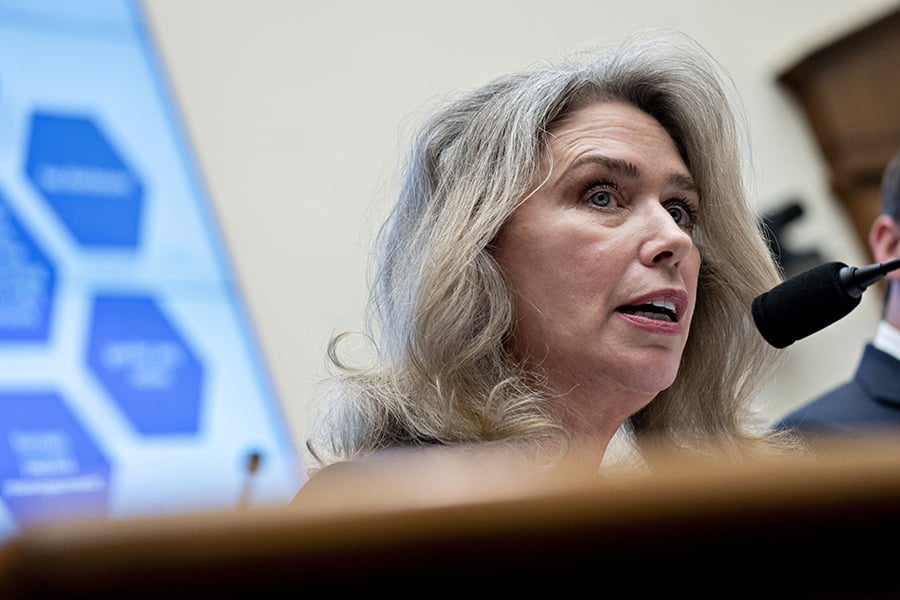
Allison Herren Lee, the acting chair of the Securities and Exchange Commission, on Wednesday called for more disclosure and transparency about proxy voting by investment funds to ensure they’re expressing shareholder sentiment, particularly on environmental, social and governance issues.
In a speech, Lee said the SEC should update its rules and guidance surrounding proxy voting and corporate governance — including the proxy voting responsibilities of investment advisers — to strengthen shareholder democracy.
“Ultimately, corporate accountability is only possible when the funds that manage American investors’ savings diligently exercise their authority to vote, clearly disclose their votes to investors, and operate in a system that efficiently provides accurate information about vote execution,” Lee said at an online Investment Company Institute conference.
Two factors are making proxy reform urgent, Lee said. One is the the growth in the number of households that invest in funds — up to 47% in 2020 from 6% in 1980 — and the other is the strong demand for investing in funds with ESG strategies, which saw an inflow of $45.7 billion into global sustainable funds in the first quarter of last year.
“Retail investors need more meaningful insight into how their money is voted, and that insight is more important than ever with the growth of interest in ESG shareholder proposals,” Lee said. “It’s hard to see how retail investors can get an accurate and reliable picture of how a fund votes on ESG issues when they are have to try to parse through these lengthy forms that use a kind of short-hand description of the proposals that were voted.”
Lee said there may be a disconnect between passive index funds' proxy voting and their investors’ ESG inclinations.
“We know investors are demanding ESG investment strategies and opportunities, but funds may not always reflect those investor preferences in their voting,” she told the ICI audience. “Addressing this agency cost is at the heart of corporate governance today, and that is why it is critical that we at the SEC — along with all of you in this virtual room — focus more attention on fund and adviser voting duties and disclosure.”
Lee’s remarks add to agency momentum surrounding climate risk and ESG issues. Earlier this week, she announced the launch of a public comment period on corporate climate disclosures.
She also recently directed SEC staff to ramp up reviews of corporate ESG disclosures and announced the formation of a climate and ESG enforcement task force. In addition, the SEC elevated climate risk and ESG in its examination priorities.
This intense focus on ESG is likely to continue when the Biden administration’s nominee for SEC chair, Gary Gensler, is confirmed by the Senate.
In her ICI appearance, the acting chair said the agency should reconsider guidance it issued in 2019 on investment advisers’ proxy voting responsibilities.
The guidance “may have tilted … against shareholder voting without sufficient data or analysis to support the wisdom of doing so,” Lee said. “This guidance should be revisited to ensure that fiduciaries understand how to weigh the competing concerns of all types in deciding whether and how to cast votes on behalf of their beneficiaries.”
Other potential steps include rulemaking to update a proxy voting information form and to standardize disclosures and clarify data about proxy votes.
“In sum, there is a lot of work to do in this area,” Lee said. “And it is important work because it gets to the heart of ensuring that our system of shareholder democracy works.”

Retiring RIA seller David Laidlaw alleges the Carnegie valued his stake on $11.7 million EBITA while pitching potential buyers on $21.3 million.

New tool gives RIAs and family offices AI help vetting private market deals, with some users reportedly halving review time.

Investors got projected returns dressed up as real ones, SEC says

Parents must still act to get the $1,000 federal seed and employer contributions, giving financial advisors a role in the rollout.

FINRA booted Rudy Anguiano from the industry for “conversion - the intentional and unauthorized taking of another person’s property.”
As AI makes financial information more accessible than ever, Lana Hock explains why human judgment, trust, and empathy remain the qualities clients value most in a financial advisor
Northern Trust’s Ken Lassner shows advisors how to convert volatility into after-tax portfolio gains

