

Advisers are feeling a bit more optimistic than they were three months ago.
When InvestmentNews Research took the industry’s temperature heading into the third quarter, 87% of advisers surveyed believed it was at least somewhat likely that the COVID-19 pandemic would trigger another significant market decline of 10% or more.
Heading into the fourth quarter, advisers are feeling more confident about financial markets, their businesses and the overall economy than they were in our last survey.
The survey, consisting of a sample of 106 financial advisers, was fielded in the first half of October and focused on plans for the coming quarter and sentiment about the year ahead.
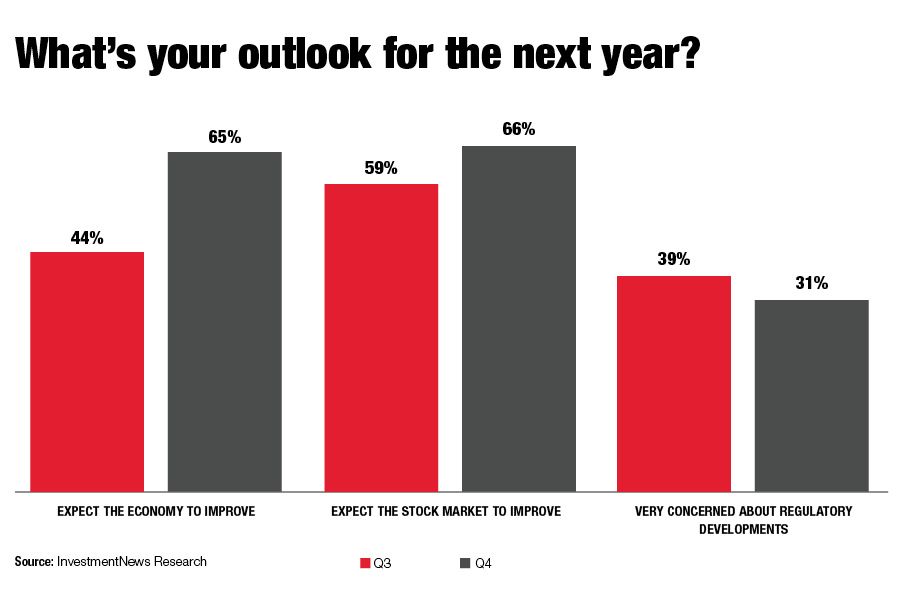
Adviser expectations for the overall U.S. economy were the most notable change from the third to fourth quarters, shifting from a negative to positive outlook. In the most recent survey, 65% of advisers expected economic growth over the next year, compared with 44% who felt similarly in the third quarter. Fewer than 25% of advisers surveyed this quarter anticipated a deterioration in economic conditions.
The rosier outlook was also reflected in views on financial markets. About two-thirds of advisers expected an improvement in the S&P 500, and the bulls were more bullish: Among advisers expecting growth in the index, the median projection rose from 7% to 9%.
Notably, advisers were also less concerned about adverse regulatory developments. Despite the approach of a presidential election, the share of advisers very worried that regulatory and political shifts would hurt their business declined from 39% to 31%.
This survey was fielded by InvestmentNews Research. For more information on IN’s research offerings, visit our data store or contact [email protected].

Meanwhile, DPL Financial Partners adds two annuity executives and Prime Capital Financial hires a Mid-Atlantic retirement plan consultant

Andrew Komarow pleaded guilty Thursday in federal court in Hartford to defrauding three financial services companies of close to $3.3 million.

Elsewhere, Cetera picks up a $210 million Connecticut team from MML, while Wells Fargo FiNet adds a San Diego family practice from LPL

Celebrity endorsements, $500M in claimed assets, and a state regulator stepping in.

“We needed to become a more agile and efficient organization,” said American Express CEO Stephen Squeri.
Knighthead Life entered the market with a competitive MYGA. A strong launch earned advisor confidence and paved the way for FIAs.
As AI makes financial information more accessible than ever, Lana Hock explains why human judgment, trust, and empathy remain the qualities clients value most in a financial advisor

