
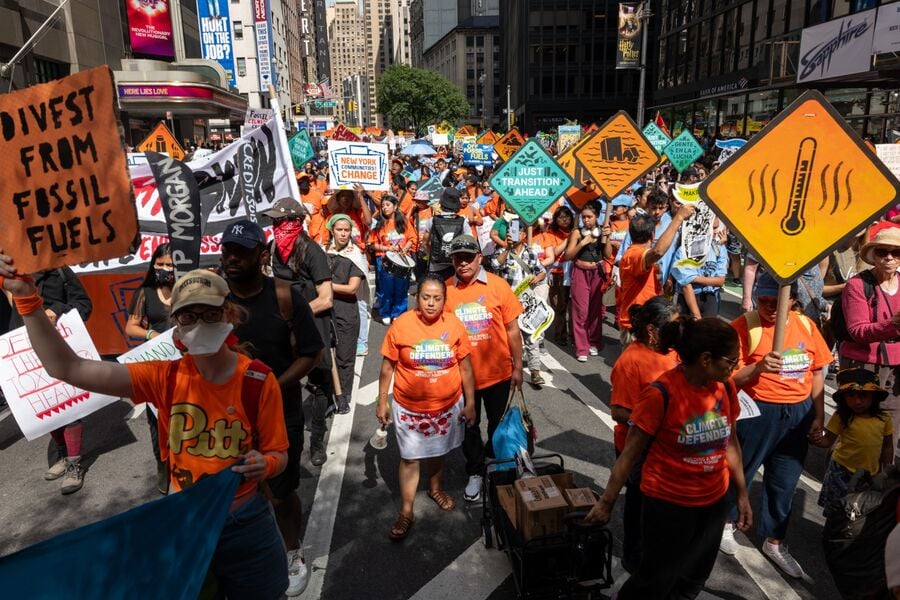
This week, one of the hallmark events centered on curbing global warming — NYC Climate Week — convened sustainability experts and evangelists from around the world in one place.
The event, which coincides with the United Nations General Assembly, has become a must-attend occasion for people in the field, mixing a festival-like atmosphere with serious talks and panels about how to address what many consider to be the biggest threat facing humanity and the world.
But the major news has occurred outside the event – it’s an optimal time for announcements, protests and new sustainability-related legislation or regulations.
Over the past week, the Securities and Exchange Commission finalized its long-awaited fund names rule, largely an anti-greenwashing regulation focused on sustainable investments. California’s Democratic Gov. Gavin Newsom indicated he will sign climate-disclosure bills that are significantly wider-ranging than similar ones the SEC is expected to pass later this year. President Joe Biden announced a new initiative, American Climate Corps, a program that will train younger people on clean energy and sustainability as well as help create jobs in the field.
Meanwhile, the Taskforce on Nature-related Financial Disclosures issued a set of recommendations for companies on how they let the public and investors know about risks they face related to nature and how they are addressing them.
And in addition to more general protests on Manhattan focused on fossil fuels, demonstrators amassed in front of the offices of BlackRock, Citi and Bank of America.
It could just be serendipity that the SEC passed its updated fund names rule during Climate Week, given the agency’s regulatory agenda and tightly controlled hearings schedule. But the crux of the new rule addresses a major issue in the world of sustainable investing: greenwashing.
On Wednesday, the commission voted 4-1 to approve the expanded names rule, which requires that funds labeled as “sustainable,” “green” or similar terms must have investment approaches that reflect their packaging. However, the version that the SEC passed excluded a prohibition that was part of the proposed rule that would have prevented funds that use ESG factors only minimally from including “ESG” or similar titles in their names. The SEC has hinted that it will address that issue separately, in another of its upcoming final rules.
“The SEC's names rule was certainly a long time coming in order to combat greenwashing and is consistent with the stricter reporting requirements that USSIF has used when collecting growth in the sustainable investing space,” Jennifer Coombs, director of client success at Ethos ESG, said in an email. “However, I feel they may have put the cart before the horse here by requiring that fund investments be consistent with ESG criteria … They have yet to establish a minimum set of reporting requirements by publicly traded companies that go into the analysis of ESG criteria. If the focus was more on the minimum set of requirements, implementing a names rule wouldn't be necessary.”
The State of California will use its might as the world’s fourth-largest economy to push companies both public and private to disclose carbon emissions and climate risks and opportunities. Days after the state legislature approved bills for such requirements, Newsom stated that he intended to sign them into law.
The forthcoming laws are significant not only because they pertain to businesses operating in California, but also because they could force any major companies with operations in the state to comply. The measures go beyond what the SEC has proposed in that they also cover private businesses of a certain size and they require so-called Scope 3 emissions disclosures. Those emissions are wide-ranging and pertain to the greenhouse gases connected with supply chains and end users.
The Biden administration's latest move on the environment is an executive action the administration announced Wednesday: creation of an American Climate Corps.
The White House said the program will provide paid career training for more than 20,000 people during its first year, “putting them to work conserving and restoring our lands and waters, bolstering community resilience, deploying clean energy, implementing energy efficient technologies and advancing environmental justice.”
That will lead to more private-sector careers in clean energy, according to the announcement.
The TNFD recommendations published this week include 14 types of disclosures for companies to make regarding the risks they face over nature issues. The guidance comes after two years of development, including testing by a group of more than 200 companies and financial services firms. The recommendations, which TNFD said are science-based and voluntary, cover governance, strategy, risk management and metrics, “serv[ing] as a starting point for companies to begin identifying, assessing and disclosing the nature-related issues in their own time.”
“Nature loss is accelerating, and businesses today are inadequately accounting for nature-related dependencies, impacts, risks and opportunities. Nature risk is sitting in company cash flows and capital portfolios today,” TNFD co-chair David Craig said in the group’s announcement. “The adoption of the TNFD Recommendations represent a step-change in the momentum and capacity for business and finance to identify, assess and disclose their exposure to nature-related issues in a manner consistent with climate-related reporting.”
Leading up to climate week and the larger-scale March to End Fossil Fuels, numerous groups demonstrated at the headquarters of BlackRock, Citi and Bank of America, targeting those firms over investments in the oil and gas industry. More than 100 people were arrested as they blocked entrances to the buildings during the protests, according to Eyewitness News ABC7 New York.
The groups participating in the Sept. 13 action at BlackRock included Green Peace, 350.org and others.
In a statement released ahead of the protest, the groups pointed to Republicans’ pressure on BlackRock to tone down its ESG messaging and cited the recent appointment of Saudi Aramco CEO Amin Hassan Ali Nasser to the asset manager’s board as one outcome.
Saudi Aramco was recognized as the most profitable company in the world. Learn more here.
Despite BlackRock CEO Larry Fink’s messaging on stakeholder capitalism in recent years, the firm has been one of the biggest investors in the fossil fuel industry — including in Texas, a state that has become one of the firm's biggest critics.
“In effect, the right-wing attacks seek to force BlackRock to keep financing oil, gas and coal,” the groups stated. “Climate protesters [urged] BlackRock to align its portfolio with the minimum standards necessary to avoid global catastrophe: ending fossil fuel investments in new coal, oil and gas, as well as tackling deforestation.”

Shorter waits for failed SIE and Series 7 candidates take effect Jan. 19, speeding the path to registration

Raymond James and Cetera also welcomed advisors from UBS and LPL as competition for experienced teams stays fierce

Jim Walesa worked in the securities industry for 39 years before leaving in 2021.

As the market turned from pricing in cuts to betting on hikes this year, the developing reality of a K-shaped economy has had real implications for households and investors alike.

Alleged cash payments, stolen client data, and a court that jumped the gun
Knighthead Life entered the market with a competitive MYGA. A strong launch earned advisor confidence and paved the way for FIAs.
As AI makes financial information more accessible than ever, Lana Hock explains why human judgment, trust, and empathy remain the qualities clients value most in a financial advisor
