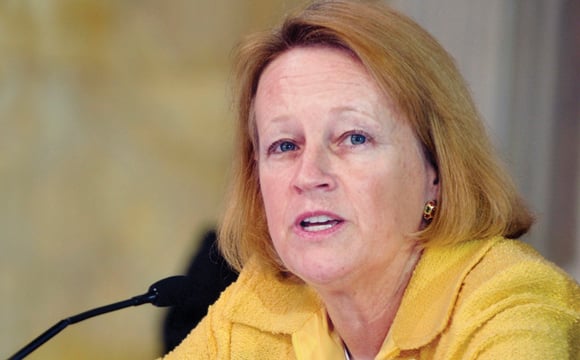
SEC Chairman Mary Schapiro said that the agency will issue an initial rule this fall imposing a universal fiduciary duty for anyone providing retail investment advice.
Securities and Exchange Commission Chairman Mary Schapiro said that the agency will issue an initial rule this fall imposing a universal fiduciary duty for anyone providing retail investment advice — the next step in what is likely to be a long process.
“It's my hope that in the fall, we'll be able to get to it,” Ms.
Schapiro told reporters Thursday following a hearing of the Senate Banking Committee marking the first anniversary of the enactment of the Dodd-Frank financial reform law. “Whatever we do, we'll have lots and lots of comments, and have lots of issues to work through.”
The Dodd-Frank law gives the SEC the authority to promulgate a fiduciary-duty rule but does not mandate that it do so.
The SEC delivered a report to Congress in January that recommended such a regulation to improve protection of investors who are confused by differing standards of care that investment advisers and broker-dealers must meet. Advisers have a fiduciary duty to act in a client's best interests, while broker-dealers adhere to a less stringent suitability standard when selling financial products.
After completing the study, which was called for by Dodd-Frank, the SEC addressed dozens of other regulations required by Dodd-Frank. At Thursday's hearing, Ms. Schapiro said that the SEC has proposed or adopted two-thirds of the more than 90 mandatory Dodd-Frank rulemaking provisions and finalized 10 of the more than 20 studies the law requires.
Interest groups that represent advisers used the one-year anniversary of Dodd-Frank on Thursday to urge the agency to revisit fiduciary duty.
“Having met many of the initial study and rulemaking deadlines required in the first year following the law's enactment, the SEC should now turn its attention to one of Dodd-Frank's most critical investor protection reforms,” the Financial Planning Coalition said in a statement. “Adopting a fiduciary standard would ensure that clients receive advice that is in their best interest, regardless of their advisers' compensation or other interests.”
The Financial Services Institute Inc. also called on the SEC to act.
“For the last year, FSI has urged the implementation of Dodd-Frank in a way that preserves investor choice and investor access,” FSI president and chief executive Dale Brown said in a statement. “We have urged regulators to take a thoughtful approach that avoids unintended consequences and moves us toward our goal of harmonized, effective regulation. Unfortunately, we are no closer to that goal than we were a year ago. A big first step toward that goal would be the adoption of a uniform fiduciary standard of care and the creation of a self-regulatory organization for investment advisors.”
As the SEC contemplates a new fiduciary-duty rule, it is seeking more funding to implement Dodd-Frank. Ms. Schapiro reiterated to the Senate committee that the agency can't hire the additional 770 staff required to handle the new law without a bigger budget.
“The new responsibilities assigned to the agency under the Dodd-Frank Act are so significant that they cannot be achieved solely by wringing efficiencies out of the existing budget without also severely hampering our ability to meet our existing responsibilities,” Ms. Schapiro said in prepared testimony.
Under a bill approved in June by the House Appropriations Committee, the SEC's budget will be frozen at its fiscal 2011 level of $1.18 billion. That's $222 million less than the amount requested by the Obama administration in its budget proposal.
House Republicans have prioritized federal spending reductions and said all agencies should take a budget hit. Critics said the GOP is trying to starve agencies of the funding they need to implement Dodd-Frank.
One of the ways that Dodd-Frank tries to ease the SEC burden is by moving about 3,200 investment advisers with assets under management of
$25 million to $100 million from SEC oversight to state regulation by next June.
Ms. Schapiro told reporters, however, that the adviser “switch” will not result in streamlining the agency's agenda, because Dodd-Frank adds oversight responsibility for more than 750 advisers to hedge and private-equity funds.
“While we lose a significant number of advisers to state registration in the middle of next year, we will take on a significant number of hedge funds for the first time,” Ms. Schapiro said. “Our workload isn't diminished in any way. The complexity of the assets under management is going to be increasing.”
The agency examined only 9% of the approximately 11,800 investment advisers under its aegis last year. About one third of investment advisers never have been examined.