
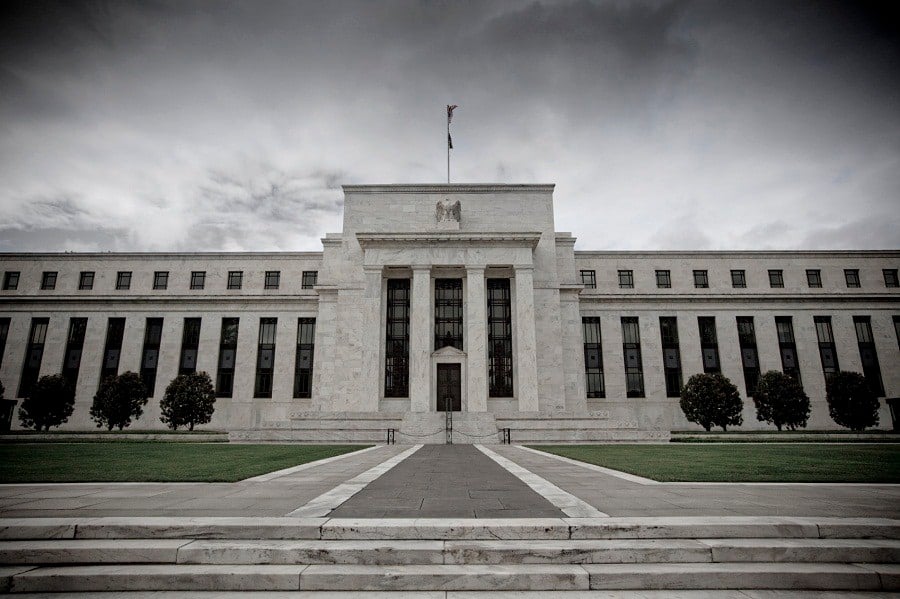
Morgan Stanley’s acquisition of ETrade Financial Corp. will have to pass muster with the Federal Reserve, but Washington experts foresee the union avoiding regulatory and political roadblocks.
With Morgan Stanley spearheading the $13 billion deal announced on Thursday, the transaction involves a globally significant financial institution, as defined by Financial Stability Board.
That designation for Morgan Stanley triggers a Fed review about whether the combined institution will affect systemic stability, according to Jaret Seiberg, managing director of the Cowen Washington Research Group.
“This is not going to be an easy deal to move through the Federal Reserve,” Mr. Seiberg wrote. “We believe Morgan Stanley had to informally run this transaction past regulators before announcing it. That is normal practice as it does not benefit financial stability for the Federal Reserve to reject bank mergers. This would suggest there is a path to approval.”
Mr. Seiberg predicted the Fed review would take until the end of the year.
Saule Omarova, a professor of law at Cornell University, said it is difficult to predict how regulators and legislators will react to the acquisition, but she said the odds are good it will not be stopped by Washington.
“Generally, it is difficult to imagine financial regulators going after Morgan Stanley based simply on the size of the new entity,” Ms. Omarova wrote in an email. “This kind of antitrust-type strictness has not been the norm among financial regulators, especially in recent years. Such a big deal is hardly happening without at least an implicit acquiescence or at least knowledge of the key regulators.”
Ms. Omarova added: “Politically, the company’s emphasis on expanding its gold-standard Wall Street asset management services to regular folks probably makes this merger more difficult to attack head-on. This deal lacks an intuitively graspable political salience that usually prompts a strong political reaction.”
Nonetheless, the Morgan Stanley-ETrade tie-up generated push back on Thursday from a liberal financial services organization.
“The last thing that our economy needs is for one of the 'Too Big to Fail' banks to get even bigger,” Graham Steele, a senior fellow at the American Economic Liberties Project, said in a statement. “This deal would allow one of Wall Street's biggest banks to accumulate even more market power, giving it more control over working people's retirement savings and deposits, and putting the public on the hook for even more potential risks. Any public official that is truly concerned about preserving competitive markets and preventing taxpayer bailouts must oppose this acquisition.”
But that kind of political opposition from an interest group may not gain traction in the capital.
“I don’t think anybody is worried this is going to give Morgan Stanley monopoly pricing power in the retail market,” said Tyler Gellasch, executive director of Healthy Markets, an investor trade group.
Mr. Gellasch, a former counsel at the Securities and Exchange Commission and a former Senate aide, said the lack of objections in Washington to Charles Schwab Corp.’s acquisition of TD Ameritrade is instructive when it comes to Morgan Stanley taking over ETrade.
“I thought Schwab buying TD Ameritrade would raise more concerns with regulators and policymakers,” he said. “I would expect even less resistance for this acquisition.”
Morgan Stanley’s swallowing up ETrade could be viewed two ways in terms of its impact on the Schwab-TD deal. On the one hand, it effectively removes ETrade as an independent competitor for servicing registered investment advisers.
But Mr. Seiberg says it could ensure approval for the Schwab-TDA deal.
“This might help Schwab’s acquisition of TD Ameritrade as a Morgan Stanley-backed ETrade may be seen as a stronger potential competitor,” he wrote. “It is worth watching if Morgan Stanley discusses plans for the custodial business for registered investment advisers, which we see as the key issue for Schwab.”

“Today’s actions send a clear message that even the biggest financial institutions are not above the law,” said Treasury Secretary Scott Bessent.

To build a truly self-sustaining practice, enterprising advisors have to start with a vision of what they want to be – and accept the realities that come with building toward it.

Serial acquirers add a 35-year-old Oregon wealth manager and a New York practice focused on women navigating life transitions.

Mara Glassel and Julie Fox will co-lead the fast-growing hybrid RIA’s ultra-high-net-worth and private wealth businesses.

The banking giant's wealth arm extends its revenue streak as it pushes to exit consent orders weighing on growth since 2020.
Knighthead Life entered the market with a competitive MYGA. A strong launch earned advisor confidence and paved the way for FIAs.
As AI makes financial information more accessible than ever, Lana Hock explains why human judgment, trust, and empathy remain the qualities clients value most in a financial advisor

