
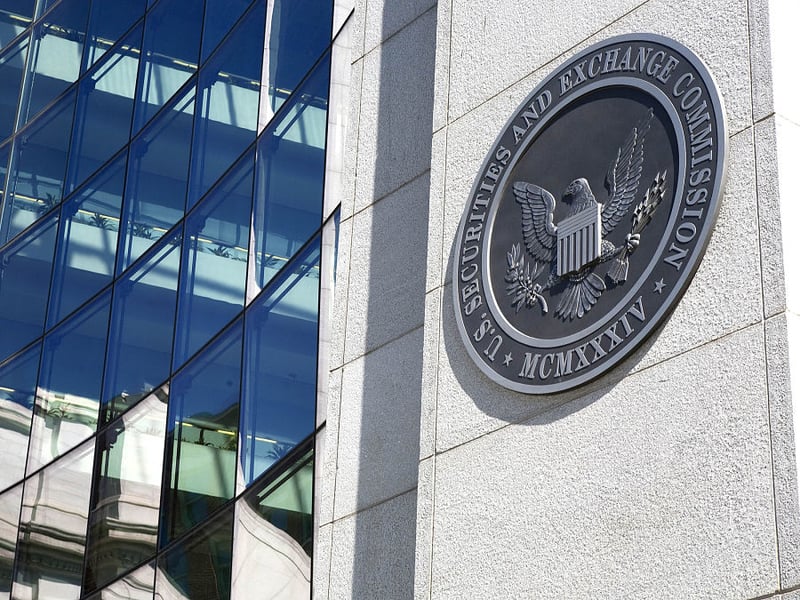
Foreign corporate insiders would have to reveal when they buy or sell company stock under a provision included under the House-passed defense authorization bill, a move backers describe as closing a loophole that hurts US investors.
The narrow section of the $901 billion defense bill amends US securities laws so overseas companies are required to report within two business days when officers and directors scoop up or dump shares, which is similar to insider reporting requirements for American businesses. The legislation now heads to the Senate.
The SEC rule is meant to deter insiders from making what appear to be well-timed trades. There’s no equivalent rule for a class of companies the SEC calls foreign private issuers — companies based overseas that enjoy certain breaks on US disclosure and reporting requirements.
That’s not only a problem for transparency but also for cracking down on pump-and-dump schemes, said Daniel Taylor, accounting professor at the University of Pennsylvania who studies insider trading. If there are no disclosure rules for foreign company executives, it is hard for investors to see if insiders cashed in during stock price surges.
“It tells the SEC in clear and uncertain terms it is the will of the people’s elected representatives that they meaningfully crack down on foreign exemptions from US disclosure rules,” Taylor said.
The SEC declined to comment.
Research by Taylor and other academics at the University of Chicago and New York University documented what they described as opportunistic stock sales among executives based in countries like Russia and China that are largely outside the reach of US authorities. The defense bill includes a provision that the SEC can exempt any company or person from the requirements if the agency determines the laws of the foreign jurisdiction are substantially similar to US requirements.
Senators John Kennedy, a Louisiana Republican, and Chris Van Hollen, a Maryland Democrat, have previously introduced a bill that would have required similar disclosures.
The SEC recently forced several foreign companies to temporarily stop trading due to suspicious activity and the Financial Industry Regulatory Authority has also been probing broker-dealer firms involved in taking small foreign companies public.

“People aren't effectively using their wealth in retirement,” said David Blanchett of Prudential.

Second-generation NFL ref Shawn Hochuli co-founded IWM Partners in Irvine, California, a wealth management practice with more than $500M in client assets
U.S. seniors lose $28.3 billion annually as a result of financial exploitation, according to a 2023 AARP study.

Cornerstone Capital, Echo Wealth Management, and Compass Wealth Management add about $2 billion as RIA M&A heads for a record year.

Bogus SEC filings, WhatsApp groups, and AI trading signals that never existed
As AI makes financial information more accessible than ever, Lana Hock explains why human judgment, trust, and empathy remain the qualities clients value most in a financial advisor
Northern Trust’s Ken Lassner shows advisors how to convert volatility into after-tax portfolio gains

