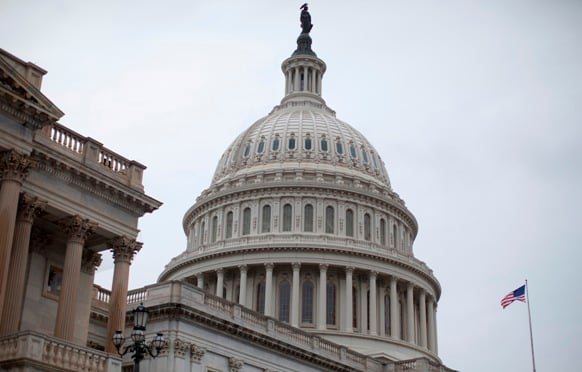
Even if a stalemate between Democrats and Republicans over the federal budget results in a government shutdown on Saturday, taxpayers still need to file their returns on time,
Internal Revenue Service Commissioner Douglas Shulman told a Washington audience on Wednesday.
“While we're not going to have a full complement of operations if the government shuts down, the IRS will be accepting tax returns,” Mr. Shulman said in an appearance at the National Press Club. “The due date will remain April 18.”
The normal April 15 deadline has been extended to April 18 because of the Emancipation Day holiday celebrated in the District of Columbia. But there will be no tax grace period related to the shuttering of the federal government — a result that could happen if congressional budget negotiations fall through.
Mr. Shulman recommended that Americans file electronically to avoid any problems that may emanate from the shutdown.
“Most of these returns are processed automatically and will not experience any delays,” Mr. Shulman said.
The House, Senate and White House are trying to hammer out a budget agreement that will keep the government operating through the end of the fiscal year, Sept. 30. Since last October, federal agencies have been operating on a so-called continuing resolution that provides funding at fiscal 2010 levels.
Over the last few months, Congress has approved several short-term continuing resolutions. The current one expires at midnight on Friday. The three previous measures have reduced spending by $10 billion. House Republicans approved a bill in February that would slash $61 billion from the current budget. Democrats are offering $33 billion in reductions.
Publicly, both parties are locked into positions that are far apart. Cutting the budget is the Republicans' top legislative goal because of what they say are the dangers posed by a $1.6 trillion budged deficit and national debt of $14.3 trillion.
Democrats assert that the GOP approach would hurt vulnerable Americans. It's not clear whether congressional negotiations will result in an agreement before the shutdown deadline.
Like other federal agencies, the IRS is making contingency plans for a shutdown, which includes identifying non-essential workers who will have to stay home. Mr. Shulman declined to speculate on which of the agency's 100,000 employees would report to work on Monday should there be a work stoppage, or how a reduced staff level would affect IRS enforcement operations.
“The nuances of who's going to be doing what, I'm not ready to get into,” Mr. Shulman said.
He did, however, discuss the future of the agency, laying out a vision for an IRS that looks ahead rather than behind in detecting tax return irregularities.
Mr. Shulman's idea is to have the agency collect all tax information, such as W-2s and 1099s, from third parties before a taxpayer submits a return. If there's a problem when the person files, it will be flagged before it's processed. Currently, audits can occur anytime for three years after a return is filed.
The process would require a substantial upgrade of IRS technology, Mr. Shulman acknowledges. Budget constraints have kept the agency underinvested in technology for 20 years, he said.
Nonetheless, taking a pre-emptive approach to compliance is a priority.
“We would see significant gains in both service and compliance that have the potential of saving billions of dollars across the public and private sectors in reduced administrative burden,” Mr. Shulman said.