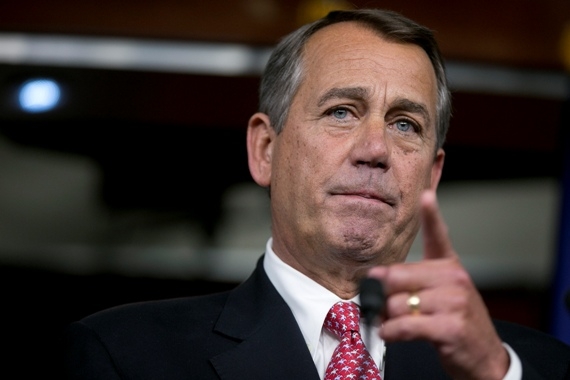
As Washington approaches the precipice of the fiscal cliff, one lawmaker will have to decide whether to take a leap of political faith that could determine the outcome: House Speaker John Boehner.
On Friday afternoon, President Barack Obama and Vice President Joe Biden will meet in the Oval Office with Mr. Boehner, R-Ohio, House Minority Leader Nancy Pelosi, D-Calif., Senate Majority Leader Harry Reid, D-Nev., and Senate Minority Leader Mitch McConnell, R-Ky.
It's the first time since the election that all of the principals in the effort to avert the fiscal cliff have sat down together to talk. At this late hour, the most they'll be able to achieve is a limited package to delay the worst of the cliff, which will automatically trigger about $600 billion in tax increases and spending cuts on Jan.
Even that small advance will depend on a political decision that has to be made by Mr. Boehner. Last week, he pulled from the House voting calendar a bill that would have extended Bush administration tax cuts for households making less than $1 million annually.
House Democrats united in opposition. When it was clear that plenty of House conservatives were also dead-set against it, Mr. Boehner killed the measure himself. The incident showed that many Republicans won't countenance a tax increase on any income level.
The underlying message, however, is that a majority of the Republicans' approximately 243-member caucus probably would support legislation that averts some of the fiscal cliff.
That's where the bill approved by Senate Democrats over the summer comes into play. The measure would extend the Bush tax cuts for households making less than $250,000, set the capital gains and
dividend rates at 20% and renew the alternative minimum tax exemption. This is the bill that Mr. Obama and Mr. Reid are touting.
But the measure is stuck in the Senate because all revenue legislation must start in the House, according to the Constitution.
Mr. Boehner and other House GOP leaders are insisting that the Senate take up a bill the House passed over the summer that would extend the Bush tax cuts for all income levels. The Senate can amend that bill, and the House would consider the resulting legislation, according to Mr. Boehner. But Mr. Reid has insisted that the Republicans are making procedural excuses.
Perhaps today's White House discussion will catalyze an agreement to move a bill that looks a lot like the Senate Democrats' summer legislation – with an extension of unemployment benefits thrown in for Democrats and a promise to address entitlement reform next year and an increase in the tax-cut threshold to around $500,000 added for Republicans. The bill would also lifte a $1.2-trillion domestic spending sequester.
Then Mr. Boehner must make his decision. If he allows a vote on such a fiscal-cliff bill, he could rile up conservatives again and risk his speakership, when House Republicans elect leaders shortly after the new Congress is seated on Jan. 3.
“I still think he has 85% of the [Republican] caucus with him,” said Brian Gardner, senior vice president for Washington research at the investment bank Keefe Bruyette & Woods. “He would keep a majority of Republicans, who would join a majority of Democrats, and they could pass it that way. How willing they are to go down that road is the $64,000 question.”
If Mr. Boehner acquiesces, it dramatically reduces the chances that Senate Republicans would filibuster the Senate Democrats' bill. The only reason Mr. McConnell allowed an up-or-down vote over the summer is because he knew procedural roadblocks would halt the measure.
There's precious little time between now and Monday night for the legislative wheels to turn. Instead, Congress might agree to a legislative framework and promise to pass fiscal-cliff legislation after the New Year.
Such an outcome will far fall short of the grand-bargain that Mr. Obama and Mr. Boehner once hoped to achieve. It will do nothing immediately to address the burgeoning deficit nor will it address the debt ceiling. But for frustrated investment advisers, even a little fiscal-cliff progress would be welcome.
“The limited agreement sure beats both parties throwing up their hands and walking away,” said E. Michael McGervey, president of McGervey Wealth Management LLC. “At least a limited agreement provides some promise that these folks can continue on that path and create something more substantial in the weeks and months to follow.”
It looks as if Mr. Boehner will have to make the first small step.