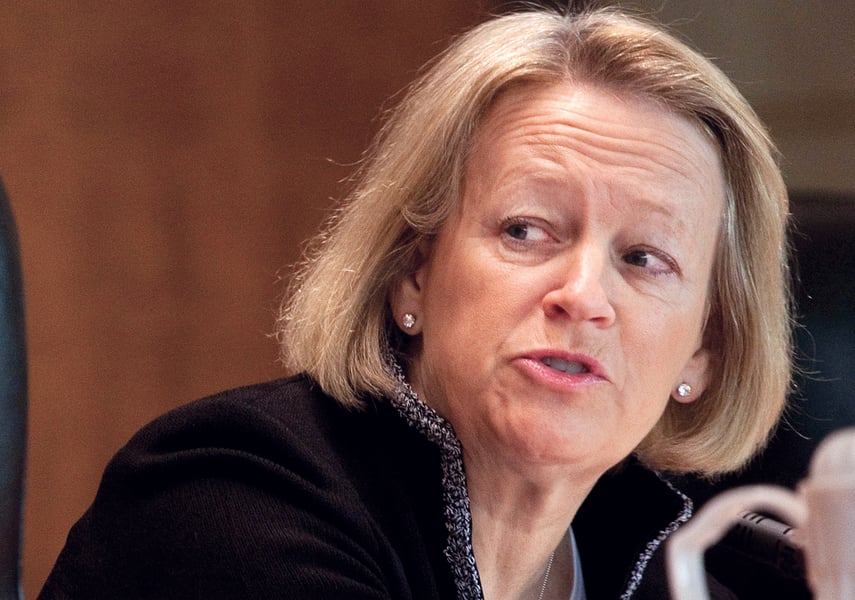
Former SEC Chair Levitt calls her 'bedeviled'; Congressman defends Capitol Hill's constant questioning
Securities and Exchange Commission Chairman Mary Schapiro recently made her 43rd appearance before a congressional committee during her three-year tenure. Over the last 15 months, her visits to Capitol Hill have been especially challenging.
Every time the SEC boss sets foot in a House hearing room, the majority Republicans question her about Dodd-Frank financial law rules, press her on what they say is a poorly functioning agency and look skeptically at her funding requests.
A former SEC chairman says that Ms. Schapiro is running a unique gauntlet.
“I think she's done a fine job under very, very difficult circumstances,” Arthur Levitt Jr., who was SEC chair during the Clinton administration, said on May 1 at the Bloomberg Washington Summit. “She's had constant harassment from appropriators, from congressional overseers, and I wish she had more outspoken support from the administration as well.”
Mr. Levitt got into a tit-for-tat with Rep. Scott Garrett, R-N.J., chairman of the House Financial Services Subcommittee on Capital Markets. Such theatrics, although common on TV talk shows, are still fairly rare for a Washington event.
In his remarks, Mr. Garrett also praised Ms. Schapiro.
“I think she's done an admirable job in the difficult time that she's come into the position,” Mr. Garrett said, adding that she “tends to be responsive” to concerns that he and his GOP colleagues raise.
But Mr. Garrett defended the prerogative of hauling Ms. Schapiro up to Capitol Hill. “It's appropriate that we have her before Congress,” Mr. Garrett said. “That's congressional oversight.”
Before he could finish, Mr. Levitt cut him off.
“I don't think any chair of the SEC has ever faced the problems, the issues, the harassment and the bedevilment that Mary Schapiro has had,” Mr. Levitt said.
Mr. Garrett jumped back in and reiterated, “It's Congress performing its constitutional responsibility.”
The political tension isn't limited to the congressional arena. It also occurs behind the closed doors – and at the open meetings – of the agency. Two prominent examples involve issues important to investment advisers.
First, Ms. Schapiro may not be able to cobble together support from at least three commissioners to approve money-market-fund reform. Observers say that the two Republican commissioners – Troy Paredes and Daniel Gallagher Jr. – will almost certainly oppose it. Ms. Schapiro and Commissioner Elisse Walter would support it, while Commissioner Luis Aguilar is the swing vote.
When Republicans took over the House in January 2011, the Republicans on the Commission asserted themselves on the issue of fiduciary-duty for retail investment advice. Mr. Paredes and then-Commissioner Kathleen Casey dissented from an SEC-staff report recommending that the agency move forward with a rule.
Mr. Paredes and Ms. Casey maintained that the report lacked sufficient economic analysis to support its conclusion, presenting an argument that has been at the heart of GOP attacks on Dodd-Frank rules. The SEC has delayed a universal-fiduciary-duty regulation until after it conducts a cost-benefit analysis.
There's a different atmosphere on the Commission than when Richard Breeden was chair during the George H.W. Bush administration.
“I wouldn't bring anything up unless we had four votes,” Mr. Breeden said on the sidelines of the Bloomberg conference. “I was there at a time when there was less partisanship within the commission. There were no party-line votes.”
To keep the peace on the commission and with Capitol Hill Republicans, Ms. Schapiro has combined being firm with seeking wide-ranging input from industry and investor advocates.
“Mary has always been a sensitive chair,” Mr. Breeden said. “She listens to people. She's good at discussing issues.”