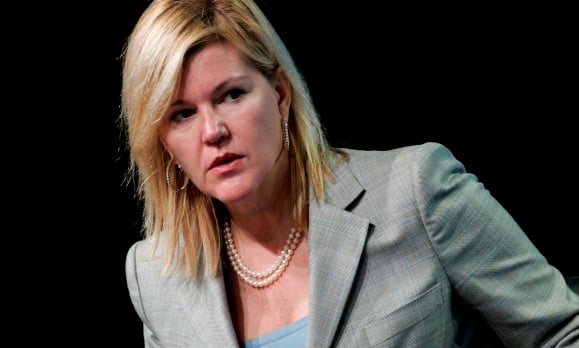

JPMorgan hedges were really prop trades: Meredith Whitney

JPMorgan hedges were really prop trades: Meredith Whitney
Jamie Dimon claims the $2B trading loss at JPMorgan came from a credit hedge that morphed 'into something I can't justify,' but Meredith Whitney insists it was a simple proprietary bet all along.
JUL 03, 2012
JPMorgan Chase & Co.'s $2 billion trading loss stemmed from profit-seeking bets rather than hedges meant to mitigate loan losses, as Chief Executive Officer Jamie Dimon has described them, banking analyst Meredith Whitney said. “It's very hard to argue that what Jamie Dimon is now on the Hill for is a hedge,” Whitney said today in a radio interview with Bloomberg as the bank chief testified at a hearing of the House Financial Services Committee in Washington. “A credit hedge in banking should be a loan-loss provision, plain and simple. Anything else is a proprietary bet.” Dimon has described the loss as stemming from a hedge that “morphed into something I can't justify.” He has publicly opposed the so-called Volcker rule, a Dodd-Frank Act provision meant to limit deposit-taking lenders from making proprietary trades, or bets with their own money. “Of the large banks, JPMorgan has the lowest loan-to-deposit ratio,” said Whitney, CEO of Meredith Whitney Advisory Group LLC. “It didn't frankly seem to bother anyone there because they clearly were making money in this trading book.” Whitney, 42, also disputed Dimon's claim that bank regulation may curb lending. Dimon, 56, confronted Federal Reserve Chairman Ben S. Bernanke at a public forum last year, blaming excessive regulation for slowing the U.S. economic recovery. “It stymies the velocity of money in the system, you have to hold more capital,” Whitney said. “But in terms of lending, absolutely not.” Dimon's performance at a Senate hearing last week went more smoothly than Whitney expected, she said. “I was very surprised because it's a very difficult trade to explain,” she said. “He charms, he's incredible. He gave the senators a massage, they gave him a massage back.” --Bloomberg News--

Latest News

Estate planning becomes a client retention issue for financial advisors, survey finds

Clients are saying they would consider switching advisors if another professional offered estate planning services, according to a new Trust & Will survey.

Candidly adds AI agents for Trump Accounts, workplace benefits

CEO Laurel Taylor says the fintech's composable AI stack helps workers optimize dollars across Trump Accounts, 529s, 401(k)s, and other employee benefits.

BMO adds three advisors in Dallas amid Y'all Street wealth boom

The bank has swiped three private banking veterans from BNY as the city climbs the ranks of America's fastest-growing wealth hubs.

UBS moves toward full-service US bank as plans to extend wealth business

Employee accounts, crypto trials and job cuts frame a pivotal year for the Swiss lender.

$5B broker-dealer NBC Securities has a new name after almost 30 years

New name draws on founder's family history as consolidation reshapes the broker-dealer landscape.

SPONSORED Who builds the income when the pension disappears?

Dan Biagini of American Equity says the steady decline of pensions, longer lifespans and a reset in interest rates are rewriting how advisors build retirement income

SPONSORED Why direct indexing stopped being optional

Direct indexing is on pace to outgrow ETFs and mutual funds. Northern Trust's Ken Lassner explains why the advisors who get it wish they had started sooner.