
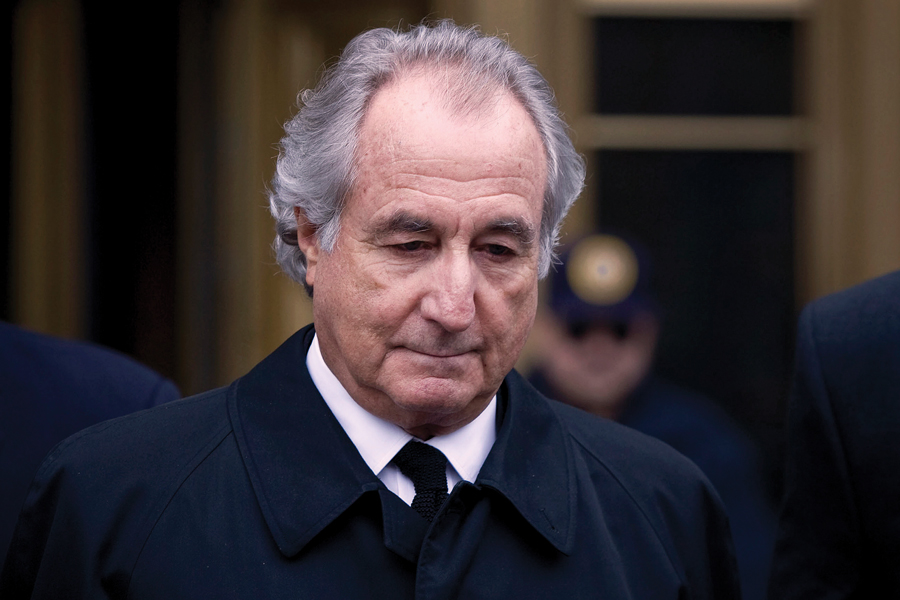
Bernard Madoff, who defrauded investors of more than $19 billion in history’s biggest Ponzi scheme, has asked for early release from his 150-year prison sentence, saying he has 18 months left to live.
Mr. Madoff, 81, asked U.S. Circuit Judge Denny Chin to release him after serving just 10 years, saying he suffers from terminal kidney failure and other ailments.
His lawyer, Brandon Sample, said in a court filing that Mr. Madoff has “chronic kidney failure that has progressed to end-stage renal disease.” Mr. Madoff also suffers from other conditions, including heart disease, high blood pressure, esophageal reflux, insomnia, shortness of breath, back pain, itching, leg cramps and anxiety, according to the filing.
“Madoff humbly asks this court for a modicum of compassion,” Mr. Sample said in papers filed in Manhattan federal court Wednesday.
Early release for Mr. Madoff could outrage many of his victims. Investors lost $19 billion in principal when Mr. Madoff’s securities firm collapsed in December 2008. His victims included thousands of wealthy investors, Jewish charities, celebrities and retirees.
“He showed no remorse whatsoever for what he did, so why should we?” asked Gregg Felsen, a victim of Mr. Madoff who lives in Palm Springs, Calif. “His crime was horrendous.”
Ebbers Released
If granted, an order freeing Mr. Madoff would come on the heels of one granted to former WorldCom Inc. CEO Bernard Ebbers in December for medical reasons. Mr. Ebbers, who was convicted in 2005 of securities fraud following WorldCom’s collapse, served more than 13 years of a 25-year sentence. He died on Feb. 2 at age 78.
Mr. Madoff built a reputation over three decades as a brilliant stock-picker who delivered uncannily steady returns in good markets and bad. But his results were largely fictitious, and he told his family in December 2009 that the business was “all just one big lie.” Mr. Madoff’s two sons turned him in to the Federal Bureau of Investigation. One of his sons later committed suicide while the other died of cancer.
The scheme had unraveled in 2008 when the economic crisis led to more withdrawals than Mr. Madoff could afford to pay out. Some clients learned they lost their life savings after Mr. Madoff’s confession and arrest.
Mr. Chin sentenced him to 150 years behind bars after the con man pleaded guilty in 2009.
“This was not merely a bloodless financial crime that occurred on paper, but one that takes a staggering toll,” Mr. Chin said at the time. “The breach of trust here was massive.”
Robin Swernoff, of Bayside, Wisc., urged Mr. Chin in a 2009 sentencing letter to confine Mr. Madoff for the rest of his life for stealing from so many people, including her mother and father. She hasn’t changed her mind. Ms. Swernoff said she believes the shock exacerbated her father’s health problems.
“He probably died earlier than he would have,” she said. “My mother is down to nothing.”
“I think he should rot in jail until he’s ready to rot in hell,” Ms. Swernoff said.
Commute sentence
In July, Mr. Madoff asked President Donald J. Trump to commute his sentence. At the time, legal experts generally dismissed the possibility that his request would be granted, given the magnitude of his crime.
“While I would never wish dying in jail on anyone, it is hard to imagine a less sympathetic nonviolent offender than Bernard Madoff,” said Matthew L. Schwartz, a former federal prosecutor on the con man’s case who’s now at Boies Schiller Flexner. “His tens of thousands of victims still continue to feel the profound and devastating harm from his decades-long fraud to this day.”
A trustee appointed to recover money for Madoff’s victims says that as of Jan. 24, they’ve been repaid some $12.9 billion.
Mr. Madoff is seeking early release under the 2018 First Step Act, which allows some federal inmates who are over 60 years old, or who face terminal illnesses, to serve the end of their sentences at home. Mr. Ebbers was released under the same law.
In July, Raj Rajaratnam, co-founder of Galleon Group and the mastermind of what prosecutors said was one of the largest hedge-fund insider trading rings in U.S. history, was released two years early under the First Step law. Mr. Rajaratnam, 62, served nine years in prison.
Mr. Madoff is serving his time at a federal medical center in Butner, N.C.

House-passed measure would let fraud victims deduct losses and waive early-withdrawal penalties on stolen retirement funds.

Anthropic's Enterprise plan offers advisors stronger data controls — but smaller RIAs may struggle with the cost.

Partnership with DPL adds Jackson and Protective to insurance marketplace as fee-based annuities gain traction with fiduciary advisors.

Morgan Stanley is one of the leading wealth management companies in the country.

South Carolina and Bay Area advisory teams join the WPCG-backed national platform as RIA dealmaking hits new highs.
Northern Trust’s Ken Lassner shows advisors how to convert volatility into after-tax portfolio gains
Dan Biagini of American Equity says the steady decline of pensions, longer lifespans and a reset in interest rates are rewriting how advisors build retirement income

