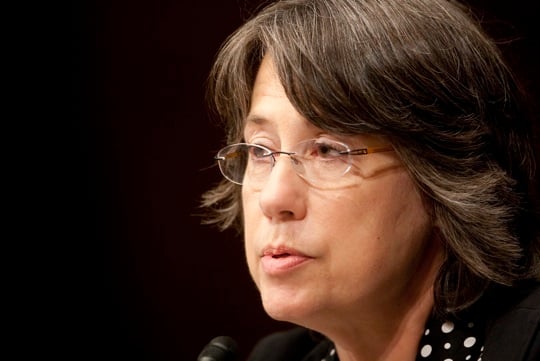
Federal Deposit Insurance Corp. Chairman Sheila Bair called money-market mutual funds “destabilizing” to the financial system and said investors would be served just as well if share prices floated.
“Money-market funds are maintaining a fiction of a stable” net-asset value, as shown by the September 2008 failure of the $62.5 billion Reserve Primary Fund, Bair said yesterday at a round-table meeting of fund-company executives and regulators arranged by the U.S. Securities and Exchange Commission in Washington. “That is skewing investment dollars into a structure that is highly unstable in a crisis.”
Former
Federal Reserve Chairman Paul A. Volcker called a floating share price the “simplest” solution to the risk posed by money funds, which trade at a constant $1 a share.
Their remarks lent support to proposals fund executives have said may ruin the product's appeal to investors, and its role as the biggest collective provider of short-term financing for U.S. corporations through the commercial-paper market. Calls to make funds safer began after Reserve Primary's collapse helped freeze global credit markets. The SEC, after passing rules last year that made funds more liquid and more transparent, is considering whether further changes are needed.
Representatives of
Fidelity Investments, JPMorgan Chase & Co. and Federated Investors Inc., the three biggest money-fund providers, defended the business as popular among investors and crucial to the financing of U.S. companies and municipalities.
Capital Requirements
The industry has said bank-like regulations, including capital requirements or forcing funds to abandon their stable $1 share price, would destroy their appeal to customers while failing to prevent runs.
Money funds book their holdings based on their value at maturity and round to the nearest cent, allowing customers to buy and sell shares at $1. Returns are distributed monthly in cash or new shares.
Reserve Primary suffered a loss, initially set at 3 percent of assets, on debt issued by bankrupt Lehman Brothers Holdings Inc., causing the fund to close on Sept. 16, 2008, and denying shareholders access to most of their cash for months as it liquidated.
Investors, fearing that other funds might “break the buck,” withdrew $230 billion from the industry by Sept. 19 in a run that threatened to cripple issuers of short-term debt.
Volcker has previously said the stable share price creates an incentive for investors to flee at the first sign of trouble.
Preventing Panic
The government in 2008 “had to run from one extreme action and safeguard to another” to prevent additional money-fund failures amid the panic, Volcker said at yesterday's meeting.
“What is the public good that makes it worthwhile to run such a big risk?” he said.
The run on money funds that followed Reserve Primary's collapse abated only after the Treasury Department guaranteed shareholders against losses and the Federal Reserve loaned money to purchase fund holdings at face value.
Robert Brown, head of Boston-based Fidelity's money-market fund group, said rules already enacted by the SEC had made the industry better prepared to handle a run by investors. The changes forced funds to hold more in securities easily convertible to cash and to reveal more about their holdings.
“There is a great danger in looking at all sorts of mechanisms for reinventing the money-market fund business,” said John D. Hawke, of Washington law firm Arnold & Porter LLC, who represented Pittsburgh's Federated. “The danger is that people who find money-market funds extremely useful will be denied the usefulness of those funds.”
Government ‘Subsidy'
The regulators at the forum examined two industry proposals for backing money funds with emergency liquidity. A plan put forward by the Investment Company Institute, the mutual-fund industry's Washington-based trade group, was criticized for its provision that in a crisis funds should enjoy access to the Fed's discount borrowing window.
“You are in effect asking for some kind of subsidy to be transferred from the federal government to the corporate sector and this is a distorting thing,” said Paul Tucker, deputy governor of the Bank of England.
U.S. Treasury Undersecretary Jeffrey A. Goldstein questioned whether the proposed facility's size, $24 billion after 10 years, would be “even close to enough.”
Goldstein was one of six present representing the Financial Stability Oversight Council, the regulatory panel charged with addressing companies and activities that can endanger the U.S. economy. The council was created by last year's Dodd-Frank Act.