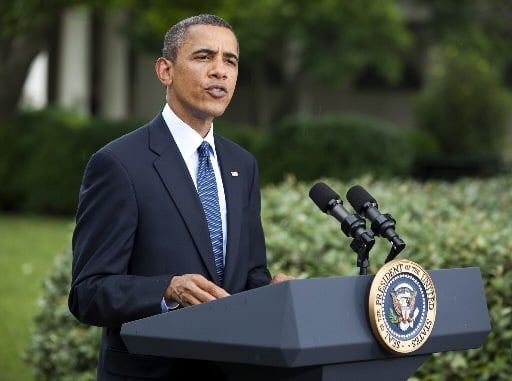
The $3.8 trillion budget that President Barack Obama proposed today for 2013 would hoist $1.4 trillion in new tax burdens squarely onto the shoulders of wealthy Americans.
In perhaps the most surprising element of the proposal, dividends paid by high-income Americans would be taxed as ordinary income, boosting the rate paid to 39.6% from a current rate of 15%.
The higher rates would apply to couples making $250,000 or more and individuals making $200,000 or more.
Originally, the president had supported continuing to tax dividends at a favorable rate, but administration officials said Mr. Obama decided the nation couldn't afford to do so any longer.
“We don't need to be providing additional tax cuts for folks who are doing really, really, really well,” Obama said today in a speech at Northern Virginia Community College.
Before 2003, dividends were taxed as ordinary income.
Not surprisingly, Republicans in Congress immediately criticized the president's budget and predicted failure for the tax increases wanted by the White House. House Speaker John Boehner, R-Ohio, said the president's budget would be bad for the economy and suggested older Americans' retirement security could be hurt.
“The budget also does nothing to protect and preserve important safety net programs for America's seniors,” Mr. Boehner said. “The greatest threat to American's retirement security is the status quo and the president has offered seniors nothing more with this budget,” he said.
The change in
dividend taxation would raise $206.4 billion over a decade, according to the administration, which has said the wealthy need to pay more to help the nation control its deficit and spur economic growth.
The president's proposal would end the Bush era tax cuts and limit tax deductions to 28% for wealthy Americans, again defined as those couples earning $250,000 and individuals making at least $200,000. Those in the top marginal tax bracket can get a benefit of as much as 35% from such deductions because that's the rate they would otherwise pay on their highest earnings.
The Philanthropy Roundtable criticized the president's proposal for limiting deductions, including those for
charitable giving.
“The President is sending mixed messages to the charitable community,” said Sue Santa, senior vice president of the group. “On one hand, he wants to limit the charitable deduction. On the other, wants millionaires to continue to give to charity while also paying higher taxes.”
These high-income earners already were set to take a hit in next year when a provision of the 2010 health care law kicks in that will tax their unearned income at 3.8%.
The administration's proposed budget also would boost the top
capital gains tax rate to 20% from today's top rate of 15% and the income tax rate would max out at 39.6% in 2013, an increase from 35%. As expected, the plan also would tax private-equity managers' profits-based compensation at ordinary income rates instead of the 15% current capital gains rate.
The president's proposal would make permanent the estate and gift tax parameters that were in place in 2009, with the top tax rate being 45%. It would incorporate a $3.5 million exclusion for estate taxes and $1 million exclusion for gift taxes. Both exclusions are set at $5 million for 2011 and 2012 as part of a compromise hammered out between Congressional Republicans and the president in the waning days of 2010, the last time the Bush-era taxes were set to expire.
The president's budget also suggests a “Buffett rule,” that would set a 30% minimum tax for individuals with $1 million or more of annual income, a proposal that's been discussed since last year after billionaire Warren E. Buffett said the wealthy weren't paying enough in taxes. That tax would replace the alternative minimum tax, which the White House contends hits the middle class instead of its goal of keeping the richest Americans from paying too little.
With Republicans in control of the House and the party wielding significant influence in the Senate with 47 members, it's unlikely that Mr. Obama's budget will make it out of Congress. The House GOP will introduce a competing plan in the coming weeks.
Brian Gardner, senior vice president of Washington research at Keefe, Bruyette & Woods, said many of these proposal are just repeats of old ideas that haven't gone anywhere.
Nothing will happen on these tax proposals at least until after 2012 presidential election, he said. The only opportunity may be in November and December as Congress faces the expiration of the 2001 and 2003 Bush-era tax cuts in 2013, these issues could get some consideration.
“These rates will all go up if the Bush tax cuts expire,” said Brian Gardner. “All this will be flushed out in the fall and early winter.”
--Bloomberg News contributed to this story--