

Pressure is increasing on managers of ESG-labeled investment funds to show they’re being truthful with customers about what they’re selling.
The heat was really turned up last week when the Securities and Exchange Commission and BaFin, Germany’s financial regulator, initiated a probe into allegations that Deutsche Bank’s DWS Group asset management arm has been misstating the environmental — and possibly the social — credentials of some of its ESG-labeled investment products. Regulators have signaled the review is at an early stage, and DWS has rejected claims it overstated ESG assets.
Since then, researchers have raised questions about the credentials of money managers who claim they are marketing funds designed to address the climate crisis and social injustice.
A London-based nonprofit called InfluenceMap said more than half of climate-themed funds are failing to live up to the goals of the Paris Agreement. Christiana Figueres, former executive secretary of the United Nations Framework Convention on Climate Change, said the world’s sovereign wealth funds will be on the wrong side of history if they cling to strategies that don’t acknowledge how rapidly the planet is warming. Figueres didn’t accuse wealth funds of greenwashing, but she bemoaned what she said was the industry’s failure to embrace strategies that commit to a lower carbon footprint.
The timing of these comments is troubling for an industry that has ballooned to $35 trillion of assets, with many money managers betting that investors will keep pouring more money into funds marketed as adhering to the best environmental, social and governance principles.
Marketed being the key word. The reality, however, is quite different. InfluenceMap found that 55% of funds marketed as low carbon, fossil-fuel free and green energy exaggerated their environmental claims, and more than 70% of funds promising ESG goals fell short of their targets.
“As the number of ESG and climate-themed funds has exploded in recent years, so too have concerns among investors and regulators about greenwashing and transparency,” said Daan Van Acker, an analyst at InfluenceMap.
The SEC formed a task force in March aimed at investigating potential misconduct related to companies’ sustainability claims. Gary Gensler, who took over the agency in April, has said his staff is working on a rule to boost climate disclosures by stock issuers, and that the regulator remains focused on ESG issues.
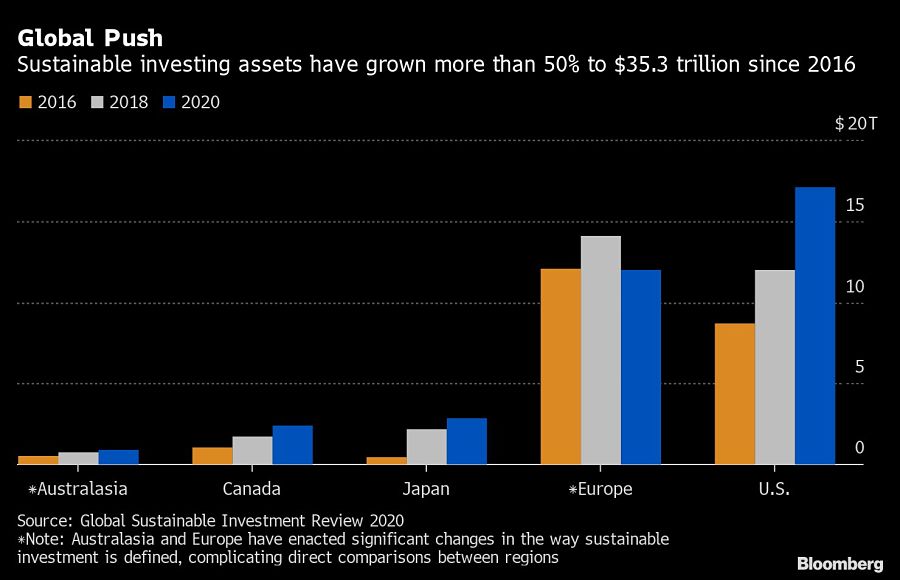
In a recent report, the Global Sustainable Investment Alliance erased $2 trillion from the European market for sustainable investments after anti-greenwashing rules were introduced in March by the European Union.
The Sustainable Finance Disclosure Regulation, or SFDR, demands that fund managers evaluate and disclose the ESG features of their financial products. For ESG, there are now “light green” Article 8 funds, which are defined as those that actively promote environmental or social characteristics, and “dark green” Article 9 funds, which have sustainable investment as their main objective. Both groupings are subject to higher standards of disclosure under the SFDR.
There aren’t yet similar requirements in the U.S., so it’s uncertain how many true-green ESG funds there really are. At the end of 2020, sustainable assets totaled about $12 trillion (after GSIA’s decision) in Europe, compared with closer to $17 trillion in the U.S.
Given the shrinkage in Europe, the U.S. figure may see a similar reduction when more regulatory rigor is brought to bear.

Richardson firm joins as Kestra builds out its platform with new leadership, technology, and expanded planning tools.

Retiring RIA seller David Laidlaw alleges the Carnegie valued his stake on $11.7 million EBITA while pitching potential buyers on $21.3 million.

New tool gives RIAs and family offices AI help vetting private market deals, with some users reportedly halving review time.

Investors got projected returns dressed up as real ones, SEC says

Parents must still act to get the $1,000 federal seed and employer contributions, giving financial advisors a role in the rollout.
As AI makes financial information more accessible than ever, Lana Hock explains why human judgment, trust, and empathy remain the qualities clients value most in a financial advisor
Northern Trust’s Ken Lassner shows advisors how to convert volatility into after-tax portfolio gains

