
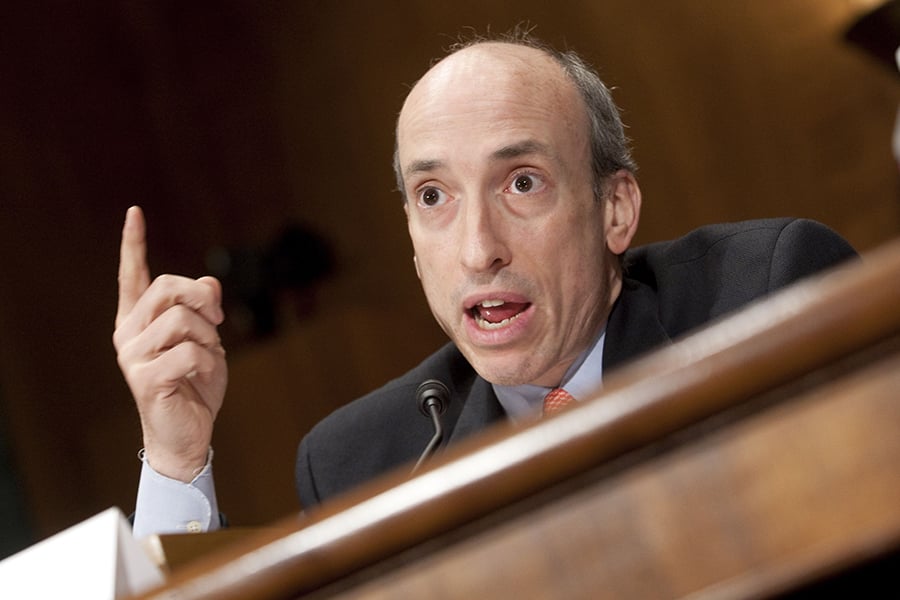
Securities and Exchange Commission Chairman Gary Gensler took to social media Tuesday to promote increased disclosure of climate risk by public companies.
In a thread on Twitter, Gensler briefly outlined the directive he’s given to agency staff to draft by the end of the year a proposal that would make climate reporting mandatory. Currently, firms that report how climate change affects their operations and finances do so voluntarily.
Gensler established a Twitter account July 26. His climate-risk tweets were among the first 30 he has posted, and he appears to be the first SEC leader to use social media to advocate for a rulemaking.
As he did in a speech last week, Gensler referred to the recent Olympic Games in Tokyo to support his argument that the time has come to require companies to provide more information to investors about climate risk and other environmental social and governance factors.
He said that judges for Olympic events use metrics to measure an athlete’s performance. He added that the sports included in the Olympics change over time because of public demand.
“I think that’s a good analogy for public company disclosure,” Gensler posted on Twitter. “With climate risk disclosures, investors are asking regulators for more. ... It’s now time for the Commission to take the baton.”
Gensler said he supports “consistent and comparable” disclosures. He also said he asked SEC staff to develop recommendations about greenhouse gas emissions disclosures and whether there should be specific metrics for different industries, such as banking, insurance or transportation.
In the last Tweet, he refers followers to his July 28 speech at an online event sponsored Principles for Responsible Investment. Most of the language in the Tweets is repurposed from those remarks.
The push for increased ESG disclosures — by Gensler and the other two SEC Democratic commissioners Allison Herren Lee and Caroline Crenshaw — has drawn resistance from SEC Republican Commissioners Hester Peirce and Elad Roisman. They have expressed concerns about whether ESG disclosures are material to financial results and whether the SEC is acting outside its authority in mandating them.
Peirce, who has been on Twitter since 2012, has become more prolific in the last few months. She welcomed Gensler to the social media platform the day he joined.

Retiring RIA seller David Laidlaw alleges the Carnegie valued his stake on $11.7 million EBITA while pitching potential buyers on $21.3 million.

New tool gives RIAs and family offices AI help vetting private market deals, with some users reportedly halving review time.

Investors got projected returns dressed up as real ones, SEC says

Parents must still act to get the $1,000 federal seed and employer contributions, giving financial advisors a role in the rollout.

FINRA booted Rudy Anguiano from the industry for “conversion - the intentional and unauthorized taking of another person’s property.”
As AI makes financial information more accessible than ever, Lana Hock explains why human judgment, trust, and empathy remain the qualities clients value most in a financial advisor
Northern Trust’s Ken Lassner shows advisors how to convert volatility into after-tax portfolio gains

