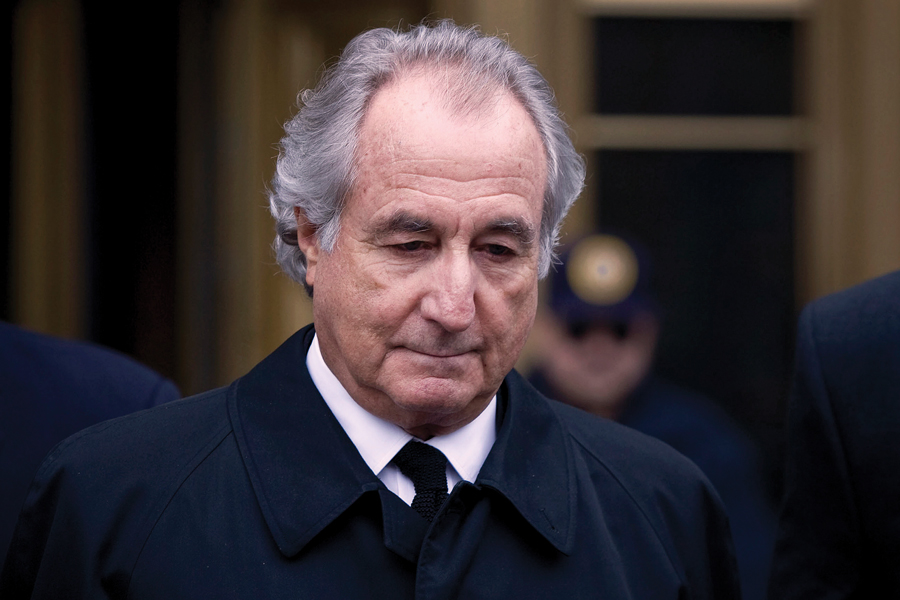
Ten years ago this December, Bernard Madoff, known as a "broker's broker" to many on Wall Street, told his sons that his business was one big, $65 billion lie.
It turned out that Mr. Madoff wasn't the only financial adviser stealing from clients. In the following months, a wave of fraud involving financial advisers and brokers came to light. In February 2009, Allen Stanford, sitting atop a network of brokers, was charged with running a massive, $7 billion fraud based on phony certificates of deposit.
In 2010,
InvestmentNews identified Ponzi schemes with more than $9.2 billion in losses. The charges of shocking frauds and Ponzis gradually died down, but not before harming countless investors and wiping out their life savings.
Jump ahead to August 2017. The Department of Justice filed criminal charges against Dawn Bennett, with parallel charges by the Securities and Exchange Commission, alleging that she and her retail sports apparel business sold a fraudulent unregistered securities offering that raised more than $20 million from at least 46 investors from December 2014 to July 2017.
At the time, this column asked whether Ms. Bennett's Ponzi, a strange scheme with overtones of the occult and voodoo, was a one-off, or did it signal something more pernicious. Last week, Ms. Bennett was convicted in federal court in Maryland of 17 charges, including a Ponzi scheme.
In the 14 months since those charges, frauds involving financial advisers have blossomed. For almost five years, the SEC said last December that the Woodbridge Group of Companies operated a billion-dollar Ponzi scheme, taking advantage of 8,400 investors, many of them elderly.
On behalf of Woodbridge, hundreds of insurance agents and brokers, some with checkered careers in the securities industry, sold notes supposedly backed up by mortgages, which the SEC last month claimed were the foundation of a massive, $1.2 billion Ponzi.
The SEC and the U.S. Attorney's office in July said they were investigating an alleged fraud called 1 Global Capital, a company that raised $283 million from investors to make short-term business loans. The money was raised, at least in part, through a network of unregistered brokers and financial advisers.
The SEC opened its investigation into the company's activities related to alleged securities laws violations, "including the alleged offer and sale of unregistered securities," and "the alleged sale of securities by unregistered brokers," according to a court filing.
(Please note, the 1 Global Capital loan business is a separate, unrelated company from 1st Global Capital Corp., an independent broker-dealer based in Dallas.)
While none of the schemes are of the magnitude of Madoff's massive Ponzi, big time fraud involving financial advisers is back. The potential harm to investors is mounting, as is the potential reputational risk to all financial advisers.
The schemes typically pitch investors a presumably safe or secured investment with fixed, steady returns and low risk. Ms. Bennett, for example, was pitching out-sized returns of 15% on clients' money, telling them that investing in her sportswear company was low risk, according to the SEC and FBI.
And state securities regulators have seen a recent surge in cases involving unregistered advisers, or the kinds that sold Woodbridge promissory notes.
"This year's enforcement survey reflects a large increase in enforcement actions against unregistered individuals and firms," according to a report this month from the North American Securities Administrators Association. Members of the group reported actions in 2017 against 675 unregistered individuals and firms — an increase of 24% over the prior year — and 647 registered individuals and firms — a 9% percent increase.
"The surge in cases against unregistered actors reversed a two-year trend in which registered individuals and firms in the securities industry, broker-dealers and investment advisers, had constituted the majority of respondents in state enforcement actions," according to NASAA.
"A lot of the scamsters are getting a lot smarter," said Joe Borg, director, Alabama Securities Commission. "For example, if you asked me 10 years ago, do you have a problem with lawyers, I would have said no. Now, there are a slew of cases where lawyers are roped in by the crooks. They recruit the attorney to open an LLC or create an operating agreement."
"Scams are based on
trust," Mr. Borg said. "If you bring in lawyers or accountants, it gives the scheme the look of respectability."
A surge in unregistered advisers? Smarter scam artists?
The financial advice industry should brace itself for what could very well prove to be a turbulent time ahead.