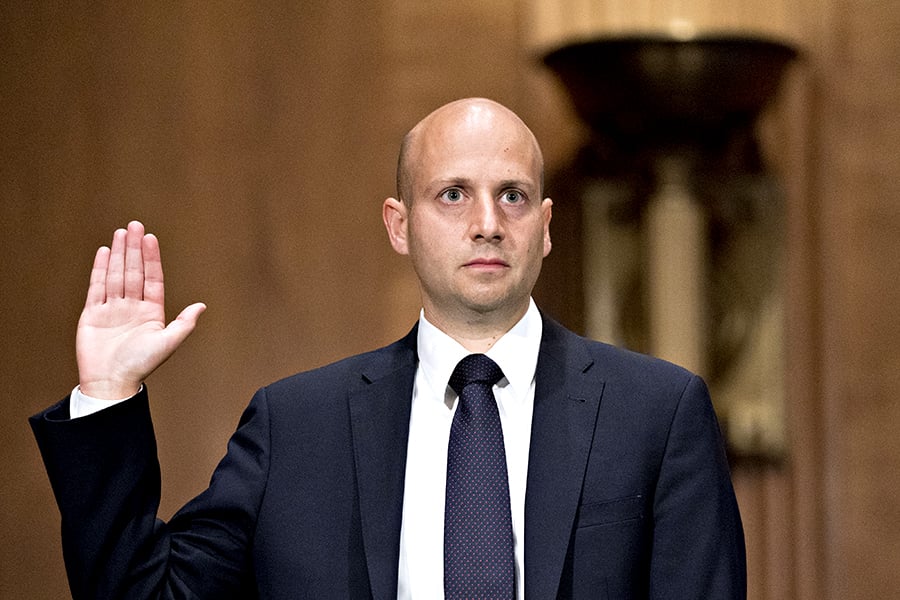
Securities and Exchange Commission nominee Elad Roisman avoided taking a position on the agency's investment advice reform proposal Tuesday and stressed the importance of disclosure when pressed by Democratic senators on advice standards.
In an appearance
before the Senate Banking Committee, Mr. Roisman — tapped by the Trump administration to become a Republican SEC member — said that he would keep an open mind about the advice proposal, which was introduced in April and is open for public comment until Aug. 7.
Without evaluating the recommendations, which include requiring brokers to act in the best interests of their clients, he said that it was important to consider whether a new standard would preserve investor access to advice and illuminate details of their adviser relationship.
Sen. Elizabeth Warren, D-Mass., asserted that the SEC proposal did too little to rein in broker conflicts of interest and pressed Mr. Roisman for his general position on conflicts.
"It's important for [investors] to have adequate disclosure and understand the nature of their relationship, including how conflicts of interest exist and how they can be addressed," Mr. Roisman replied.
Ms. Warren wasn't satisfied with that answer.
"Why should you be able to get a kickback from a [financial] company for recommending a particular product that's not the best product for you?" she asked Mr. Roisman, who currently serves as chief counsel for the Senate banking panel.
Mr. Roisman trod cautiously. "I would have concerns if someone is providing you a product that incentivizes themselves over a customer," he said.
Ms. Warren shot back: "You would be concerned. So do you think sometimes they should be able to do it and sometimes not?"
"I'd like to speak to the people who may receive advice as well as provide it to have a better sense of what is actually happening in the space," Mr. Roisman replied.
Ms. Warren asserted that investors are losing $17 billion a year as a result of conflicted advice, a number that the Obama administration used to support the Labor Department's fiduciary rule for retirement accounts.
Mr. Roisman wanted to avoid throwing all financial advisers under the bus.
"The amount of people doing wrong is small," he said. "We want to get them out, but it's not an entire industry."
The exchange illustrated that Mr. Roisman will likely align with current and previous Republican SEC commissioners on advice reform. He was counsel to former Republican SEC member Daniel Gallagher.
The back-and-forth with Ms. Warren also highlighted that Democrats would have liked the SEC to propose a uniform fiduciary standard for retail investment advice, subjecting brokers, who currently adhere to the suitability rule, to the same standard as investment advisers.
SEC Chairman Jay Clayton maintains that the SEC's proposal would raise broker advice standards.
Republicans at the hearing criticized the now dead DOL rule and essentially raised it as a cautionary tale for the SEC's efforts.
"The fiduciary rule made it very, very expensive for these individuals with small sums, yet very important sums, to be able to get access to the equity markets," said Sen. Mike Rounds, R-S.D.
If confirmed, Mr. Roisman would replace Republican SEC Commissioner Michael Piwowar, who departed earlier this month. It's not clear whether the Senate will vote on his nomination before it receives a Democratic nominee to take the spot of commissioner Kara Stein, who must leave the SEC by December.
In other testimony before the committee, Mr. Roisman said that is important for the SEC to have a strong enforcement program to fight the "perception that markets are rigged against the little guy."
As is typical at confirmation hearings, Mr. Roisman, 37, highlighted his family background. Both of his parents are immigrants.
"My parents did not have much when they came here," he said. "But what they did have was confidence — confidence in America and confidence in a financial system that would enable them to save and invest so that they could raise their family and help provide for their children's education."