
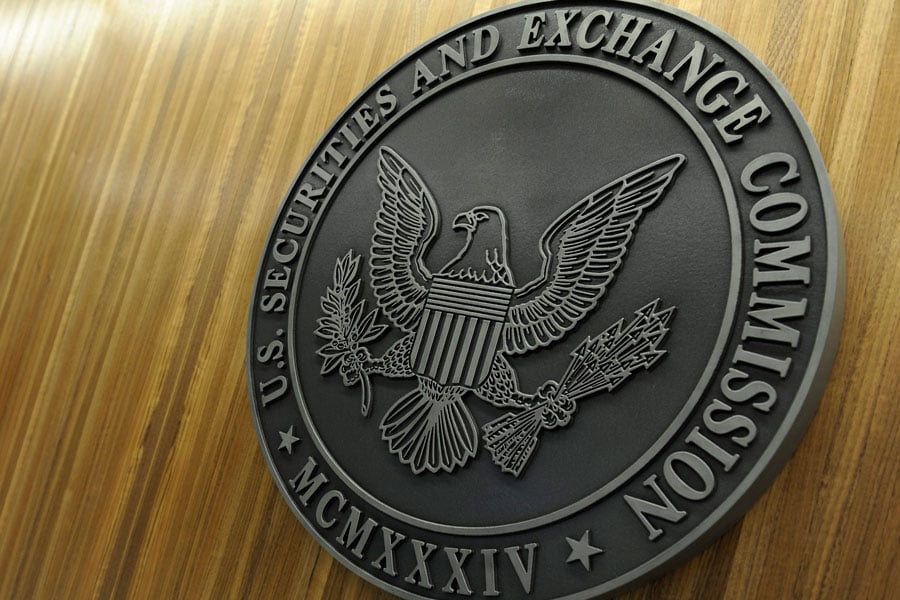
The Securities and Exchange Commission won't bring charges against BlackRock, Vanguard or State Street over their role in the 2021 shareholder revolt at ExxonMobil, but it warned the biggest index-fund managers that coordinated pressure campaigns could cost them their standing as passive investors.
The agency released its findings Wednesday after a roughly yearlong probe into the episode, according to multiple news outlets.
The SEC issued a formal report of investigation under Section 21(a) of the Securities Exchange Act of 1934, covering Climate Action 100+ and the election of directors at Exxon's fateful May 2021 annual meeting.
In it, the SEC said it "has serious concerns about the conduct" of some fund managers that belonged to Climate Action 100+. The coalition, also known as CA100+, is an investor group focused on climate risk. It backed activist hedge fund Engine No. 1 in its successful campaign to replace three Exxon directors.
The regulator told large investors to review their reporting obligations before the 2027 proxy season, when most large public companies hold annual meetings and shareholders have their opportunity to make consequential votes.
For the three managers, the outcome is only a partial win. As reported by Reuters and elsewhere, they were able to avoid enforcement actions that could have carried financial penalties. In place of charges, the commission used a report of investigation, a tool it rarely deploys, to set out how it views similar conduct in the future.
"It appears to us the players on the field came very close to not being passive — instead of being eligible to report their shares on 13G," an SEC official told the Financial Times. The official added that the report "encapsulates our findings after one year." He also called it "instructional guidance to the marketplace."
The stakes are mainly about paperwork, but that paperwork is onerous. Investors who own more than 5% of a company and have no intention of influencing control can disclose their stakes on Schedule 13G, a short form. Investors who seek to change or influence control must file the longer Schedule 13D, which carries much heavier ongoing disclosure.
BlackRock, Vanguard and State Street typically rank among the largest shareholders of S&P 500 companies, making 13G central to how they operate.
"Membership in an organization whose stated purpose is to change or influence control of a specific issuer by promoting the election of dissident directors or otherwise could be a factor in the loss of eligibility" to file the shorter form, the SEC report said.
The guidance builds on a February 2025 move by the SEC to tighten its interpretation of 13G eligibility for managers that press companies on environmental and social issues. BlackRock and Vanguard responded by temporarily scaling back company meetings. Last month, the SEC clarified that routine engagement would not trigger that 2025 guidance.
In a statement reported by Reuters, Jim Moloney, director of the SEC's Division of Corporation Finance, said the report "reminds asset managers and investors of their responsibilities with respect to shareholder engagement, especially in the context of organized efforts that follow a playbook similar to that of Climate Action 100+. Shareholders have the right to express their views on a particular topic and explain their voting decisions."
The report is the latest step by the Trump administration and SEC Chairman Paul Atkins to reduce shareholder influence over public companies, including the sway of proxy advisers and large passive managers. Following former commissioner Hester Peirce's resignation from the agency this month – sped up from previous reports that she'd be departing for the academia in November – the commission currently has only two members, both Republicans.
The SEC has been trudging along a path of broad deregulation ever since the premature departure of Former Chair Gary Gensler. Under Atkins, the agency has pushed to ease the reporting burden on corporations, with a proposal to let public companies report results semi-annually instead of quarterly.
Last month, the commission proposed to eliminate a pay-to-play rule that has barred investment advisors from receiving compensation from government clients for two years after making certain political contributions. The regulator also proposed ending its oversight of shareholder proposals and handing that authority to the states.
Republicans and business groups have targeted the three managers since the 2021 Exxon vote, arguing their campaigns to promote sustainability were effectively an abuse of market power. BlackRock joined CA100+ in 2020 and largely stepped back in early 2024, citing legal considerations; State Street left at the same time. Vanguard never joined CA100+, but in 2022 it was the first of the three to exit a separate industry climate alliance.
A 2024 report from a Republican-led congressional committee found that BlackRock and State Street had been wary of joining CA100+ because of antitrust and reputational concerns. The SEC's report adds detail on how some pension-fund members of the coalition pushed the asset managers to take tougher positions.
Michael Boudett, general counsel of the sustainability nonprofit Ceres, which helps run CA100+, defended the coalition.
"Climate Action 100+ has always operated within US securities law. It supports investors as they assess and address the financial risks that climate poses to the companies they invest in. It is up to every participating Climate Action 100+ investor to make their own decisions, including how they vote their shares," he said in a statement.
Ann Lipton, a law professor at the University of Colorado, said the 13D requirement would force large managers to disclose every trade in a company's shares over 60 days. That would be a heavy burden for firms running many funds that trade frequently.
"Applying the activist rules to their conduct provides no additional information to the public; it merely uses the threat of paperwork to inhibit shareholder engagements," Lipton told the Times.
"It's rather ironic that this SEC is proposing to rescind the shareholder proposal rule on the ground that corporate governance should be left to the states, while simultaneously invoking bureaucratic red tape at the federal level," she added.

Advisors say record balances aren't a retirement income plan and urge clients to benchmark their lives, not an index

Wealth enterprises are leaving revenue on the table - a new PureFacts and Ascentix partnership aims to help firms take it back.

What if one investment decision could create tax-saving opportunities across your entire portfolio? Chris Vizzi shares how the Stacking Strategy helps investors align tax planning, portfolio construction, and wealth preservation to maximize long-term outcomes while keeping more of what they earn.

Buyers spending on AI may treat less efficient sellers as overstaffed and price the cost of rightsizing into lower offers
Kenneth Leech pleaded guilty in June to one obstruction charge, and could face six to 12 months in prison.
Knighthead Life entered the market with a competitive MYGA. A strong launch earned advisor confidence and paved the way for FIAs.
As AI makes financial information more accessible than ever, Lana Hock explains why human judgment, trust, and empathy remain the qualities clients value most in a financial advisor

