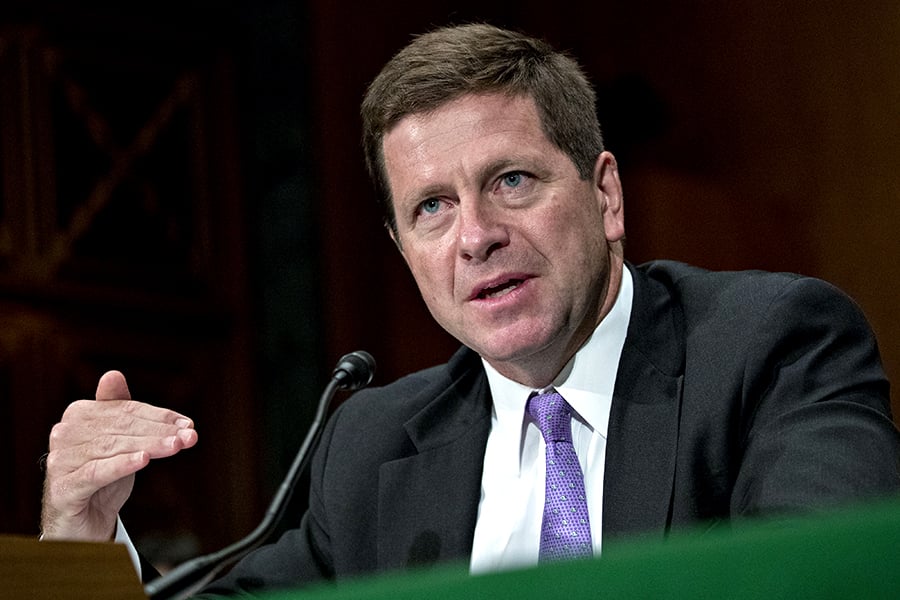
When Securities and Exchange Commission chairman Jay Clayton asserted at a congressional hearing last week that investment advisers can "contract around" their obligation to act in a client's best interests, it caused some head scratching in the adviser community.
In response to being pressed by Sen. Elizabeth Warren, D-Mass., about the SEC's investment advice reform proposal, Mr. Clayton said: "Advisers are allowed to contract around this standard; it's not well known. This is something we want people to understand."
The exchange was truncated due to the five-minute limit on questions during the Dec. 11 session of the Senate Banking Committee.
Over the past week, some adviser advocates have had trouble squaring what Mr. Clayton said with a line in the
interpretation of the adviser standard of conduct contained in the SEC advice proposal.
"[T]he investment adviser cannot disclose or negotiate away, and the investor cannot waive, the federal fiduciary duty," the interpretation states.
Dalia Blass, director of the SEC Division of Investment Management, on Wednesday elaborated on Mr. Clayton's brief Capitol Hill comments.
"Although the investment adviser fiduciary duty is not waivable, it is long established that the terms of the investment adviser relationship — and therefore the scope of the investment adviser's fiduciary duty — may be shaped by disclosure and informed consent," Ms. Blass said in a statement to
InvestmentNews. "This process, including through account agreements and Form ADV, is widely accepted in the industry and provides for arrangements such as limited account services and certain third-party compensation to the investment adviser. The Commission's interpretation, if adopted, will bring greater clarity to these arrangements."
In other words, an adviser and client can contour a relationship in a contract by specifying the services an adviser will provide and outlining potential conflicts of interest.
"This is a very complex area," said Arthur Laby, professor of law at Rutgers University. "It's rather nuanced."
For instance, an adviser and client can agree that the adviser is providing one-time advice.
"If the contract is clear about that, the adviser is not obligated to monitor the account on an ongoing basis," Mr. Laby said.
Highlighting conflicts of interest can get tricky. For instance, what if the adviser discloses that she intends to invest client funds in a business run by her spouse?
"This is complicated," Mr. Laby said. "One person might say the adviser, through disclosure, is contracting away the fiduciary duty, which does not allow conflicted advice. Another might say the adviser is abiding by the fiduciary duty, which requires disclosure of conflicts. So, if the adviser makes disclosure, the duty is satisfied."
Knut Rostad, president of the Institute for the Fiduciary Standard, expressed concern that in its enforcement of fiduciary duty, the SEC is "dumbing fiduciary down" by cracking down on advisers for disclosure failures instead of failures to act in a client's best interests.
"It's the advice, for gosh sakes, not the disclosure" that's important, Mr. Rostad said. "The SEC has to provide guidance on what constitutes real informed consent."
The heart of the SEC's proposal is the so-called
Regulation Best Interest, which would require brokers to emphasize their clients' well-being over their own compensation.
The SEC asserts such a standard would be a step up from the current suitability rule that governs brokers. Under the SEC proposal, advisers would continue to adhere to fiduciary duty and be regulated separately from brokers.