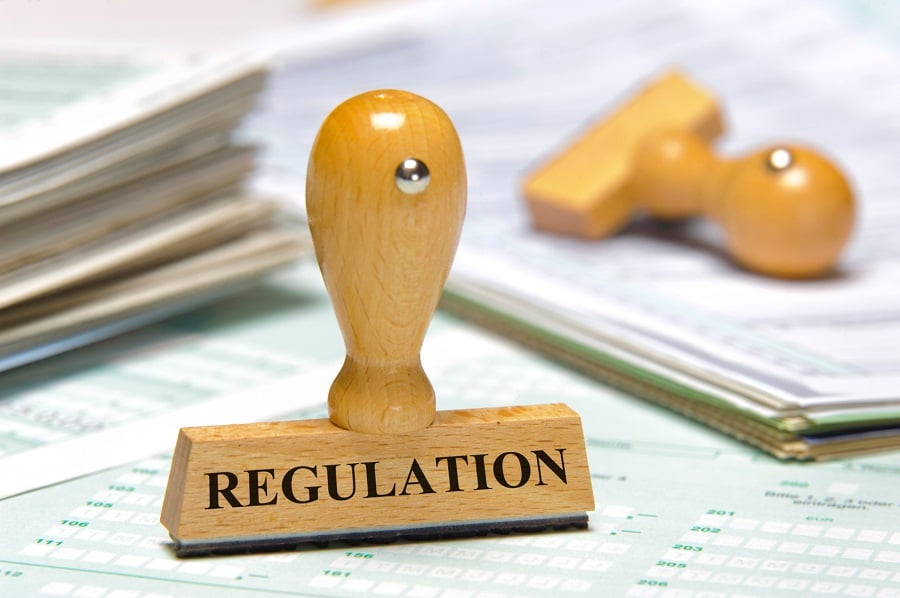
State securities regulators are skeptical of the idea of loosening rules surrounding unregistered securities to allow ordinary investors to buy them.
Earlier this year, the Securities and Exchange Commission
issued a concept release focused on simplifying and harmonizing regulations on the sale of nonpublic investments, or private placements. Under current rules, individuals need to meet certain income and wealth thresholds to make such purchases.
Allowing more investors the opportunity to get in on the ground floor of startup companies and giving
retirement savers access to private funds has been a recurring theme for SEC Chairman Jay Clayton.
But state regulators say they want to see more data about the private markets and the risks they pose to investors.
Christopher Gerold, chief of the New Jersey Securities Bureau, raised concerns about private securities at the North American Securities Administrators Association's annual conference in Austin, Texas, earlier this week.
In his inaugural speech as
the new NASAA president, Mr. Gerold said many private offerings "are low-quality investments with high commission costs with far less transparency" than securities sold on public markets.
"The expansion of avenues for capital formation must not come at the expense of investor protection," he said.
In an interview, Mr. Gerold said the number of emerging companies that take off has to be kept in perspective.
"For every wildly successful private offering, there are multiples of companies that have failed or not been successful," he said.
Mr. Gerold's immediate predecessor as NASAA president, Michael Pieciak, testified Wednesday before a House Financial Services subcommittee, cautioning lawmakers to think carefully before advancing
several pieces of draft legislation focused on easing private market exemptions.
"Additional changes to the federal securities laws aimed at further expanding unregistered offerings are unnecessary, and in some instances, risk profound damage to our capital markets," Mr. Pieciak, the Vermont commissioner of financial regulation, said
in prepared testimony. "Instead, Congress' focus must be on ways to reinvigorate and grow our public securities markets in ways that preserve existing investor protection measure, to keep them vibrant and open to investors of all sizes and levels of wealth and sophistication."
[Recommended video: Next generation clients want advisers to help them lead better lives]
An SEC watchdog also is raising concerns about the move to open private markets to mom-and-pop investors. SEC data show that in 2018, $2.9 trillion was raised in private markets compared to $1.4 trillion in public markets.
In an appearance at the NASAA conference, Rick Fleming, the SEC's investor advocate, said he doubts there would be much demand for private offerings from unsophisticated investors.
In a
July comment letter, Mr. Fleming had noted
Federal Reserve data that show the median value of financial assets is under $62,100 for 75% of U.S. households. The median value between the 75th and 90th quartiles is $283,900, but most of that is tied up in retirement accounts.
In an interview on the sidelines of the NASAA conference, Mr. Fleming said the premise of the
SEC's concept release is that ordinary investors will look out for themselves if they wander into private markets.
"I question whether it makes sense to expect somebody that has only $10,000 to invest to do things like due diligence and asset valuation," Mr. Fleming said. "There needs to be some discussion about the appropriateness of using retirement assets for exempt offerings. I don't think that the harmonization concept release really elicits that type of discussion."