
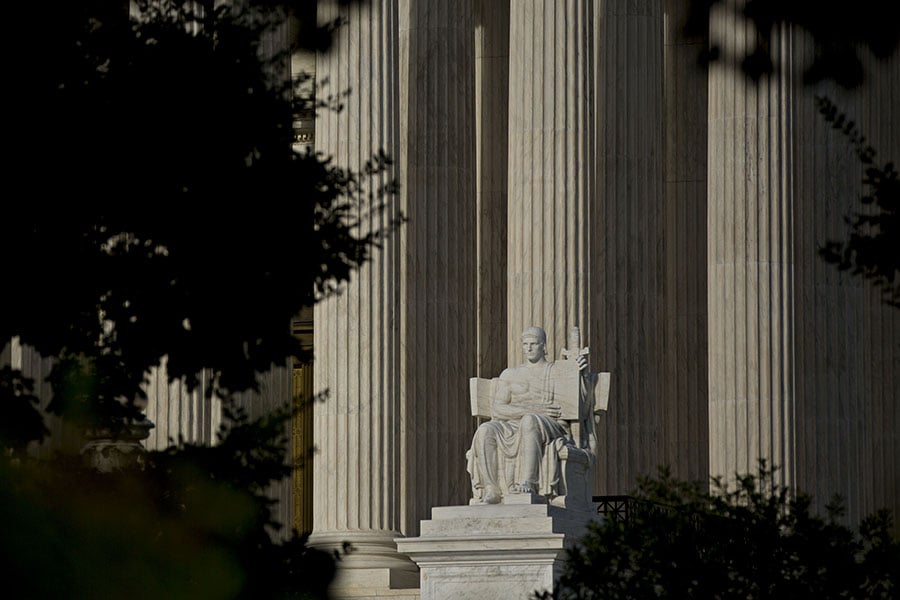
The Supreme Court’s conservative majority cast doubt on the Securities and Exchange Commission’s use of in-house judges, hearing arguments in a case that could strip the agency of a key enforcement tool.
In a session that lasted more than two hours, the justices suggested that people accused of fraud by the SEC have a constitutional right to go before a federal court jury, at least when the commission is seeking civil penalties.
“It seems problematic to say the government can deprive you of your property, your money, substantial sums in a tribunal that is at least perceived as not being impartial,” Justice Brett Kavanaugh said.
The dispute is part of a Supreme Court term likely to have broad implications for federal regulators. The justices are also considering whether the Consumer Financial Protection Bureau’s funding system is constitutional and whether to overturn a precedent that gives agencies leeway when they interpret ambiguous congressional commands.
The session underscored the deep skepticism among the court’s six Republican-appointed justices toward the expansion of federal regulatory power in recent decades.
The “impact of government agencies on daily life today is enormously more significant than it was 50 years ago,” Chief Justice John Roberts said.
One of the court’s liberals, Justice Elena Kagan, countered that “our problems have only gotten more complicated and difficult, and it’s usually Congress that decides how to solve those problems.”
The Biden administration is appealing a ruling that found multiple flaws with the SEC’s reliance on its administrative law judges. The high court session focused almost entirely on contentions that the Constitution’s Seventh Amendment guarantees the right to a jury trial in SEC enforcement cases.
Wednesday’s case involves George Jarkesy, a former hedge fund manager and conservative radio host. In 2013, the SEC accused Jarkesy of misleading investors about who served as his funds’ prime broker and auditor and about their investment strategies and holdings.
An SEC judge found Jarkesy had committed securities fraud, and the commission eventually ordered him and his firm to pay almost $1 million. Jarkesy then appealed to the 5th Circuit Court of Appeals.

According to a federal charges Bradley Heppner, 60, received more than $150 million in payments through funneling money from GWG Holdings to a shell company.

TCI Wealth Advisors also has also tapped JIFFYAI to unify onboarding and servicing, while TradePMR adds ICE market data to its Fusion advisor platform

Also, CAPTRUST adds a $300 million planning team from Sanctuary in its home market of Raleigh, and Sequoia Financial Group buys a Boulder family office.

New nonvoting shares would let the Meta CEO cover eyed Proposition 40 tax without losing control, in exchange for an eight-year residency pledge

New research exposes a wide gap in how affluent parents and their adult children understand and prepare for the transfer of family wealth.
Knighthead Life entered the market with a competitive MYGA. A strong launch earned advisor confidence and paved the way for FIAs.
As AI makes financial information more accessible than ever, Lana Hock explains why human judgment, trust, and empathy remain the qualities clients value most in a financial advisor

