
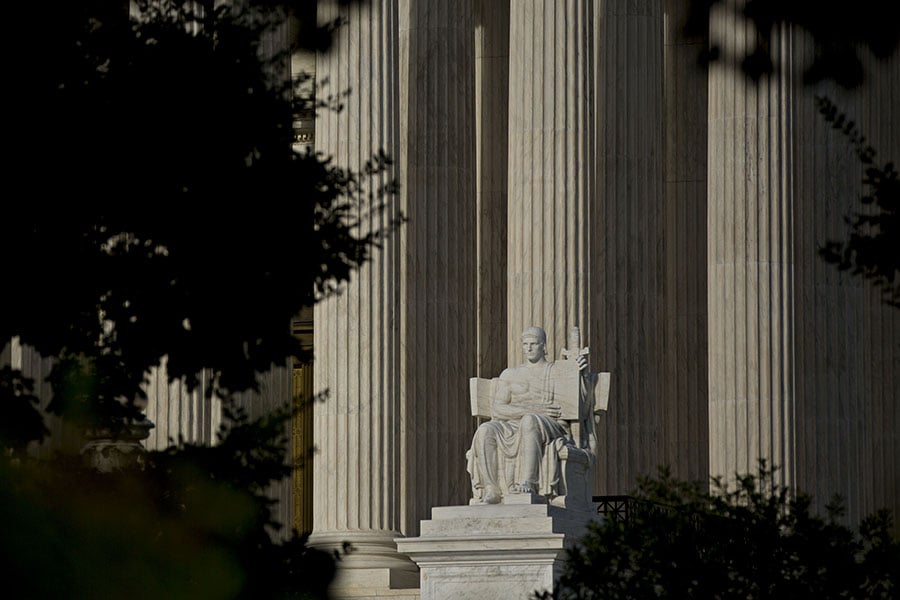
Investor advocates declared victory Monday after the Supreme Court sent back to an appeals court a case in which Goldman Sachs was accused of hiding conflicts of interest related to sales of mortgage-backed securities.
The Arkansas Teacher Retirement System, other pension funds and individual investors who bought Goldman shares between February 2007 and June 2010 allege the price of the stock was influenced by Goldman’s claims that it avoided conflicts of interest.
The plaintiffs asserted that Goldman knew of conflicts surrounding the sales of collateralized debt obligations made up of subprime mortgages. They brought a class action suit in 2011 following Goldman’s $550 million settlement with the SEC in 2010.
The U.S. 2nd Circuit Court of Appeals affirmed the class designation last April. Goldman appealed the 2nd Circuit’s decision to the Supreme Court, arguing that the appeals court made it too easy to bring a class-action suit. The firm asserted that its statements about putting its clients’ interests first were generic and aspirational and didn’t affect the stock price.
In its decision, the Supreme Court returned the case to the 2nd Circuit for further review.
“The parties … dispute whether the Second Circuit properly considered the generic nature of Goldman’s alleged misrepresentations,” Justice Amy Coney Barrett wrote for the majority. “Because the Court concludes that the Second Circuit’s opinions leave sufficient doubt on this question, the Court remands for the Second Circuit to consider all record evidence relevant to price impact, regardless whether that evidence overlaps with materiality or any other merits issue.”
Barrett was joined in the opinion by Chief Justice John Roberts and Justices Stephen Breyer, Elena Kagan and Brett Kavanaugh. Justices Clarence Thomas, Samuel Alito, Neil Gorsuch and Sonia Sotomayor concurred with parts of the decision and dissented with other parts.
“From the perspective of investors, this is like an asteroid that completely missed the earth,” said Paul Bland, executive director of Public Justice, a nonprofit legal advocacy group. “Goldman Sachs was looking to make it much harder for investors to bring securities fraud cases, and that just didn’t happen.”
The Supreme Court didn’t fully embrace the positions of either Goldman or the plaintiff pension plans and investors. But the decision to send the case back to the 2nd Circuit was welcomed by Barbara Roper, director of investor protection at the Consumer Federation of America.
“This is the narrow remand we were hoping for,” Roper said. “In that sense, this is a win for us.”
Goldman Sachs countered that the Supreme Court decision gives it another chance to prevail.
“We are pleased the Supreme Court has vacated the grant of class certification and we will continue to vigorously defend ourselves as the case returns to the lower courts,” Goldman spokesperson Maeve DuVally said in an emailed statement.
The case has implications for Regulation Best Interest, the broker investment advice standard that went into force last year, according to investor advocates. Reg BI prohibits brokers from putting their interests ahead of those of their customers.
If Goldman doesn’t have to abide by its statement about avoiding conflicts of interest, could firms also dodge Reg BI’s strictures?
Roper has qualms about the Supreme Court opinion referring to the “generic nature” of Goldman’s statement on conflicts of interest.
“One concern is what appears to be an underlying assumption that statements about policies to protect investors from conflicts of interest are generic in nature, when that’s the principle at the heart of Regulation Best Interest,” she said.
But Bland said that if the Supreme Court were going to hold that Goldman’s statement was generic, it would have thrown the case out. Instead, the decision reflects the fact that misleading information can affect stock price.
“The court resoundingly affirmed the presumption that the market operates based on information,” he said.
The case was the first one involving a shareholder dispute that the Supreme Court has decided since former President Donald Trump appointed three justices, including Barrett, to give the court a 6-3 conservative majority.
“It's nice to see a brand-new justice writing such a good opinion for investors,” said Salvatore Graziano, a partner at Bernstein Litowitz Berger & Grossman.
Bloomberg News contributed to this story.

FINTRX data shows 342 company transactions in the quarter, with wealth management consolidation driving nearly one in seven deals.

State regulators secure $4.4 million from two broker-dealers over unreasonable charges on small-dollar retail equity trades.

New F&G survey finds most pre-retirees are delaying or redesigning retirement, creating fresh planning opportunities for financial advisors.

Focus Partners Wealth’s Jeffrey Levine says a Democratic House or Senate would make new legislation on Trump Accounts much harder to pass

Docupace also rebuilt its wealth operations platform around a single client record, while Focus Financial picks Nevis to bring AI to its advisors.
Knighthead Life entered the market with a competitive MYGA. A strong launch earned advisor confidence and paved the way for FIAs.
As AI makes financial information more accessible than ever, Lana Hock explains why human judgment, trust, and empathy remain the qualities clients value most in a financial advisor

