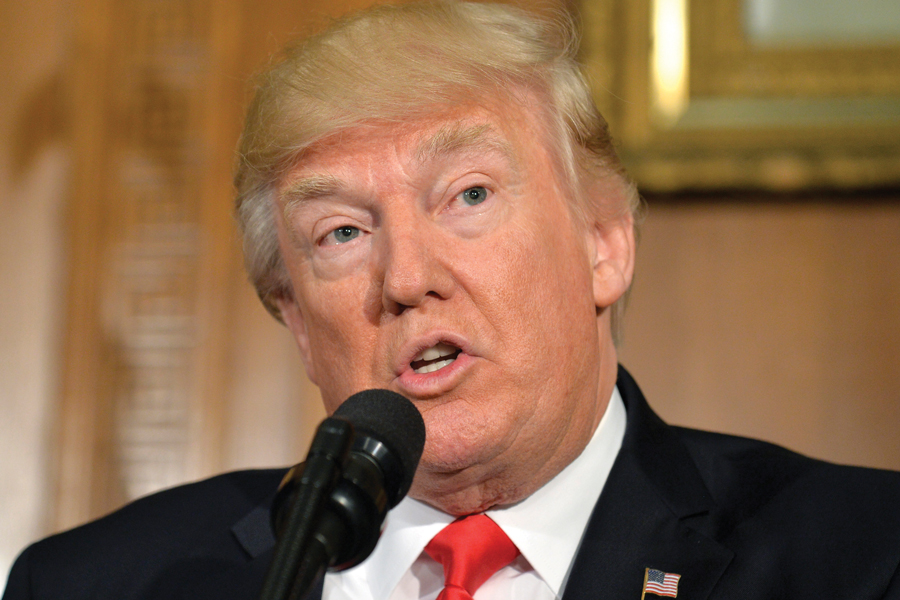
President Donald Trump said he's asked the Securities and Exchange Commission to study ending quarterly reporting for U.S. businesses in order to ease regulations and spur growth.
"In speaking with some of the world's top business leaders I asked what it is that would make business (jobs) even better in the U.S. 'Stop quarterly reporting & go to a six month system,' said one. That would allow greater flexibility & save money. I have asked the SEC to study!" Mr. Trump said in a
Twitter post Friday.
The regulatory burdens of being a public company have been in the spotlight lately, including playing a role in why Elon Musk wants to take Tesla Inc. private. And corporate leaders and trade groups have increasingly vented about Wall Street's obsession with short-term earnings and revenue targets, arguing that they can prevent firms from growing their businesses and creating jobs.
A top criticism is that if companies are striving to report profit gains every quarter, they are more likely to buy back shares and cut costs than invest in their businesses.
Earlier this year, Berkshire Hathaway Inc.'s Warren Buffett and JPMorgan Chase & Co.'s Jamie Dimon urged companies to stop issuing quarterly earnings guidance. Moving away from reporting earnings every three months would be a much more dramatic change that would almost certainly trigger resistance from shareholders who want transparency from the companies they invest in.
"Investors will demand they get their information," Ed Yardeni, founder of Yardeni Research Inc., said in a Bloomberg Television interview. "Short-termism, that's been floating around for a long time, just doesn't jibe with the facts. The idea that companies have been taking all their profits and just buying back shares, paying dividends and spending nothing on employees and capital spending, it's just not right."
Quarterly reporting has long been a cornerstone of U.S. capital markets, with bank analysts known for making closely monitored recommendations on buying or selling stock tied to the numbers. While some business leaders have groaned about the rigors associated with having to disclose financial figures four times a year, the SEC has been reticent to make any changes.
SEC Chairman Jay Clayton, a Trump nominee, has said increasing the number of public companies and initial public offerings are among his top priorities. Still, Mr. Clayton hasn't floated reducing the number of times that companies must disclose their financial performance each year.
The SEC could make such a change on its own without Congress passing legislation but that doesn't mean it will, said David Martin, who previously ran the agency unit that oversees corporate filings.
"You're probably going to get a debate where you have people saying these reports are unnecessary, and I don't think that will convince a lot of people," said Mr. Martin, who's now a senior counsel at the law firm Covington & Burling. "On the other side will be the argument that information is basically a lubricant of a great capital-markets system."
The SEC enjoys some level of distance from the White House because it's an independent agency. It's rare for presidents to make public demands of such regulators.
SEC spokesmen didn't respond to requests for comment.
(More: SEC ponders creating video to help investors decide between investment adviser and broker)
The U.S. Chamber of Commerce and other lobbying groups have blamed compliance burdens for preventing more companies from selling shares. A statistic they often point to is the drop in IPOs over the past 20 years. In 1996, almost 950 companies went public, according to data compiled by Bloomberg. That number fell to 237 in 2017.
But some academics have argued that criticizing regulation oversimplifies the situation. Firms have an ever-expanding menu of ways to raise money outside the stock market.
In a Friday statement, White House spokeswoman Lindsay Walters said Mr. Trump is interested in "examining this issue on whether short-term earnings reporting requirements for public companies reduce incentives for them to engage in long-term investing in the United States."
Mr. Trump's position in some ways puts him on the same page as one of his most vocal political opponents. Sen. Elizabeth Warren has long argued that corporations are too focused on appeasing Wall Street's desire for hitting short-term benchmarks, at the expense of boosting jobs. For instance, the progressive Massachusetts Democrat has often criticized companies for spending so much money on repurchasing stock, which boosts earnings per share.
Mr. Trump's Twitter missive featured what has become a hallmark of his speeches — unnamed leaders at unspecified companies supportive of his agenda. At a July rally in Florida, Mr. Trump said the chief executive of "one of the greatest companies in the world" urged him to press his tariff fight even though it would impact his business.
In some cases, events differ from one telling to another, such as in Mr. Trump's frequent recounting of a story involving a friend who hired ex-convicts and told him they were exemplary employees. Mr. Trump also cites conversations with unnamed foreign leaders, such as his claim a high-placed Chinese leader who said he's the first president to stand up to that nation.
(More: Allison Lee most likely choice for SEC commissioner, reports say)