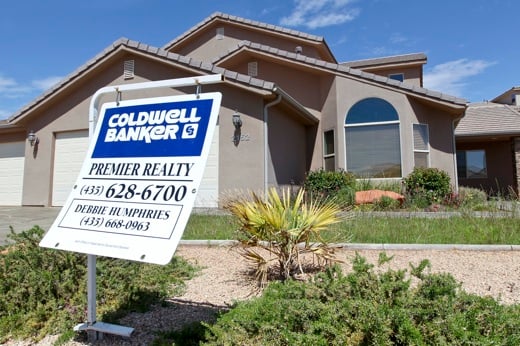
Home prices in the U.S. fell 5.9 percent in the second quarter from a year earlier, the biggest decline since 2009, as foreclosures added to the inventory of properties for sale.
Prices dropped 0.6 percent from the prior three months, the Federal Housing Finance Agency said today in a report from Washington. In June, prices retreated 4.3 percent from a year earlier, while increasing 0.9 percent from the previous month.
Foreclosures are boosting the supply of properties on the market and undercutting the confidence of homebuyers, sapping demand even as mortgage rates tumble to the lowest in more than half a century. The U.S. inventory of homes for sale averaged 3.7 million during the second quarter, the highest since the third quarter of 2010, data from the National Association of Realtors show. The mortgages on 6.5 million U.S. homes had late payments or were in foreclosure in June, according to Lender Processing Services Inc. in Jacksonville, Florida.
“Foreclosures water down home prices because banks want to get rid of properties as fast as they can,” said Patrick Newport, an economist at IHS Global Insight in Lexington, Massachusetts. “The key number driving foreclosures is the unemployment rate, and we saw that worsen in the second quarter.”
The unemployment rate in the three months ended June 30 rose to 9.1 percent from 8.9 percent, the first quarterly increase since 2009, according to the Labor Department.
California, Nevada
Home prices in June fell the most in the region that includes California, slumping 8 percent from a year earlier, the FHFA said. They decreased 7.9 percent in the area that includes Nevada and Arizona.
The month-over-month gain in prices exceeded analysts' forecast of 0.2 percent, the median of 16 estimates compiled by Bloomberg. The region that includes Wisconsin, Illinois and Ohio had the biggest increase from May, with a 3.3 percent rise.
Mortgage rates for 30-year fixed loans fell to 4.15 percent last week, McLean, Virginia-based
Freddie Mac said. The rate probably will average 4.6 percent this year, lower than 2010's 4.7 percent, according to
Fannie Mae in Washington.
Sales of U.S. previously owned homes dropped in July, reflecting an increase in contract cancellations due to strict lending rules and low appraisals, Lawrence Yun, chief economist of the National Association of Realtors, said Aug. 18. Purchases decreased 3.5 percent to a 4.67 million annual rate, the weakest since November.
Today's FHFA report measures changes in real estate values using repeat data on individual properties with mortgages backed by
Fannie Mae or Freddie Mac. It doesn't include a dollar value for homes. The U.S. median home price was $171,900 in the second quarter, according to NAR.
--Bloomberg News--