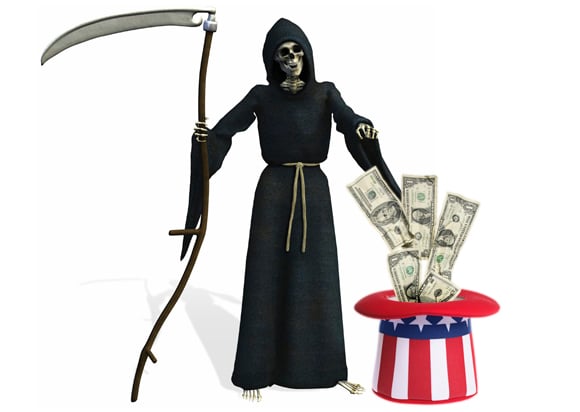
On paper, a mere 10 percentage points and 2,860 wealthy taxpayers separate Republicans and Democrats in the fight over taxing multimillion-dollar estates. The political differences loom larger.
As the U.S. Congress moves to reinstate the estate tax next year with a top 35 percent rate, the lowest in 80 years, Republicans say they've made concessions after seeking to abolish the levy, while Democrats insist the new rules would benefit the nation's wealthiest households at a time of record income inequality.
The compromise by President Barack Obama and Senate Republicans to extend Bush-era tax cuts would subject 3,600 U.S. estates to any tax, of an estimated 2.6 million projected deaths in 2011, according to estimates. House Democrats support an alternative that would collect a higher rate of tax from 6,460 multimillionaires. While that's a difference of just 2,860 taxpayers, Democrats see the new compromise as an affront to the philosophy of taxation based on ability to pay.
“Their concern is the estate tax is and has long been the most progressive tax in the system,” said Columbia University law professor Michael Graetz, who wrote a 2005 book on efforts to repeal the estate tax. “It's symbolic for the Democrats of the difficulty of raising much revenue at the top of the income scale.”
House Democrats last year voted to reinstate the estate tax permanently with a 45 percent top rate and a $3.5 million per-person exclusion, a measure that died in the Senate. That would generate $14 billion more in revenue over two years than a provision in the current tax measure, according to the Joint Committee on Taxation.
Tax-Free Allowance
Few households pay the estate tax because the law allows millions of dollars to be bequeathed tax-free. The Senate bill sets a tax-free allowance for 2011 and 2012 of $5 million per person and $10 million per couple. According to the Congressional Research Service, that exemption would mean only 0.14 percent of households would pay estate tax.
The number of total estates affected is higher. In 2011, for example, the estates of about 9,100 people will have enough assets to have to file a tax return, according to an analysis by the Tax Policy Center, a joint venture of the Urban Institute and Brookings Institution, two Washington research groups.
About 60 percent, or 5,500, will owe no tax because the deceased individual would have transferred assets to a surviving spouse or donated them to charity in lieu of writing a check to the U.S. Treasury Department. One of the policy rationales for an estate tax is to encourage
charitable giving, Graetz said.
Tax-Free Gifts
Neal Weber, managing director in charge of RSM McGladrey's Washington National Tax Office, said the number of tax returns filed obscures the fact that many minimize their estate tax exposure through trusts to pass along underappreciated assets before death. The Senate measure creates more opportunities to do this in 2011 and 2012 by raising the lifetime tax-free gift allowance to $10 million per couple, up from $2 million now.
“There are thousands and thousands of taxpayers who are doing
estate planning.” Weber said.
The estate tax has been part of the law since the income tax was ratified in 1916. It was targeted for abolition in the mid-1990s by congressional Republicans and activist groups such as Americans for Tax Reform, based in Washington. Treasury Secretary Andrew Mellon also tried in the 1920s to abolish the tax.
Phased Out
In 2001, Congress agreed to phase out the estate tax as part of President George W. Bush's tax-cut proposal. It has disappeared temporarily in 2010, with a
capital gains tax on some inherited assets taking its place, and is set to return with a 55 percent rate and a $1 million tax-free allowance in 2011. About 43,540 estates would be subject to tax in 2011 if Congress doesn't act, according to the Tax Policy Center.
James Cody, director of estate and
trust services for Harris myCFO Inc. in Menlo Park, California, said groups opposed to the tax have been divided between business owners who sought to secure the highest possible tax-free allowance and those with a higher net worth who wanted the lowest possible rate.
“If the estate is $100 million, the extra exemption is a modest benefit and not going to change their behavior that much,” Cody said. A $100 million estate would face an extra $10.2 million in taxes under the Democrats' proposal.
Among those who favor repeal of the estate tax, some are willing to accept the 35 percent rate for now. Dick Patten, president of the American Family Business Institute, a Washington group founded by wealthy families to fight the levy, said voting for the compromise wouldn't violate the “No Death Tax” pledge signed by 130 Republican lawmakers and Senator Joe Manchin, a newly elected Democrat from West Virginia.
“The pledge is for permanent, total repeal, although not necessarily at once,” Patten said. “If the death tax has to be dismantled piece by piece, we'll do that.”
--Bloomberg News--