
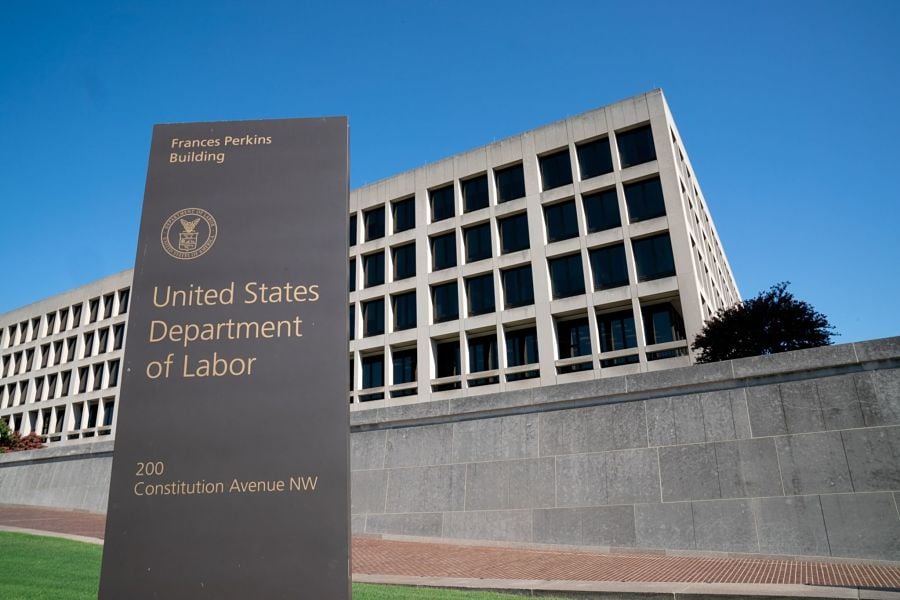
Life just got more complicated for some asset managers that oversee retirement plan investments, as a change made Tuesday by the DOL restricts an exemption many have relied upon.
Most notably, the Department of Labor amended its qualified professional asset manager, or QPAM, exemption to clarify that individuals and companies with foreign convictions for serious financial crimes aren't eligible for it. Such crimes include fraud, tax evasion, extortion, embezzlement, or misappropriation of funds, among others. Asset managers rely on being QPAMs to distribute funds in retirement plans.
To the chagrin of some companies with international footprints, the limitation on the exemption applies regardless of whether an affiliate or the corporate parent was convicted.
The DOL added a disqualifier around “prohibited misconduct,” where companies have entered into non-prosecution agreements or deferred prosecution agreements, in the US. Although the agency’s proposed amendments included that provision for foreign countries, it cut that aspect from the final version.
The amendment updates an exemption that has been in effect since 1984 with changes necessary amid industry consolidation and the growing global reach of many financial institutions, the DOL said in its announcement.
“The Qualified Professional Asset Manager exemption is an important tool for plans and asset managers that must be viewed in the context of what is protective of the rights of plans, participants, beneficiaries and individual retirement account owners,” Lisa Gomez, assistant secretary for employee benefits security, said in a statement. “The final amendment reflects changes to modernize the QPAM exemption, input received from public comments, and the DOL’s experience administering the exemption.”
In addition to clarifying foreign convictions and types of misconduct that can disqualify companies from relying on the exemption to manage retirement plan assets, the DOL added a one-year transition period that gives plans time to disentangle themselves from QPAMs that become ineligible. It also clarified the level of independence and control for such entities with regard to investment decisions.
“The changes to the QPAM Exemption merit a close consideration of whether an asset manager acting as a fiduciary to an ERISA plan, IRA and plan assets fund should continue to rely on the QPAM Exemption or pivot to an alternative exemption,” Erica Rozow, partner in Simpson Thacher’s executive compensation and employee benefits practice, said in a statement provided by the firm. “Moreover, as we continue to see consolidation in the asset management industry, we think these changes to the QPAM Exemption will likely lend themselves to additional diligence considerations in the M&A space.”
The inclusion of foreign convictions appears to put the QPAM exemption on a “parallel track” with the DOL’s proposal to amend its Prohibited Transaction Exemption 20-02, which covers investment advice for retirement plans and IRA rollovers, said Jason Roberts, CEO of the Pension Resource Institute.
“The [PTE 20-02] proposal could add foreign convictions and also sweep in affiliates,” Roberts said. “I hope that the DOL in its final rule implements a lot of the stuff that QPAM did.”
To address concerns that commenters have raised since the DOL proposed the amendment in 2022 about foreign convictions in certain countries, the agency will not consider convictions in any countries deemed “foreign adversaries” by the Department of Commerce. That list currently includes China, Cuba, Iran, North Korea, Russia, and Venezuela under President Nicolás Maduro.
In a letter supporting the DOL’s proposed amendment to the QPAM exemption in 2022, Sens. Elizabeth Warren, D-Mass., and Tina Smith, D-Minn., noted that although QPAM status has been disqualified because of domestic and foreign convictions, the regulator has granted exemptions “in virtually every relevant case, even when institutions have blatantly and repeatedly broken the laws.”
The senators cited an exemption granted to Credit Suisse Group in 2022 despite “previous convictions for financing a loan for a tuna fishing project in Mozambique and assisting US taxpayers with filing false income tax returns.” They also pointed to a 2021 exemption for Goldman Sachs after a subsidiary’s connection to a global bribery scandal in Malaysia, as well as exemptions in 2016 for Deutsche Bank, Citigroup, JPMorgan Chase, Barclays, and UBS “despite their criminal convictions for currency price fixing.”
In the final amendment, the DOL addressed a separate concern raised by lawyers and asset managers over “sole authority” in managing plan assets, which had been construed to prevent QPAMs from using subadvisors in collective investment trusts, target-date funds, and other products.
Using a prudently selected and monitored subadvisor by itself would not violate the exemption “as long as the QPAM retains sole authority with respect to planning, negotiating, and initiating the transactions covered by the QPAM Exemption,” the agency stated.

MyComplianceOffice's AI-assisted surveillance links employee chats on Slack and Telegram with prediction market trades as Wall Street tightens rules

Elsewhere, Raymond James absorbs a family-run practice from Commonwealth into its independent channel, while RBC welcomes a father-son tandem formerly from UBS.

Fuel-driven inflation drove the supersized adjustment, but advocates say retirees are still losing ground as trust fund insolvency nears.

State mandates and plan complexity are opening doors for financial advisors in the 401 market.

New LIMRA data reveal a stubborn advice gap that financial professionals are well-positioned to close.
Knighthead Life entered the market with a competitive MYGA. A strong launch earned advisor confidence and paved the way for FIAs.
As AI makes financial information more accessible than ever, Lana Hock explains why human judgment, trust, and empathy remain the qualities clients value most in a financial advisor

