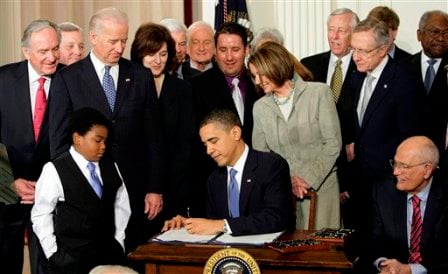
The tax implications of the health care legislation signed into law today by President Barack Obama raises critical questions for investors looking to protect their assets, financial advisers and other industry experts said.
The tax rates on long-term capital gains were already set to go up at the end of the year to 20%, from 15%, for households earning over $250,000. But now with the passage of the health care bill, investors will see the tax rate jump to 23.8%.
“For large earners, this certainly is another reason for them to look at bringing gains in for this year,” said Andrew Altfest, executive vice president of strategy and investments at Altfest Personal Wealth Management, which manages about $500 million in assets.
But for it to make sense to take capital gains now, an investor would have to believe that a stock would fail to appreciate more than the tax loss that would be realized, he said.
The legislation doesn't call for the increase to take effect until 2013, and a lot can happen between now and then, Mr. Altfest said.
“You're taking chances by trading ahead of the rule change,” he said.
There is no reason to rush, agrees Clint Stretch, a managing principal the tax policy group at Deloitte Tax LLP.
“People at the end of this year should do their analysis and ask: ‘Do I want to go ahead and recognize the gains or hold on to the stock?'” he said.
Of course, the health care legislation affects more than just capital gains.
“A significant portion of the revenue raised by the act — $86.8 billion over 10 years — comes in the form of an additional Medicare tax hike that will affect higher-income taxpayers,” Deloitte analysts noted in a report released yesterday.
For example, beginning in 2013, the act imposes an additional 0.9% Medicare hospital insurance tax on self-employed individuals and employees with respect to earnings and wages in excess of $200,000.
If an individual or employee files a joint return, the tax applies to all earnings and wages in excess of $250,000 on that return.
Micha Porter, president of Minerva Planning Group, which has $60 million under management, said he hasn't had a chance to review the tax implications of the health care legislation.
Early indications, however, suggest that investors will have more incentives to consider tax-efficient investing, Mr. Porter noted.
Mr. Porter said he is in the process of sending out a letter to clients, discussing why it makes sense to own tax-efficient mutual funds that try and keep capital gains low by having low turnover.
The tax implications of the health care legislation should result in greater interest in such funds, he said.
As for whether investors should take capital gains now, Mr. Porter said it could make sense in some circumstances, especially for investors considering a
Roth IRA.
New rules took effect Jan. 1 that allow individuals who earn more than $100,000 annually to convert to Roth IRAs. Previously, only those who earned less than that amount could convert.
Additionally, though investors still must pay ordinary income tax on each dollar converted, they can spread the tax bill over two years, splitting it between 2011 and 2012.
“I think if you think taxes are going up, it makes
Roth conversions that much more attractive,” Mr. Porter said. “That could potentially make sense.”
“If you think capital gains are going up next year,” he continued, “then go ahead and take capital gains.”