

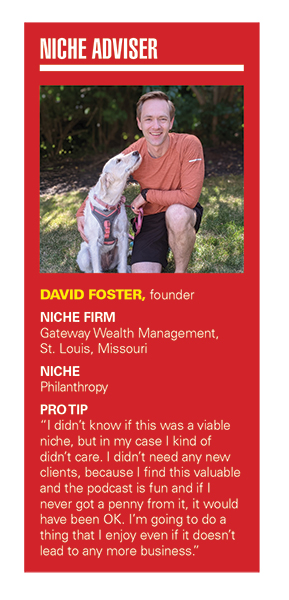
In some respects, David Foster has been living his advisory niche for most of his life. But it wasn’t until about three years ago that he realized he could incorporate his passion for philanthropy into his financial advisory practice.
The founder of Gateway Wealth Management in St. Louis, Foster credits his parents with instilling in him a general sense of gratitude and appreciation that he shoulders with enthusiasm.
“It’s kind of my mission in life to convince people to give away more money to people who are not related to them,” he said.
While that might sound like a bold and even presumptuous statement, it is less of a hard sell than it is about living by example.
Now 35 and married with three kids under the age of 7, Foster and his wife realized a few years ago they had already saved enough for retirement that they would be fine if they just stopped socking money away.
They didn’t stop saving for retirement or derail any other responsible financial planning, but they did get more serious about their philanthropic endeavors. And, thus, a niche advisory practice was born.
“About three years ago the practice was growing, my wife was working, and we started to have some extra money, so we tried to figure out how to give money away and we learned it’s actually quite difficult,” he said. “It’s challenging because it’s hard to know where your money is going, who to give to and how to make the greatest impact. I figured if I’m having a hard time there are probably lots of wealthy people having the same problem.”
Unlike traditional philanthropic consultants that connect donors with various charities and non-profit organizations, Foster is committed to making philanthropy as personal as possible by “not just leading with your heart, but also using your head.”
His general philosophy around giving is along the lines of the Effective Altruism movement, which could be roughly summed up as finding the best way to make an impact with charitable giving.
Beyond the necessary due diligence to ensure donations aren’t just lining the pockets of people sitting at the top of some foundations, Foster stresses that “not all philanthropy is created equal.”
“Some nonprofits are better than others, and it can be by hundreds and thousands of times better,” he said. “Part of what I help people determine is where is the money going. I try to steer people in good directions, by trying to uncover their passions. But what you care about isn’t enough. What’s more important is the impact you’re making.”
Similar to investing, Foster said there is even a risk tolerance to be considered when making charitable donations.
“There is very little risk in donating to malaria nets, because you know where the money is going and you know what the impact is,” he said.
But some causes supported by charitable donations, such as the decades it took for the Supreme Court to legalize gay marriage, can be open-ended, requiring patience and faith.
Foster promotes the niche through his Gateway Giving podcast and by blogs posted on his website. And he stresses that he is a financial planner first and foremost, and he isn’t yet set up to charge a separate fee for philanthropic advice.
“You can’t determine how much you have to give unless you’ve first done some modicum of financial planning, or at least you shouldn’t do that,” he said. “The financial planning helps you determine how much you can give and when and how.”
While it is natural to associate charitable giving with tax management in the financial planning process, Foster believes charitable tax deductions are not the primary driver for true philanthropists.
“Taxes are certainly factored in, and I’ve rarely run across anybody who wants to maximize their tax bill, but research shows that most advisers think minimizing the tax bill is more important while donors generally think the most important thing is the impact,” he said. “The driver is they want their money to do some good and if they can also get a tax benefit that’s just gravy.”
While Foster is clearly passionate about his niche and he hopes he is attracting like-minded clients, he is also noticing more of his original clients embracing philanthropic attitudes.
“Ever since I was a little kid, I’ve always been very aware of how fortunate I am, and that awareness has only grown as I’ve gotten older,” he said. “At some point, you will have a hard time buying more satisfaction with more money when there are billions of people who live on a tiny fraction of my income. I’ve got money that isn’t buying me a lot of extra happiness or satisfaction that will benefit somebody else. Giving feels good and you should embrace that. I’m buying that good feeling and there’s nothing wrong with that.”

The financial advice industry has been facing inquiries into its cash sweep programs for years now.

Investor money allegedly went to strip clubs, exotic cars, and landscaping

Procyon adds $415 million in assets under management in New Jersey while Savant picks up a $213 million Southern California planning firm

With a growing number of real estate-rich Baby Boomers aging into retirement, some advisors may be failing to consider all the options available for those clients' assets.

Cornerstone Advisors study reveals compliance bottlenecks stall campaigns weeks after customer opportunities close.
As AI makes financial information more accessible than ever, Lana Hock explains why human judgment, trust, and empathy remain the qualities clients value most in a financial advisor
Northern Trust’s Ken Lassner shows advisors how to convert volatility into after-tax portfolio gains

