Analyst claims she didn't say what she seemed to have said when she said it on national television
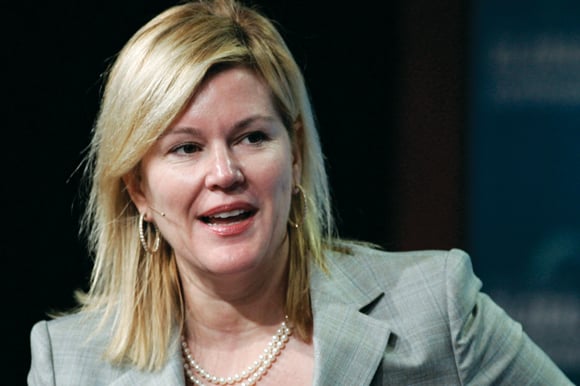
It's no wonder Meredith Whitney wants to distance herself from her prediction of the municipal market's meltdown.
“I never said that there would be hundreds of billions of defaults. It was never a precise estimate over a specific period of time.” So said Whitney on Bloomberg Radio on Wednesday morning.
This is what she said on an episode of CBS's “60 Minutes” that aired on Dec. 19, 2010:
“You could see 50 sizeable defaults. Fifty to 100 sizeable defaults. More. This will amount to hundreds of billions of dollars' worth of defaults.”
As for timing, “It'll be something to worry about within the next 12 months.”
What this sounds like is Meredith Whitney saying there will be hundreds of billions of dollars' worth of municipal bond defaults within the next 12 months. That sounds like a precise estimate over a specific period of time. And that's how it has been reported and dissected in the press since then, with not a word of protest from Whitney.
Until this week. Whitney told Bloomberg Radio host Tom Keene that she thought “60 Minutes” did a “really good job” on the story. “But the risk is that they take bits and pieces of an hour-and-a-half interview and certain portions are more magnified than others.”
Whitney also later told Keene: “In the cycle of this municipal downturn, I stand by it. But we never had a specific estimate for that. That's not the nature of our research.”
See It Yourself
So now we have Whitney standing by something she said she never said, and unfortunately -- for her -- recorded for posterity. You can watch the video for yourself on the CBS website. I saw the original segment when it was broadcast and have watched it several dozen times since then, just to make sure I heard what I thought I heard: that there would be hundreds of billions of dollars' worth of municipal bond defaults this year.
I guess the call is still for hundreds of billions of dollars' worth of municipal bond defaults, but now over the duration of “this municipal downturn,” whatever that means. So far this year, 14 municipal bond issues totaling $605 million have defaulted, according to Richard Lehmann of the Distressed Debt Securities Newsletter. The record year for defaults was 2008, when $8.5 billion in municipals went bust.
What so astonished municipal market investors about the Whitney call was its outlandishness -- “hundreds of billions” in a market that hasn't seen a year in which defaults reached even $10 billion. Nobody denied that states and municipalities were in heavy weather, on many fronts, and that some issuers might default. Still, Whitney's outlook, then and now, sounds absurd.
Essence of Whitneyism
Whitney shed some light on the “60 Minutes” call earlier this month at the Milken Institute Global Conference. The states, she said, were cutting aid to localities. “The local municipalities have nowhere to go and their bias is to save their constituents before they save their bondholders,” she said.
This, then, was the underpinning of the Whitney prognostication, which acted as a sort of punctuation mark to almost two years of hysterical headlines, misguided commentary and know-nothing blog posts about the municipal market. The numbers didn't add up because her prediction really wasn't about the numbers. It was about mass repudiation of municipal debt obligations.
As arguments go, there's a certain logic to it. Make a few bondholders suffer, and some people may think you're a hero. Raise taxes, and lose the next election.
And yet, as arguments go, Whitneyism is an unsupported assertion. In the modern era, there is little to suggest that serious public officials will shirk their duty to bondholders. The results would be catastrophic, far worse than any temporary boon to taxpayers. Past performance is no guarantee of future behavior, but there has been nothing to signal that mass repudiation will become fashionable at any time, let alone within the next eight months.
(Joe Mysak is editor of Bloomberg Brief's daily Municipal Market. The opinions expressed are his own.)