
Pimco's Gross: Obama's $300B doesn't cut it

Pimco's Gross: Obama's $300B doesn't cut it
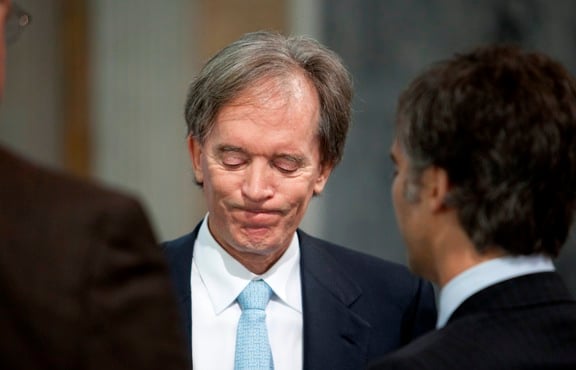
Bill Gross, founder of Pacific Investment Management Co., said President Barack Obama's plan to stimulate the economy with more than $300 billion in tax cuts and spending is inadequate.
SEP 06, 2011
Bill Gross, founder of Pacific Investment Management Co., said President Barack Obama's plan to stimulate the economy with more than $300 billion in tax cuts and spending is inadequate. “I don't think $300 billion does it,” Gross said today in an interview with Bloomberg Television's Tom Keene. “I would like to see something bold.” Obama will propose cutting payroll taxes for small businesses as part of a plan to spur hiring, according to an administration memo obtained by Bloomberg News. The tax cut will be included in a package Obama plans to lay out in a speech to Congress tonight, along with assistance for the long-term unemployed, spending on roads and bridges and repairing schools, and aid to states to keep teachers and emergency workers on the job. “I think markets will be disappointed eventually and possibly tomorrow morning if we see $300 billion or less,” Gross said. Gross, who manages the world's biggest mutual fund at Newport Beach, Calif.-based Pimco, said fiscal policy in the U.S. and Europe has been effectively frozen as governments struggle with their debt loads. Treasury Curve Credit creation has been hurt as the U.S. Federal Reserve purchased assets and kept interest rates at historic lows since December 2008, Gross said. Fed Chairman Ben S. Bernanke risks causing a decline in longer-term lending by holding down rates, he said. “The first five years of the Treasury curve is frozen,” Gross said. “Those who are looking for higher yield basically have to move out to the 10-year area and perhaps to 30 years.” The $245 billion Total Return Fund managed by Gross has lost 0.3% in the past month, underperforming 85% of its peers, according to data compiled by Bloomberg. The fund's 3.8% return this year is worse than about two-thirds of competitors, the data show. Gross has outperformed 98% of his rival fund over the past five years. --Bloomberg News--

Latest News

Private credit becoming 'big piece' of annuities, T. Rowe exec says

Goldman Sachs retirement survey finds 83% want guaranteed income, while the annuities providing that income increasingly hold private credit.

Zocks debuts Claude plugin with seven skills for financial advisors

The AI meeting assistant's Advisor Intelligence plugin turns client conversation data into annual reviews, tax scans and attrition alerts.
Stifel settles massive $30 million complaint involving star broker’s sale of structured products

Chuck Roberts and Stifel have been facing scrutiny due to sales of structured products and structured notes.

SEC floats CFP route to accredited investor status, fund rules refresh amid private market push

Among other updates, the proposals would let advisors to regulated funds earn performance fees and allow interval funds to offer monthly repurchases.

The Year Is 2046 and I’m a Financial Advisor 

What will financial advice look like 20 years from now? Evan Vladem explores how AI may transform wealth management while reinforcing the enduring value of human guidance, trust, and empathy. 

SPONSORED In the Age of AI, Trust Becomes the Advisor's Greatest Asset

As AI makes financial information more accessible than ever, Lana Hock explains why human judgment, trust, and empathy remain the qualities clients value most in a financial advisor

SPONSORED Direct indexing webinar targets tax-loss harvesting amid market swings

Northern Trust’s Ken Lassner shows advisors how to convert volatility into after-tax portfolio gains
