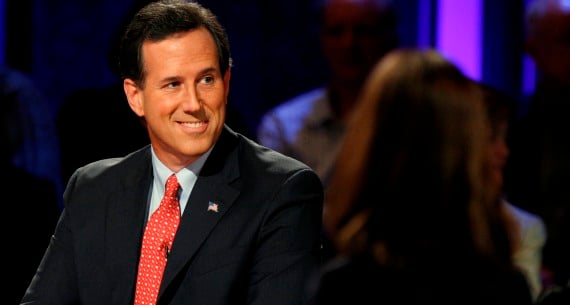
Republican presidential candidate Rick Santorum's plan to cut taxes for many individuals and corporations would expand the U.S. budget deficit by $1.3 trillion in 2015, an analysis released yesterday found.
The study by the nonpartisan Tax Policy Center in Washington compares the revenue that would be generated under Santorum's plan with the amount that the U.S. projects to collect under current law, which assumes several income tax cuts will expire at the end of 2012. The analysis doesn't consider the $1.2 trillion in spending cuts mandated to begin in 2013 or the $5 trillion in cuts that Santorum has pledged over five years.
Still, the Tax Policy Center's analysis serves as a benchmark of how Santorum's policy positions would affect federal revenue compared with the plans of his rivals for the Republican presidential nomination. Previous studies by the Tax Policy Center found that former U.S. House Speaker Newt Gingrich's proposals also would expand the deficit by $1.3 trillion. The budget shortfall would grow by $995 billion under Texas Governor Rick Perry's plan and by $600 billion in former Massachusetts Governor Mitt Romney's tax proposal.
“I was surprised at how large the revenue losses were,” said Roberton Williams, a senior fellow at the Tax Policy Center. “It's a lot of rate cuts and doesn't get rid of anything to help pay for that.”
Alternative to Romney
The study was released in advance of South Carolina's Jan. 21 primary, in which Santorum hopes to solidify his status as an alternative to Romney. Representatives for his campaign didn't respond to requests for comment on the study's findings.
For individuals, Santorum would condense the six income tax brackets that now range from 10 percent to 35 percent into two with rates of 10 percent and 28 percent. The tax rate for capital gains and dividends, which is 15 percent through 2012, would drop to 12 percent.
Santorum's tax proposal reflects his emphasis on what he calls family-friendly policies. He would triple the deduction that could be claimed for each child. His plan would retain deductions for
charitable giving, home mortgage interest, health care and retirement savings.
Keeping those provisions in place makes it more difficult to lower tax rates without creating a revenue shortfall.
Paying for It
“If you cut the rate, you have to pay for it somehow,” Williams said. “You have to go after these big meat-and-potatoes things.”
The top tax rate for corporations would be cut in half from 35 percent now to 17.5 percent. Manufacturers wouldn't pay any income tax.
Santorum's plan also wouldn't tax offshore income that corporations return to the U.S. and invest in manufacturing. Other repatriated income would be subject to a 5.25 percent tax.
Businesses would be able to write off the entire cost of capital investments and take advantage of an expanded research and development tax credit, which would become permanent in Santorum's plan.
The study found that Santorum's plan would reduce tax bills for 81 percent of U.S. taxpayers by an average of about $9,700. Those benefits would be concentrated in the higher-income brackets. For instance, about 97 percent of taxpayers with annual cash income of between $40,000 and $50,000 would receive a tax cut averaging $2,090. Meanwhile, 100 percent of taxpayers with cash income exceeding $1 million a year would receive a tax cut averaging $590,394.
--Bloomberg News--