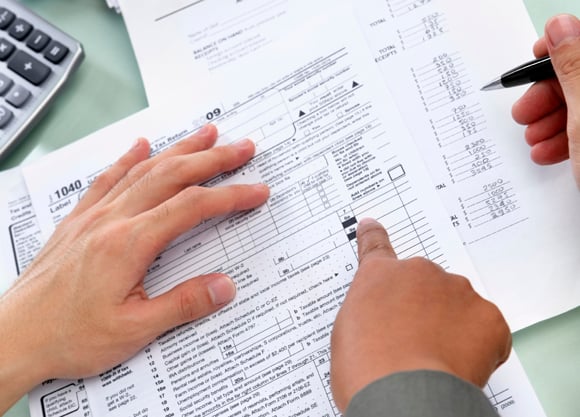
It's that time of year when you are talking to clients about taxes. And if you are like the advisors we talk to, those discussions center around how to minimize taxes in this year by harvesting losses now. And while the conversation likely centers around individual accounts you manage, you could do an even better job for your clients – and your practice – if you manage taxes with the full household in mind.
Managing client assets at the household level lets you significantly reduce taxes by locating assets in the most advantageous type of taxable or tax-qualified accounts. By reducing the taxes paid, the end result is decidedly better after-tax returns, more income in retirement and/or a greater remaining or bequest value. In fact, Ernst & Young conducted research and found this kind of approach can generate as much as 33% better results for investors. And because the client benefits by taking a more holistic view of the household, advisors report that it provides an additional, compelling reason to consolidate assets with you.
Although taxes are generally realized only in a client's taxable accounts, an advisor can reduce a client's taxes by hiding high tax-drag assets in tax-deferred and tax-free accounts and optimally managing the income and capital gains on assets in the taxable accounts. And by managing a client's multiple accounts together, you can maintain both target asset allocations and optimal locations of assets.
Estimating Tax Drag for Different Assets
The federal tax code treats income from three main categories of investment assets differently: 1) income from taxable bonds is taxed as ordinary income; 2) qualified stock dividends are taxed at capital gains rates; and 3) income from municipal bonds is not taxed. And, capital gains are taxed at either a short term (income tax) rate or a lower long-term level. For simplicity, we will address high tax bracket retirees using a 33% ordinary income tax rate and 15% capital gains rate while taking a view of a 35-year retirement period. And, we make the following assumptions:
• Taxable bonds have a 4% yield, no expected appreciation, and an after-tax yield of 2.7%.
• Stocks have a 2%
dividend, 6% appreciation and after-tax income, and annual appreciation of 5.7% and short term capital gains realization for high turnover stocks and 7.4% annual appreciation for stocks subject to optimal tax management.
• Because returns for bonds, high turnover stocks and optimally-managed stocks are not what deliver retirement income, we calculate the average pretax and after-tax retirement income yields for each asset.
o Taxable bonds have pretax and after-tax retirement income yields of 5.4% and 4.4%.
o Stocks have pretax retirement yield of 8.6%.
o High turnover and tax-managed stocks have after-tax yields of 6.7% and 8.1%. These yields (especially the after-tax yields) are higher than the annual returns because retirement income depends on investment returns and return of principal.
Optimal Location Increases Returns and Retirement Income: Three Examples
We apply these returns and yields to each of three high-tax bracket households. In each we assume the households have 50% of their assets in taxable accounts and 50% in tax-qualified accounts.
Example #1: The advisor allocates half the assets to bonds and half to high turnover stocks. Because the tax-drag is higher for stocks (1.9% equal to pretax yield of 8.6% minus after-tax yield 6.7%) than for the bonds (1% equal to pretax yield of 5.4% minus after-tax yield 4.4%), the stocks should be located in the tax-qualified account and the bonds should be located in the taxable account. By optimally locating the assets in this way, retirement income increases by 8.2% and retirement yield by 0.5%.
Example #2: The advisor allocates half the assets to bonds and half to tax-managed stocks. The tax drag is now lower for stocks (0.5% equal to pretax yield of 8.6% minus after-tax yield 8.1%) than for the bonds (still 1%), so the stocks should instead be located in the taxable account and the bonds in the tax-free account. Now with optimal asset location, retirement income and retirement income yield increase by 3.1% and 0.2%, respectively.
Example #3: The advisor has an aggressive client and allocates 50% to high turnover stocks and 50% to tax-managed stocks. Locating the high turnover stocks in the tax-free accounts and the tax-managed stocks in the taxable account increases retirement income by 9.1% and retirement income yield by 0.7%.
Paul Samuelson, PhD, is the Chief Investment Officer of LifeYield, LLC, which develops advisor software solutions to generate tax-smart returns and income.