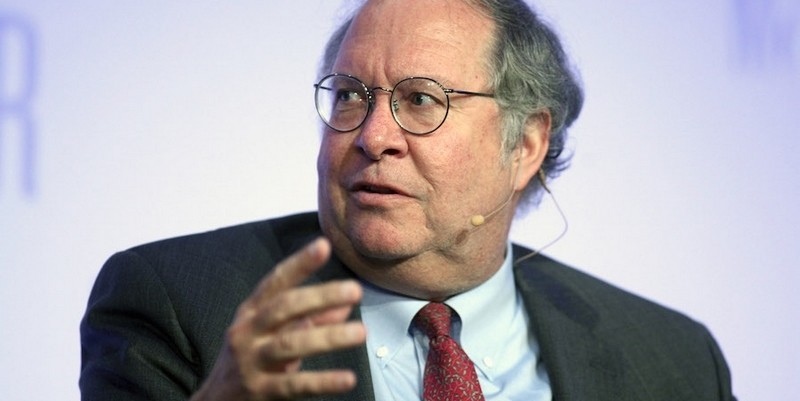
It's the end of an era at Legg Mason.
Bill Miller — stock picker extraordinaire who famously outpaced the S&P 500 for 15 consecutive years, and undoubtedly a first-ballot-hall-of-famer — is leaving the firm after 35 years.
Mr. Miller isn't hanging up his stock charts for good. He will keep trying to outsmart the market at LMM, a money manager he owned jointly with Legg Mason that will now be all his own.
Joseph Sullivan, Legg Mason's chief executive officer, had this to say about Mr. Miller's departure: “Bill has been an important part of the growth and success of Legg Mason over the years and we appreciate his many contributions.”
That's a wild understatement.
Legg Mason traces its history back to 1899, but you'll be forgiven if you had never heard of the Baltimore-based firm before the 1990s.
That changed when Legg Mason's money management business took off, with assets under management skyrocketing from the early 1990s to 2005. The firm got another boost when it acquired
Citigroup's asset management division in 2005. But Legg Mason's AUM plummeted during the 2008 financial crisis and has never recovered.
If that history seems strangely familiar, it's probably because it almost exactly parallels Mr. Miller's own track record.
During the 15 consecutive years from 1991 to 2005 that Mr. Miller beat the S&P 500, Mr. Miller's premier fund, Value Trust, returned a whopping 16.4% annually (including dividends), while the S&P 500 returned just 11.5% annually. The Value Trust swelled in that period from roughly $650 million in total assets to close to $20 billion by 2005.
Stellar runs never last forever (this column isn't the place for a Warren Buffett discussion) and Value Trust eventually stumbled — most notably tumbling 55% in 2008 while the S&P 500 declined 37% that year. Value Trust never recaptured its old glory. It returned 15.3% annually from 2009 to the end of Miller's tenure in April 2012, while the S&P 500 returned 16.5% annually over that period. By the time Miller called it quits, the fund's total assets had shrunk to roughly $2.6 billion.
Still, you can't take the star out of the manager. Mr. Miller moved on to the Legg Mason Opportunity Trust. According to Bloomberg News, he's beaten the returns of 96% of his peers over the last five years and he has outpaced the S&P 500 by 2% annually.
While Legg Mason would no doubt say that its glory days were the work of more than one person, the firm's story is a reminder that getting to the top of the stock picking heap — and staying there — often requires a star manager to have a star turn so starry-eyed investors come flocking to the door.
Mr. Sullivan says that Legg Mason will now focus on its diverse mutual fund offerings, and its current lineup today includes stocks and bonds and alternatives and allocation funds.
I looked at some of the funds that Miller leaves behind at Legg Mason. According to Morningstar, there are 50 Legg Mason mutual funds with a five-year track record. Of those, only 16 have beaten their benchmark on a risk-adjusted basis over five years through July.
The results aren't more flattering over longer periods. There are 43 Legg Mason mutual funds with a ten-year track record; only eight have beaten their benchmark on a risk-adjusted basis over 10 years. There are also 42 funds with a 15-year track record, and just 13 have beaten their benchmarks over 15 years.
Legg Mason won't be the only fund company short a star manager — Pimco is still adjusting to life without its larger-than-life founder, Bill Gross. While there are obvious differences between Mr. Gross' famously chaotic and contentious departure from Pimco and Mr. Miller's seemingly amicable and orderly exit from Legg Mason, the loss to each firm is real.
Like Mr. Miller, Mr. Gross had an epic run of his own. Mr. Gross' Total Return Fund beat the
Barclays U.S. Aggregate Bond Index by 1.1% annually from 1987 to 2014. The fund exploded during that time from a humble $20 million in total assets to close to $300 billion in its zenith in 2013. Mr. Gross's departure was a big blow to both Pimco and its Total Return Fund, which saw its total assets shrink to under $90 billion (and counting).
Legg Mason doesn't have to stay in the traditional active management game. It could move instead to more systematic forms of active management — such as smart beta, for example — that don't rely on a single manager's skills. But choosing that path may require it to move beyond the legacy of its departing hall-of-famer.
Nir Kaissar is a Bloomberg Gadfly columnist covering the markets. He is the founder of Unison Advisors, an asset management firm.