
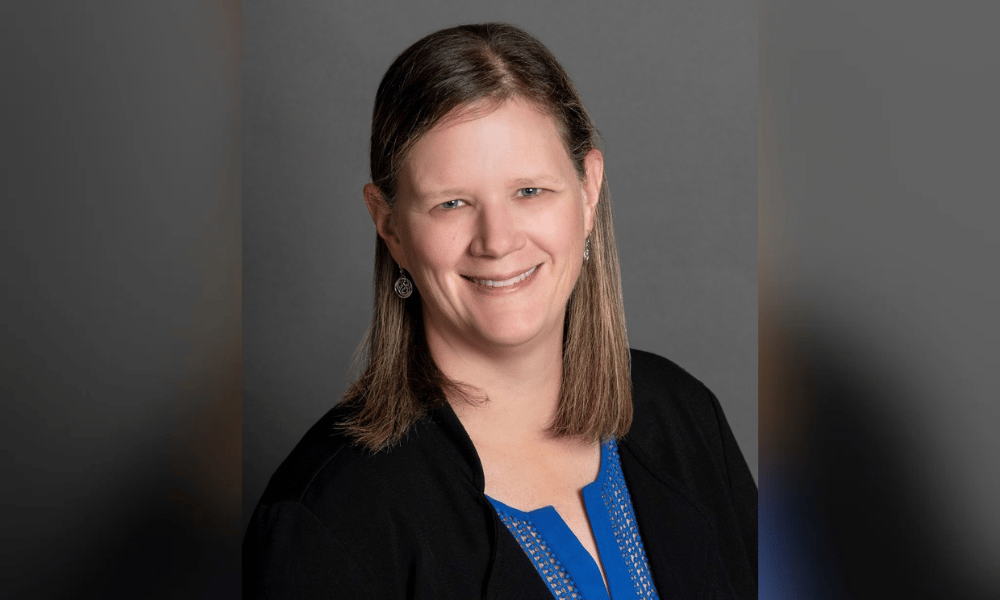
For decades, the default assumption among wealthy American families was straightforward: accumulate, then distribute at death. But that model is changing fast and Kate Maier, Vice President of Private Client at Wealth Enhancement Group, is on the front lines of that shift.
"We mostly see these conversations coming from parents," Maier said, "but more frequently lately we are also talking with adult children helping their parents get their estates in order, both to optimize estate tax planning and also to ease the transfer of their parents' assets either during lifetime or at death."
Maier leads the $187 billion AUM registered investment advisor’s estate planning team and works daily with ultra-high-net-worth families navigating a wealth transfer landscape that has grown considerably more complex. With Cerulli Associates projecting roughly $124 trillion in wealth will transfer in the United States through 2048, the pressure to plan (early) has never been greater.
Maier attributes the shift to two distinct client profiles arriving at similar conclusions by different paths. Tech-sector clients who built significant equity wealth in recent years are, in many cases, beginning the planning conversation from scratch.
"With those clients we start with a holistic view around their values, concerns, stomach for complexity," she said, "and help them build out a plan from there. That usually has us incorporating lifetime gifting very early in the planning process."
For longer-established clients, Maier points to two catalysts: a growing comfort in retirement that accumulated assets will not be needed, and sharp appreciation in portfolio values that has pushed projected estate tax liabilities into focus.
"Some clients have just seen wild appreciation of their assets," she said, "and subsequently see their potential estate tax bill increasing, especially if they think that estate taxes will go up in the future."
This dynamic is consistent with broader industry findings. A 2025 Planning & Progress Study by Northwestern Mutual found that nearly one-third of U.S. adults plan to leave a financial inheritance, yet fewer than 20 percent expect to receive one - a gap that underscores how rarely these conversations cross generations within the same family.
Getting families to talk openly about wealth is one of the most persistent challenges in estate planning practice management. Rather than confronting clients with balance sheets and tax projections, Maier asks them to put themselves in their children's shoes.
"We ask them to imagine what they would have done if they had suddenly come into a lot of money they weren't expecting when they were their kids' age," she said. "How would an unexpected windfall affect their relationship with money and work?"
The technique is designed to surface concerns that clients may not voice directly - sibling friction, changing work incentives, shifts in a child's relationship with money - and to plant the seed for a more intentional family conversation. This aligns with the broader finding that the great wealth transfer is a process, not a single event and that families who engage early tend to navigate it more effectively.
When a client arrives in November or December wanting to act quickly, Maier's approach is disciplined restraint.
Annual gift tax exclusions, 529 contributions, and donor-advised funds are the tools she reaches for at year-end because they can be executed cleanly. More complex structures - grantor retained annuity trusts (GRATs), spousal lifetime access trusts (SLATs), or any strategy requiring a legal document or independent valuation - are off the table if the calendar has run too short.
"Clients who try to complete everything anyway are more likely to get a templated document that is not personalized to their situation," she said, "and/or they're going to get a hastily-drafted document that has a lot of mistakes or doesn't take into account the whole picture. If they're setting up irrevocable transfers those issues will carry over for years."
Her advice: start small, establish the foundation, and use year-end gifting as a launching pad for more sophisticated planning in the year ahead. "Very rarely is something so time-sensitive that everything has to be done by year-end," she said.
For many parents, the more difficult calculation is not which tool to use, but how much to give without jeopardizing their own financial security or inadvertently undermining a child's relationship with money.
Maier sees both challenges regularly. "Unfortunately, most parents don't worry about this issue until it's past time they can realistically do something about it," she said.
Her practice uses retirement projection modeling to establish whether a client can afford to give before recommending any specific strategy. That analysis requires a realistic estimate of retirement spending, anticipated large expenses, the tax composition of the portfolio, and any longevity or health considerations that could affect cash flow over time.
For clients who can afford to give but remain emotionally uncomfortable doing so, Maier recommends a graduated approach.
"If they're uncomfortable making a large irrevocable gift all at once, they can still help their children by making smaller gifts over time," she said, "so that they can see how those gifts affect cash flow and their assets, and so that they can become comfortable with giving away money."
The logic, she argues, is about control as much as caution: a client who starts small retains the ability to expand. One who gives too much at once may find recovery difficult. With giving while living increasingly on the rise among wealthy Americans, advisors who can structure that generosity thoughtfully rather than reactively are well positioned to anchor multigenerational client relationships.
Wealth Enhancement's approach reflects a philosophy that the most valuable estate planning conversations are not primarily about tax efficiency. They are about family dynamics, communication, and building the kind of trust between generations that makes a wealth transfer feel purposeful rather than incidental.
For advisors looking to deepen expertise in this growing segment, InvestmentNews' 5-Star RIA Firms for High-Net-Worth Clients 2026 highlights 110 firms building practices around exactly this work.

Bank of America data shows near-term financial pressure mounting even as average balances gain nearly 10% since year-end.

Wells Fargo adds two bank-channel recruits, UBS lands a JPMorgan Chase veteran, and a multi-family office lifts Atlas past $1B

“The state comes down on you in years when you make 40% returns for clients,” said Bill Swayne, the advisor and son of Candace Swayne.

The Independent broker-dealer giant has had “active conversations” with the Claude maker, which is days away from its expected IPO

For Gen X clients entering life after work, answering the financial question isn't enough to solve the entire retirement equation.
Growing wealth, evolving priorities, and untapped opportunities are reshaping how women approach long-term investing.
Knighthead Life entered the market with a competitive MYGA. A strong launch earned advisor confidence and paved the way for FIAs.

