

For a second straight year, banks are making more money providing loans and underwriting bond sales for green-related projects than they’re earning from fossil fuel companies.
Together, banks have generated about $2.5 billion of revenue from climate-focused financing so far this year, compared with $2.2 billion from their work with oil, gas and coal companies, according to data compiled by Bloomberg.
It’s a big change from as recently as 2020, when lenders pocketed almost double the fees from Big Oil than they did from backing green initiatives.
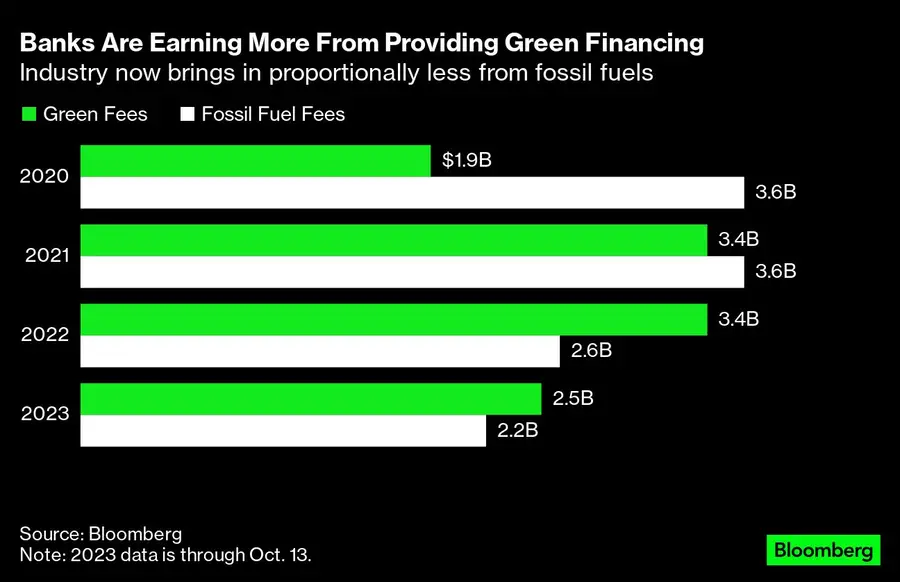
Still, such a narrow green-to-fossil fuel ratio is far from where we need to be, says Trina White, an analyst at BloombergNEF who focuses on sustainable finance.
“It is promising to see evidence of what we have long known—that the energy transition promises to be an enormous opportunity in addition to a climate necessity,” she says.
White explains that the challenge will be ensuring the private sector seizes on that opportunity in pursuit of 1.5C scenarios, which are more likely to prevent catastrophic warming. Doing that, however, will require an extraordinary ramp-up of investment.
“We need to see both real-economy investment and bank financing in low-carbon energy sources more than quadruple this decade relative to fossil fuels,” she says.
BNEF analysts use a metric that tracks investment in the energy-supply system across a range of industries. The analysts have determined that the ratio of clean energy investment to fossil fuels needs to hit 4 to 1 by the end of the decade if the planet is to avoid the worst ravages of climate change as laid out in the Paris Agreement of 2015. That ratio was 0.8 to 1 at the end of 2021, according to BNEF.
Banks have faced considerable criticism in recent years for their support of the fossil fuel industry, the primary source of planet-warming pollution. Financiers have sought to defend themselves by claiming they want to assist in the transition to a low-carbon economy by staying engaged with the industries most responsible for the accelerating climate crisis.
Additionally, growing numbers of banks have acknowledged the risks of the crisis by increasing their ambitions around green financing. For example, JPMorgan Chase & Co. announced emissions-reduction targets late last year for airlines, cement manufacturers and iron-ore and steel companies. That added to the bank’s first set of goals, which focused on the oil and gas, electric-power and auto-manufacturing sectors.
Bloomberg Intelligence analyst Grace Osborne says “net zero 2050” represents an estimated $50 trillion investment opportunity based on estimates from the World Economic Forum. The clean-energy transition has the potential to open “significant new revenue streams,” she says, including more fees from green-bond underwriting and lending, returns from investments in low-carbon technology and revenue from other types of sustainable financing.
Banks can capture “the climate upside” by attracting low-carbon clients and persuading heavy polluters to decarbonize their operations, Osborne says.
However, greenwashing among financial firms claiming sustainable investments remains a perpetual threat. Tracking progress is difficult because of the lack of standardization and market regulation, and overall doubts about the veracity of the “impactful data” that banks report related to sustainable finance, Osborne says.
That said, she says green-bond issuance is one area where it’s easier to gauge results from the banks funding of low-carbon projects. This year, BNP Paribas, Bank of America Corp. and Credit Agricole stand out as the leading green-bond underwriters, according to Bloomberg data. Overall, roughly $475 billion of green bonds and loans have been arranged so far in 2023, up from closer to $450 billion in the same year-earlier period.
By contrast, the opaque market for sustainability-linked loans — a big market measuring about $1.3 trillion — comes with reputational risks for the banks, Osborne warns. While the debt is designed to incentivize sustainable impact through environmental, social or governance key performance indicators (KPIs), a lack of disclosure around the targets, plus the absence of adequate monitoring, puts the integrity of the product in question, she says.
“The concern is the products are sometimes used as marketing tools, and as a result, they present unfortunate regulatory, reputational and greenwashing risks,” Osborne says.

Shorter waits for failed SIE and Series 7 candidates take effect Jan. 19, speeding the path to registration

Raymond James and Cetera also welcomed advisors from UBS and LPL as competition for experienced teams stays fierce

Jim Walesa worked in the securities industry for 39 years before leaving in 2021.

As the market turned from pricing in cuts to betting on hikes this year, the developing reality of a K-shaped economy has had real implications for households and investors alike.

Alleged cash payments, stolen client data, and a court that jumped the gun
Knighthead Life entered the market with a competitive MYGA. A strong launch earned advisor confidence and paved the way for FIAs.
As AI makes financial information more accessible than ever, Lana Hock explains why human judgment, trust, and empathy remain the qualities clients value most in a financial advisor

