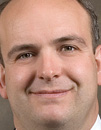
Barnaby Grist has left his position as senior managing director of strategic business development of The
Charles Schwab Corp.'s in-vestment adviser group to join Cetera Financial Group, a new independent-brokerage venture controlled by Lightyear Capital LLC.
His exit follows a reorganization at Schwab's adviser group, the largest custodian for assets managed by registered investment advisers, in which Bernard “Bernie” Clark was tapped to run the business.
Mr. Grist, who had been with Schwab's San Francisco-based RIA unit since 2003, is expected to join Cetera today as executive vice president of wealth management, focusing on recruiting advisers to the firm. He will move to Los Angeles and report to Cetera chief executive Valerie Brown.
Cetera is the new name for three independent-broker-dealer firms that ING Groep NV last week sold to a fund run by Lightyear and its founder, former Paine Webber Group Inc. CEO Donald Marron.
“It's unfortunate that he's leaving,” said Shannon Eusey, president of Beacon Pointe Advisors, an RIA firm that uses Schwab and other custodians for more than $4 billion of client assets. “They've been losing a lot of top talent.”
She said that in addition to Mr. Grist, she was referring to Charles Goldman and Deborah McWhinney, previous heads of Schwab's RIA business unit.
Mr. Grist, a former consultant at The Boston Consulting Group, most recently oversaw Schwab's effort to help brokers leave wirehouses and create or join RIA firms. He also had responsibility for sales and relationship management with large national RIAs and with independent broker-dealers, turnkey asset managers and consolidators, according to Schwab's website. An Oxford University graduate with a master's degree in business administration from Stanford University, Mr. Grist was in charge of relationship management for RIAs managing more than $1 billion in assets.
A person familiar with Mr. Grist's move said the latter had been talking with executives of the ING brokerage units that left to form Cetera — Financial Network Investment Corp., Multi-Financial Securities Corp. and Primevest Financial Services Inc. — for about three months and found it fortuitous to leave with Schwab's reorganization in place.
“Barnaby has taken an exciting new job, and we wish him the best,” Schwab spokeswoman Lindsay Tiles wrote in an e-mail. She did not respond to questions about whether Mr. Grist will be replaced as strategy head and chief of Schwab's breakaway-broker campaign.
In recent interviews, Mr. Grist said Schwab was in fairly serious talks with 300 to 400 teams of brokers at wirehouses and other firms overseeing some $30 billion of client assets and who were considering independence.
Schwab has been competing with rivals such as TD Ameritrade Institutional, Fidelity Institutional Wealth Services and Pershing Advisor Solutions LLC not only for breakaway brokers but also for so-called hybrid advisers at independent broker-dealers such as Cetera. Hybrid advisers earn both commissions for product sales and transactions, and fees for advisory services.
Firms such as Pershing and Fidelity own correspondent-clearing businesses that service small broker-dealers, giving them advantage in luring hybrid brokers already familiar with their operations and services, according to consultants.
Despite the breakaway-broker phenomenon, custodians compete most fiercely for new assets from RIAs, who increasingly use several custodians. Schwab continues to be the largest custodian, overseeing about $590 billion in assets for clients of almost 6,000 RIAs. That compares with about $390 billion in assets held by Fidelity for more than 3,000 RIAs and about $100 billion that TD Ameritrade holds for 4,000 RIAs.
Custodians make much of their money by selling investment products and brokerage services to clients of RIAs, and also by collecting interest on idle cash of some of those clients.
E-mail Jed Horowitz at [email protected].