
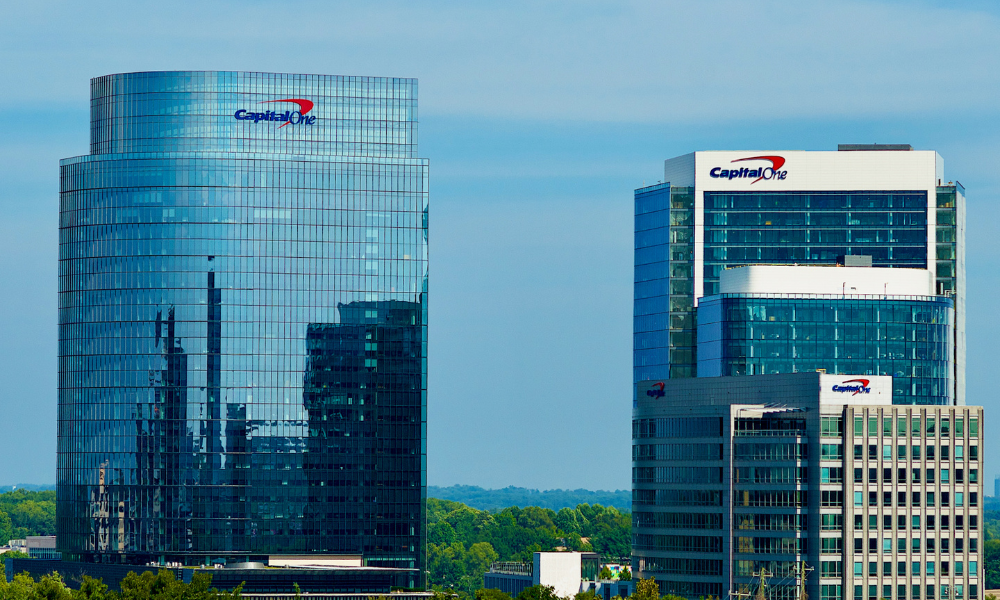
Capital One Financial Corp. agreed to buy Discover Financial Services in a $35 billion all-stock deal to create the largest US credit card company by loan volume, giving the combined entity a stronger foothold to compete with Wall Street’s behemoths.
Capital One will pay 1.0192 of its own shares for each Discover share, a 26.6% premium to the closing price on Feb. 16, the McLean, Virginia-based company said in a statement. The transaction, first reported by Bloomberg News, is expected to complete in late 2024 or early 2025, pending regulatory and shareholder approvals of both firms.
The purchase of Discover ranks as the biggest merger globally this year, surpassing Synopsys Inc.’s roughly $34 billion acquisition of software developer Ansys Inc. announced in January. It brings together two storied consumer-finance brands, a combination that will surpass rivals JPMorgan Chase & Co. and Citigroup Inc. by US credit-card loan volume, according to data compiled by Bloomberg Intelligence. The deal will also give Capital One a foothold in the world of payment networks.
It’s a “singular opportunity” to bring together two companies that can compete with the largest payment networks, Capital One Chief Executive Richard Fairbank said in the statement.
Discover rose as much as 18% in premarket trading on Tuesday. Shares in Capital One were down about 3.4%.
Capital One holders will own about 60% of the combined company and Discover holders the remainder, according to the statement. The acquisition will generate pretax synergies of $2.7 billion.
“The main rationale is the fixed costs of technology that result in bigger being better,” said Jay Ritter, finance professor at the University of Florida. “This fact has been reshaping many industries for many years, and I see no reason to think that the trend toward fewer, but larger, firms will end.”
Historically, Capital One has had to rely on Visa Inc. or Mastercard Inc. to issue its credit cards. With Discover in hand, the company would be able to cut out those two middle men and have more control over the prices merchants are charged each time a consumer swipes one of the firm’s cards at checkout.
Capital One is known for its commercials featuring celebrities like Jennifer Garner and Samuel L. Jackson asking, “What’s in your wallet?” The company, led by 73-year-old CEO Fairbank, has historically catered to subprime consumers who carry a balance on their cards each month.
Fairbank said on an earnings call in January that delinquencies had stabilized after reporting net charge offs that were higher than analysts expected as borrowers fell behind on their credit-card and auto loans.
In recent years, Capital One has been trying to attract more premium customers that tend to be heavy-spending and more loyal. It agreed to buy the digital concierge service Velocity Black last year, pushing deeper into luxury markets dominated by firms such as American Express Co. and JPMorgan.
Discover has long focused on prime customers with better credit ratings, though it has historically shied away from the flashy sign-on bonuses and lavish perks used by many of its rivals.
Discover owns three different payment networks: Discover Network, Diners Club International and its Pulse debit network. The company has spent years trying to expand acceptance and usage of the offerings, though they’ve long lagged behind the reach of Visa and Mastercard.
Capital One is the third largest issuer of Visa and Mastercard credit cards in the US, accounting for roughly 10% of US credit-card spending, according to Mizuho Securities USA’s Dan Dolev.
“We believe the combination could prove to be more competitive for Visa/Mastercard,” Daniel Perlin, an analyst at RBC Capital Markets, said in a note to clients. “At a high level, the risk to the networks is simple — can Capital One monetize Discover’s network capabilities, which historically have not gained much market share versus the networks?”
Discover said in January that its fourth-quarter profit dropped 62% as the company continued to grapple with the fallout from compliance and risk-management lapses. The company halted buybacks last year and has been seeking a buyer for its student-loan business. In December, Discover appointed Toronto-Dominion Bank’s Michael Rhodes as its new CEO, lining him up to take over by early March.
“Credit card companies have large fixed costs for information technology, partly for algorithms aimed at fraud prevention, so bigger is better,” said Ritter.

Shorter waits for failed SIE and Series 7 candidates take effect Jan. 19, speeding the path to registration

Raymond James and Cetera also welcomed advisors from UBS and LPL as competition for experienced teams stays fierce

Jim Walesa worked in the securities industry for 39 years before leaving in 2021.

As the market turned from pricing in cuts to betting on hikes this year, the developing reality of a K-shaped economy has had real implications for households and investors alike.

Alleged cash payments, stolen client data, and a court that jumped the gun
Knighthead Life entered the market with a competitive MYGA. A strong launch earned advisor confidence and paved the way for FIAs.
As AI makes financial information more accessible than ever, Lana Hock explains why human judgment, trust, and empathy remain the qualities clients value most in a financial advisor

