Former
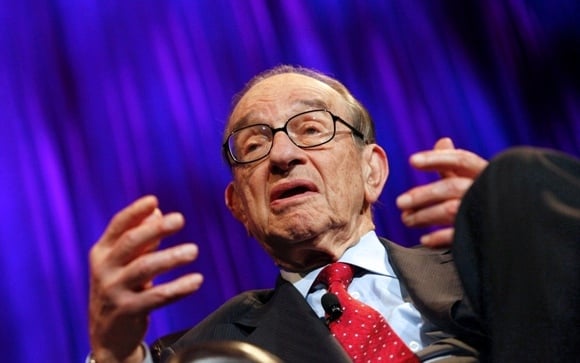
Federal Reserve Chairman Alan Greenspan said the U.S. fiscal deficit is “scary” and the federal government needs to cut spending on entitlements.
“We're involved in a dangerous game,” Greenspan said yesterday at a foreign-exchange conference in New York sponsored by Bloomberg LP, the parent of Bloomberg News. “We're increasing the debt held by the public at a pace that is closing” the gap between our debt and “any measure of borrowing capacity,” Greenspan said. “That cushion is growing very narrow.”
U.S. companies may be holding back on investment because of the rising federal deficit, which causes uncertainty about future tax policies, Greenspan said in an opinion article for the Financial Times this week. Weak investment by businesses in capital equipment and fixed assets has helped to crimp the U.S. economic recovery, he said.
“You need” austerity, said Greenspan, a paid speaker at the event. “We're going to have to start to cut” from government entitlement programs, he said, adding that reducing the budget is better than raising taxes in closing the U.S. budget deficit. Still, Greenspan reiterated that he supports allowing tax cuts enacted under President George W. Bush to lapse at the end of 2010.
The White House Office of Management and Budget in July projected the deficit for fiscal 2010, which ended Sept. 30, at $1.47 trillion and the gap for fiscal 2011 at $1.42 trillion. President Barack Obama formed a commission in February charged with presenting a plan by Dec. 1 on how to reduce deficits over the next decade.
Greenspan, 84, was chairman of the Fed from 1987 until 2006, when he was succeeded by Ben S. Bernanke.
“It is crucially important that we put U.S. fiscal policy on a sustainable path,” Bernanke said in an Oct. 4 speech.
“The only real question” is whether adjustments to taxes and spending will come from a “careful and deliberative process” or from a “rapid and painful response to a looming or actual fiscal crisis,” Bernanke said in Providence, Rhode Island. U.S. lawmakers should consider adopting rules that limit federal spending or debt, he said.
Greenspan said that if the Fed decides to expand its balance sheet through purchases of bonds, a process known as quantitative easing, it may not be enough to get “money moving” and spur growth in the U.S. economy.
Should the Fed increase “excess reserves and they just sit there on the asset side of commercial banks' balance sheets not being relent, you've merely gone through an interesting bookkeeping exercise,” Greenspan said. “You've got to break that psychology that prevents that current trillion” in reserves from being relent, he said.
Two-year Treasury yields fell to the lowest ever yesterday, setting or matching a record for a fifth consecutive day. Investors have stepped up bets that the Fed will resume buying bonds to keep borrowing costs low.
“It is very difficult to think through the scenario by which you induce” commercial banks to lend, Greenspan said. “If you don't do this, quantitative easing can't do anything to speak of.”
U.S. central bankers have kept their benchmark lending rate near zero for almost two years. In March, they finished $1.7 trillion in purchases of Treasuries, mortgage-backed securities and housing agency bonds.
A slowdown in growth in the middle two quarters of this year prompted the Federal Open Market Committee last month to warn that inflation rates were “somewhat below” its mandate to achieve stable prices and full employment.
New York Fed President William Dudley, who is also vice chairman of the FOMC, went further in an Oct. 1 speech when he called current levels of unemployment and inflation “unacceptable.”
“Further action is likely to be warranted,” Dudley said.
--
Bloomberg News