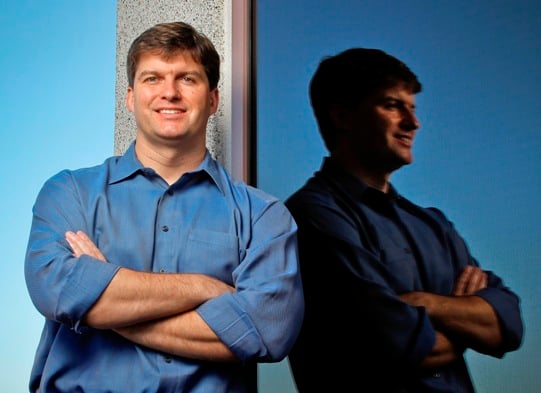
Michael Burry, the former hedge-fund manager who predicted the housing market's plunge, said he is investing in farmable land, small technology companies and gold as he hunts original ideas and braces for a weaker dollar.
“I believe that agriculture land -- productive agricultural land with water on site -- will be very valuable in the future,” Burry, 39, said in a Bloomberg Television interview scheduled for broadcast this morning in New York. “I've put a good amount of money into that.”
Burry, as head of Scion Capital LLC, prodded Wall Street banks in early 2005 to create credit-default swaps to bet against bonds backed by the riskiest home loans. The strategy paid off as borrowers defaulted, letting his investors more than quintuple their money from 2000 to 2008, according to Michael Lewis's book “The Big Short” (Norton/Allen Lane).
Burry, who now manages his own money after shuttering the fund in 2008, said finding original investments is difficult because many trades are crowded and asset classes often move together.
“I'm interested in finding investments that aren't just simply going to float up and down with the market,” he said. “The incredible correlation that we're experiencing -- we've been experiencing for a number of years -- is problematic.”
Still, it's possible to find opportunities among small companies because large investors and government officials focus on bigger ones, he said. He is particularly interested in small technology firms.
“Smaller companies in Asia, I think, are neglected,” he said. “There are some very cheap companies there.”
Investing in Gold
Gold is also a favored investment as central banks issue debt and devalue their currencies, he said. Governments haven't adequately addressed the causes of the financial crisis and may be sowing the seeds for future problems by borrowing, he said. In the U.S., lawmakers showed they didn't understand how to prevent another crisis when they gave the
Federal Reserve and Chairman Ben S. Bernanke additional authority, he said.
“The Federal Reserve, in my view, hadn't seen this coming and in some ways, possibly contributed to the crisis,” he said. “Now, Bernanke is the most powerful Fed chairman in history. I'm not sure that's the right response. The result tends to tell me they're not getting it right.”
The Dodd-Frank Act, signed by President Barack Obama on July 21, creates a consumer bureau at the Fed to monitor banks for credit-card and mortgage lending abuses. The bill also gives the Fed chairman a seat on a newly created Financial Stability Oversight Council, which is supposed to spot and respond to emerging systemic risks.
Background in Medicine
Originally, investing was a hobby for Burry, who as a resident neurosurgeon at Stanford Hospital in the 1990s typed his ideas onto message boards late at night.
He went to high school in San Jose, California, graduated from the University of California, Los Angeles and then earned a medical degree from the Vanderbilt University School of Medicine, according to “The Big Short.” The book portrays him as a loner from a young age who excelled in areas that required intense concentration. While searching for undervalued companies, he discovered his own house was overpriced, prompting a broader investigation of the housing market.
It's possible Burry is part of “an extremely small group” of economists and investors who are “really exceptionally adroit” at forecasting, former fed Chairman Alan Greenspan said in April. Burry has been critical of the role Greenspan played in fueling the crisis with low interest rates.
Goldman Sachs
Burry said Wall Street investment banks such as
Goldman Sachs Group Inc. shouldn't trade on their own account and don't always act in the best interests of clients. The firm is disbanding its principal-strategies business, one of the groups that make bets with the company's own money, two people with knowledge of the decision said last week.
“I don't believe that any Wall Street bank always acts in the best interests of its clients,” said Burry, adding that he often fought with firms while betting against housing. “It's an incredibly vicious, incredibly competitive world when you're going to go take a position opposite one of those banks.”
He asked seven Wall Street banks to help him bet against the housing market, and only
Deutsche Bank AG and
Goldman Sachs expressed any interest, Lewis wrote in his book. At the end of June 2008, original investors in Burry's
hedge fund received a return on their money, after fees and expenses, of 489.34 percent, according to the book.