
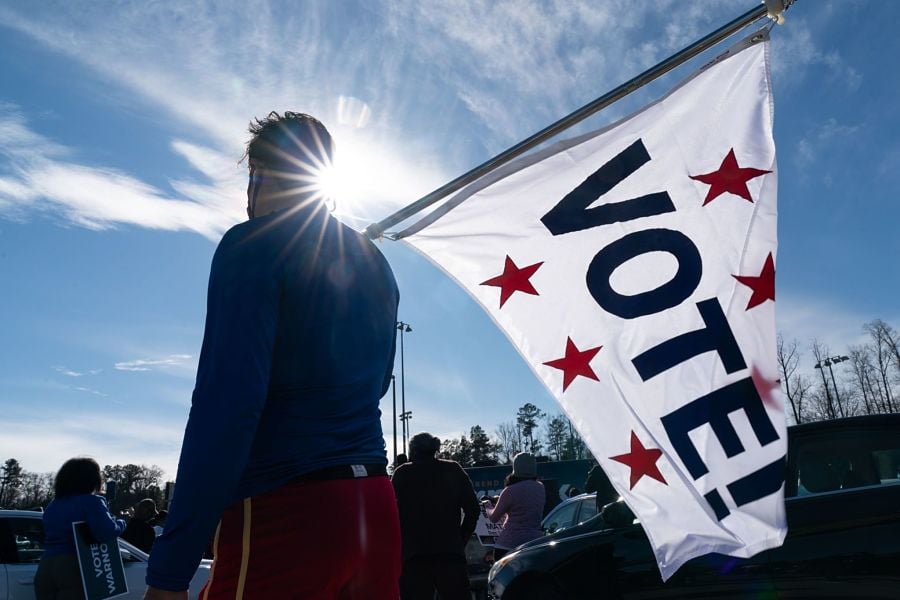
The 2024 presidential election is less than a year away. But some investors are already concerned about who’s going to win the big boy chair next November.
A survey from Janus Henderson released Tuesday shows 49% of investors are very concerned about the presidential election, surpassing the portion worried about inflation, which 35% of respondents said they were very concerned about, and the risk of recession, which was cited by 29%.
Among those “very concerned” about the 2024 presidential election, Janus Henderson found, one demographic distinction stood out: Older investors are more concerned than younger investors.
“Older Americans who are more concerned is not surprising,” Kashif Ahmed, president at American Private Wealth, wrote in an email. “They are the ones who pay more 'attention,' and who actually bother to vote.”
As it turns out, it may be premature to anticipate what the market will look like. Paul Schatz, president at Heritage Capital, said the markets rarely care about a presidential election until the middle to the end of October in the election year.
“It is next to impossible to formulate an investment process based on potential election outcomes until you're literally just staring down the election in your face,” Schatz said. “I've been doing this 34 years and I have never found worrying about the election to be worthwhile in trying to make my clients money.”
Ironically enough, there are two things that seem to happen in every presidential election, he added. “In year one, you typically get volatility, and two and more importantly, these exogenous events seem to happen more often than not in election years.”
Covid, the 2008 financial crisis and Y2K all happened in election years, but as Schatz said, “You certainly you can't attribute any of them to the current administration or the candidate at that time.”
The survey also found that S&P 500 Index returns from 1937 through 2022 show an average annual return was 11.9%. During presidential election years, the average return was 9.9%, while in nonelection years, the average return was 12.5%.
In election years in which the same party retains power, the market return has historically been 11.8%, while in election years when the presidency changes parties, the market has averaged a 7.8% gain.
A house divided would also be just fine; the survey found the average annual return of the S&P 500 was 15.9% with a Democratic president and 9.4% with a Republican one.
Schatz said that there's too much credit and blame assigned to the person sitting in the White House.
“[When it comes to] client portfolios, you don't want one party to control the House, the Senate and the presidency,” he said. “For clients’ money, you want some gridlock. Markets do very well with gridlock.”
At the end of the day, Kevin Brady, vice president at Wealthspire Advisors, said that it shouldn’t matter who’s in control of the White House.
“Investors would be better off staying fully invested in both Republican and Democratic presidencies and congressional control (versus only selling and buying depending which party is in control),” he wrote in an email.
“This is a form of market timing in a different name," Brady added. "You have to be right on both exiting the market and getting back in, and you have to be right repeatedly. This is very hard to do.”
Kenneth Leech pleaded guilty in June to one obstruction charge, and could face six to 12 months in prison.

Launch of Direct AI follows a model portfolio tie-up with Envestnet as advisors juggle AI adoption and private-market due diligence.

Meanwhile, Cetera's streak of Commonwealth recruitment continues in Washington, and an LPL advisor hops over to Raymond James in Maine.

The Sussex County wealth firm, built around business-owner clients, extends the California-based aggregator's footprint in the East Coast.

The Kestra-owned RIA acquirer merges the planning firm into KDI Wealth Management, creating a majority woman-led advisor team
Knighthead Life entered the market with a competitive MYGA. A strong launch earned advisor confidence and paved the way for FIAs.
As AI makes financial information more accessible than ever, Lana Hock explains why human judgment, trust, and empathy remain the qualities clients value most in a financial advisor

